Relapse of Monomorphic Epitheliotropic Intestinal T‐Cell Lymphoma (MEITL) in a Pericardial Fluid
Elsa Bera, Liana Veresezan, Maïssa Souissi, Fanny Drieux, Pierre Lebreton, Victor Bobée

Abstract
Genes, proteins, chemicals, diseases, species, mutations and cell lines named across the full text — each resolved to its canonical identifier and authoritative record.
Click any figure to enlarge with its caption.
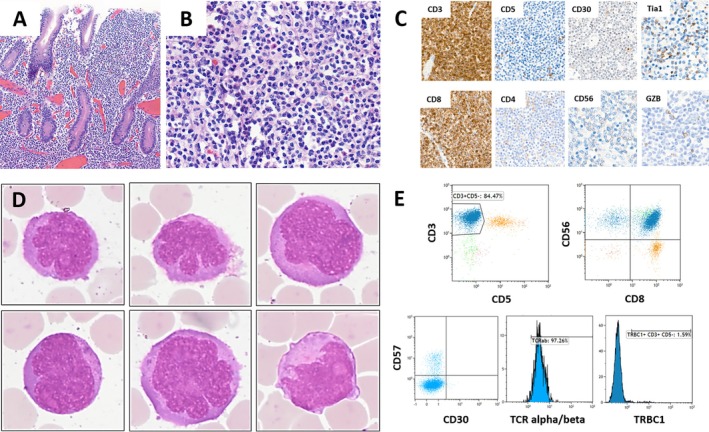 Figure 1
Peer Reviews
No public reviews on file for this paper yet. If you reviewed it on a platform where reviews are public (OpenReview, ICLR, NeurIPS, ICML), you can paste yours below so the community can read it here.
Videos
No videos yet. Explain this paper in a talk, walkthrough, or lecture? Add one.
Taxonomy
TopicsLymphoma Diagnosis and Treatment · Viral-associated cancers and disorders · Immune Cell Function and Interaction
A 51‐year‐old man presented with bowel perforation and fecal peritonitis, necessitating bowel resection, ileostomy, and jejunostomy. Macroscopic examination revealed six flat, white tumors scattered along the jejunum and ileum, ranging in size from 5 to 9 cm, with a perforation present in the ileum. The histopathological examination of the intestinal resection showed a diffuse monomorphic lymphocytic infiltrate of atypical small‐ to medium‐sized lymphocytes (Figure 1A,B) with a T‐cell phenotype CD3^+^CD5^−^CD4^−^CD8^+^CD30^−^CD56^+^ weak TIA1^+^ Perforin–Granzyme B focal (Figure 1C). In situ hybridization using EBER probes was negative. The detection of a monoclonal rearrangement of the locus TCRγ and mutations of SETD2 and STAT5B confirmed the diagnosis of Monomorphic Epitheliotropic Intestinal T‐cell Lymphoma (MEITL). The patient underwent chemotherapy (Brentuximab Vedotin, Cyclophosphamide, Doxorubicin, and Prednisone), achieving complete metabolic response, followed by an autologous stem cell transplant using the BEAM protocol (Bendamustine, Etoposide, Cytarabine, and Melphalan).
Seven months after transplantation, the patient presented with painful masses in the thoraco‐lumbar paravertebral region and left forearm, confirmed by PET‐Scan, and circumferential pericardial effusion. The cytologic analysis of the pericardial fluid revealed abnormal large cells with moderately condensed chromatin, irregular nuclei, nucleoli, and cytoplasmic granules (Figure 1D, May–Grünwald Giemsa, original magnification 1000×). Flow cytometry identified a contingent of abnormal CD3^+^CD5^−^CD8^+^CD56^+^ lymphocytes with TCRαβ phenotype and a restricted expression of TRBC1‐negative T cells (Figure 1E). A muscular biopsy of the left forearm confirmed the relapse of MEITL with the same immunophenotype. The tumor infiltrated the rectal, paraspinal, digestive, pulmonary, pericardic, and left forearm regions. Central nervous system (CNS) involvement was discussed without histological confirmation. The patient received a second‐line chemotherapy using bendamustine but unfortunately died 2 months later due to tumoral pneumopathy, 15 months after the initial diagnosis.
MEITL is a rare cytotoxic T‐cell lymphoma primarily affecting the gastrointestinal tract, following an aggressive course [1] with frequent CNS relapse [2]. Here, we report a case with atypical relapse sites, highlighting the critical role of histopathological, cytological examination, and flow cytometry, particularly in pericardial fluid, to achieve diagnosis and effective management.
Author Contributions
E.B. performed research, analyzed data, and wrote the paper. M.S., F.D., L.V., and P.L. analyzed data. V.B. coordinated the study, wrote the paper, and supervised the analysis.
Consent
No written consent has been obtained from the deceased patient, as there is no patient‐identifiable data included in this case report.
Conflicts of Interest
The authors declare no conflicts of interest.
The reference list from the paper itself. Each links out to its DOI / PubMed record.
- 1L. Veloza , D. Cavalieri , E. Missiaglia , et al., “Monomorphic Epitheliotropic Intestinal T‐Cell Lymphoma Comprises Morphologic and Genomic Heterogeneity Impacting Outcome,” Haematologica 108, no. 1 (2023): 181–195.35708139 10.3324/haematol.2022.281226 PMC 9827163 · doi ↗ · pubmed ↗
- 2J. H. Yi , G. W. Lee , Y. R. Do , et al., “Multicenter Retrospective Analysis of the Clinicopathologic Features of Monomorphic Epitheliotropic Intestinal T‐Cell Lymphoma,” Annals of Hematology 98, no. 11 (2019): 2541–2550.31493002 10.1007/s 00277-019-03791-y · doi ↗ · pubmed ↗