Two new species of the spider genus Songthela (Mesothelae, Liphistiidae) from Hunan Province, China

Abstract
Genes, proteins, chemicals, diseases, species, mutations and cell lines named across the full text — each resolved to its canonical identifier and authoritative record.
Click any figure to enlarge with its caption.
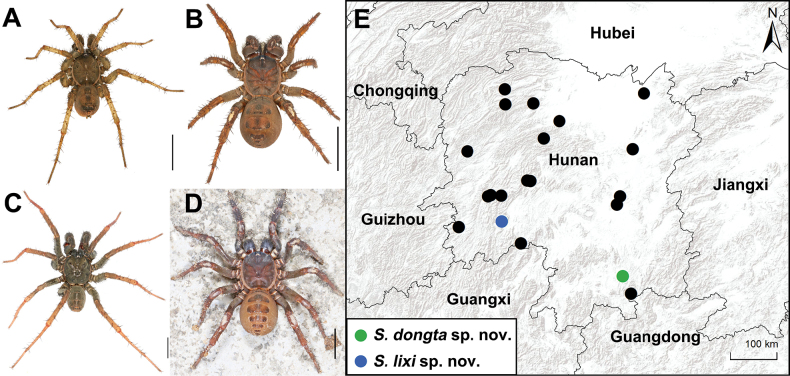 Figure 1
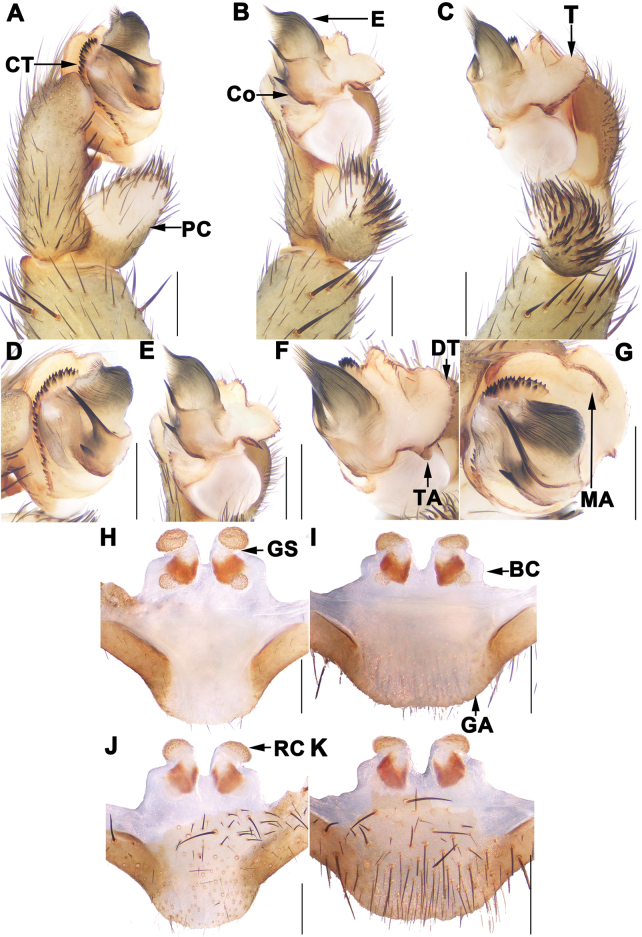 Figure 2
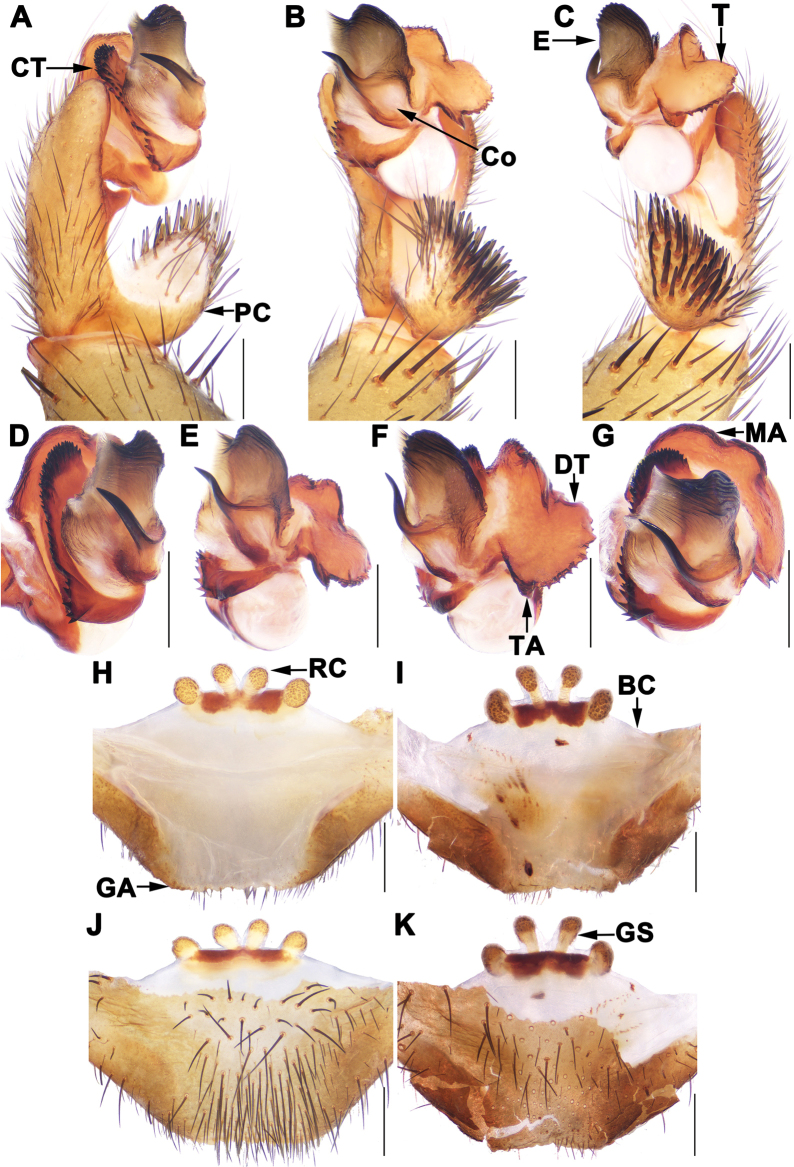 Figure 3
| Species | 1 | 2 | 3 | 4 | 5 | 6 | 7 | 8 | 9 | 10 | 11 | 12 | 13 | 14 | 15 | 16 | 17 | 18 | 19 | 20 | 21 | 22 | 23 | 24 | 25 | 26 | 27 | 28 | |
|---|---|---|---|---|---|---|---|---|---|---|---|---|---|---|---|---|---|---|---|---|---|---|---|---|---|---|---|---|---|
| 1 | 12.59 | 10.47 | 10.62 | 17.30 | 11.23 | 11.08 | 15.93 | 10.47 | 15.93 | 13.66 | 16.84 | 12.29 | 15.48 | 16.54 | 15.02 | 18.51 | 11.53 | 16.69 | 18.36 | 12.75 | 15.78 | 18.21 | 11.76 | 16.84 | 18.06 | 15.93 | 10.91 | ||
| 2 | 13.85 | 13.66 | 14.87 | 15.02 | 15.63 | 14.57 | 17.15 | 13.51 | 15.78 | 6.83 | 15.33 | 14.57 | 15.17 | 15.33 | 8.65 | 15.48 | 15.78 | 13.81 | 16.54 | 10.77 | 15.48 | 15.93 | 14.89 | 13.96 | 15.93 | 14.87 | 15.10 | ||
| 3 | 11.44 | 15.23 | 10.17 | 17.00 | 12.90 | 9.86 | 16.84 | 9.56 | 16.24 | 13.96 | 15.78 | 8.95 | 14.42 | 17.00 | 15.02 | 17.60 | 11.08 | 16.54 | 17.75 | 13.05 | 15.17 | 17.15 | 9.38 | 15.63 | 16.84 | 14.57 | 12.92 | ||
| 4 | 11.59 | 16.74 | 11.12 | 17.30 | 12.29 | 10.93 | 17.00 | 10.47 | 16.24 | 13.35 | 17.15 | 11.53 | 15.48 | 17.15 | 14.26 | 18.21 | 10.47 | 18.06 | 18.36 | 13.51 | 15.93 | 17.15 | 12.32 | 14.87 | 17.60 | 17.15 | 12.25 | ||
| 5 | 19.90 | 16.86 | 19.53 | 19.87 | 18.21 | 17.00 | 18.06 | 15.63 | 15.48 | 15.63 | 9.10 | 16.39 | 17.75 | 14.42 | 16.54 | 13.51 | 18.06 | 16.24 | 10.93 | 16.39 | 16.84 | 10.47 | 17.46 | 9.41 | 8.95 | 16.39 | 16.28 | ||
| 6 | 12.39 | 17.66 | 14.37 | 13.67 | 21.17 | 13.81 | 19.58 | 13.20 | 17.30 | 15.48 | 17.60 | 12.90 | 17.00 | 17.15 | 15.78 | 19.73 | 14.42 | 18.97 | 19.88 | 15.48 | 17.15 | 19.73 | 15.26 | 17.75 | 18.51 | 16.39 | 12.08 | ||
| 7 | 12.14 | 16.39 | 10.68 | 12.00 | 19.57 | 15.54 | 17.30 | 4.10 | 16.84 | 13.96 | 15.78 | 7.44 | 15.48 | 17.45 | 14.26 | 18.21 | 12.59 | 15.78 | 16.84 | 14.11 | 15.78 | 16.69 | 5.88 | 16.39 | 15.17 | 15.78 | 12.92 | ||
| 8 | 18.04 | 19.65 | 19.20 | 19.42 | 20.89 | 23.00 | 19.79 | 16.84 | 15.78 | 16.08 | 18.06 | 17.30 | 15.78 | 16.39 | 16.84 | 16.69 | 16.54 | 13.20 | 17.60 | 14.57 | 16.24 | 17.45 | 18.75 | 17.30 | 18.21 | 16.69 | 18.12 | ||
| 9 | 11.42 | 15.02 | 10.33 | 11.44 | 17.75 | 14.79 | 4.25 | 19.18 | 15.63 | 13.51 | 15.63 | 6.37 | 14.72 | 16.39 | 14.87 | 18.06 | 11.23 | 15.78 | 16.08 | 13.20 | 15.78 | 16.39 | 4.60 | 15.48 | 15.78 | 15.48 | 12.75 | ||
| 10 | 18.09 | 17.82 | 18.52 | 18.47 | 17.50 | 19.92 | 19.31 | 17.80 | 17.70 | 15.93 | 15.17 | 16.08 | 13.20 | 16.39 | 16.84 | 16.24 | 18.06 | 15.93 | 16.54 | 16.24 | 14.87 | 15.93 | 16.54 | 15.17 | 16.08 | 15.17 | 16.78 | ||
| 11 | 15.22 | 7.24 | 15.62 | 14.86 | 17.65 | 17.52 | 15.65 | 18.22 | 15.06 | 18.04 | 16.08 | 15.02 | 14.87 | 14.57 | 7.44 | 15.63 | 15.48 | 14.57 | 16.39 | 11.08 | 14.42 | 15.17 | 15.07 | 13.81 | 15.63 | 14.72 | 15.44 | ||
| 12 | 19.21 | 17.24 | 17.85 | 19.65 | 9.87 | 20.25 | 17.88 | 20.91 | 17.65 | 17.03 | 18.22 | 16.08 | 17.15 | 13.51 | 16.08 | 14.11 | 17.30 | 15.93 | 8.04 | 15.48 | 16.69 | 11.84 | 16.91 | 10.02 | 5.61 | 15.17 | 16.78 | ||
| 13 | 13.68 | 16.36 | 9.65 | 12.76 | 18.81 | 14.40 | 7.94 | 19.84 | 6.74 | 18.31 | 16.98 | 18.31 | 16.08 | 18.06 | 15.63 | 17.60 | 11.38 | 16.84 | 16.24 | 13.35 | 15.63 | 17.00 | 6.80 | 15.78 | 15.33 | 14.87 | 13.59 | ||
| 14 | 17.46 | 17.07 | 16.10 | 17.52 | 20.44 | 19.47 | 17.48 | 17.82 | 16.47 | 14.64 | 16.65 | 19.62 | 18.26 | 16.24 | 15.78 | 16.54 | 16.84 | 15.63 | 17.15 | 15.17 | 13.66 | 17.15 | 17.65 | 14.26 | 17.00 | 12.14 | 15.77 | ||
| 15 | 18.85 | 17.22 | 19.46 | 19.65 | 16.24 | 19.71 | 20.11 | 18.65 | 18.66 | 18.56 | 16.23 | 15.05 | 21.00 | 18.38 | 16.08 | 12.29 | 15.93 | 16.54 | 13.51 | 15.33 | 17.75 | 15.02 | 17.83 | 13.96 | 13.51 | 16.24 | 15.94 | ||
| 16 | 16.89 | 9.31 | 16.90 | 15.89 | 18.79 | 17.84 | 15.96 | 19.24 | 16.76 | 19.21 | 7.88 | 18.22 | 17.73 | 17.82 | 18.20 | 16.24 | 15.78 | 15.33 | 15.93 | 10.62 | 15.33 | 17.30 | 16.54 | 15.02 | 15.63 | 15.93 | 16.28 | ||
| 17 | 21.57 | 17.53 | 20.34 | 21.17 | 15.23 | 23.32 | 21.19 | 19.05 | 20.98 | 18.46 | 17.70 | 15.91 | 20.38 | 18.87 | 13.53 | 18.52 | 17.91 | 15.48 | 12.59 | 16.39 | 18.82 | 13.81 | 18.93 | 11.99 | 13.20 | 16.69 | 16.44 | ||
| 18 | 12.79 | 18.00 | 12.23 | 11.49 | 21.02 | 16.51 | 14.09 | 18.82 | 12.39 | 21.04 | 17.62 | 19.90 | 12.58 | 19.25 | 18.05 | 17.91 | 20.73 | 18.06 | 17.15 | 14.57 | 15.17 | 17.45 | 10.85 | 16.24 | 17.15 | 15.48 | 11.41 | ||
| 19 | 19.00 | 15.30 | 18.83 | 20.78 | 18.42 | 22.11 | 17.78 | 14.59 | 17.77 | 17.99 | 16.27 | 18.08 | 19.19 | 17.56 | 18.77 | 17.23 | 17.37 | 20.85 | 15.78 | 14.57 | 16.69 | 15.78 | 17.46 | 15.17 | 15.63 | 16.84 | 17.28 | ||
| 20 | 21.30 | 18.83 | 20.47 | 21.27 | 12.06 | 23.44 | 19.25 | 20.22 | 18.21 | 18.85 | 18.65 | 8.64 | 18.46 | 19.57 | 15.03 | 17.98 | 13.93 | 19.64 | 17.81 | 16.54 | 17.00 | 12.75 | 16.91 | 10.47 | 6.22 | 16.08 | 17.45 | ||
| 21 | 14.03 | 11.78 | 14.39 | 14.95 | 18.66 | 17.49 | 15.75 | 16.28 | 14.59 | 18.40 | 12.13 | 17.42 | 14.78 | 17.07 | 17.24 | 11.55 | 18.72 | 16.31 | 16.29 | 18.83 | 16.24 | 16.39 | 15.26 | 13.81 | 15.33 | 14.26 | 15.44 | ||
| 22 | 17.93 | 17.48 | 17.17 | 18.14 | 19.33 | 19.66 | 17.98 | 18.34 | 17.98 | 16.78 | 16.14 | 19.07 | 17.78 | 15.17 | 20.47 | 17.22 | 21.98 | 17.17 | 18.97 | 19.49 | 18.49 | 18.06 | 16.36 | 15.93 | 17.00 | 8.04 | 16.61 | ||
| 23 | 21.21 | 18.03 | 19.71 | 19.76 | 11.45 | 23.37 | 19.12 | 20.05 | 18.68 | 18.11 | 17.06 | 13.11 | 19.53 | 19.64 | 16.98 | 19.75 | 15.53 | 20.20 | 17.80 | 14.27 | 18.64 | 21.02 | 18.57 | 10.17 | 10.32 | 17.45 | 16.61 | ||
| 24 | 12.96 | 16.77 | 10.12 | 13.67 | 20.15 | 17.37 | 6.18 | 21.79 | 4.76 | 18.87 | 17.04 | 19.33 | 7.19 | 20.29 | 20.56 | 18.90 | 22.11 | 11.85 | 19.97 | 19.32 | 17.15 | 18.75 | 21.61 | 17.46 | 16.36 | 16.54 | 13.42 | ||
| 25 | 19.28 | 15.53 | 17.69 | 16.73 | 10.14 | 20.47 | 18.68 | 19.84 | 17.46 | 17.04 | 15.34 | 10.85 | 17.92 | 15.90 | 15.60 | 16.81 | 13.18 | 18.47 | 17.00 | 11.38 | 15.38 | 18.04 | 11.02 | 20.07 | 9.71 | 15.48 | 16.11 | ||
| 26 | 20.88 | 18.07 | 19.28 | 20.27 | 9.71 | 21.51 | 17.08 | 21.12 | 17.85 | 18.24 | 17.66 | 5.90 | 17.30 | 19.42 | 15.05 | 17.60 | 14.76 | 19.69 | 17.65 | 6.59 | 17.27 | 19.52 | 11.26 | 18.58 | 10.51 | 16.24 | 16.44 | ||
| 27 | 18.15 | 16.67 | 16.31 | 19.74 | 18.69 | 18.68 | 17.93 | 18.99 | 17.53 | 17.14 | 16.52 | 17.05 | 16.73 | 13.29 | 18.42 | 18.07 | 19.13 | 17.56 | 19.16 | 18.24 | 15.91 | 8.55 | 20.15 | 18.89 | 17.45 | 18.47 | 15.77 | ||
| 28 | 11.97 | 17.03 | 14.53 | 13.65 | 18.62 | 13.45 | 14.47 | 21.00 | 14.29 | 19.22 | 17.51 | 19.25 | 15.41 | 17.83 | 18.15 | 18.55 | 18.79 | 12.73 | 19.78 | 20.12 | 17.48 | 19.10 | 19.02 | 15.06 | 18.31 | 18.79 | 17.98 |
Peer Reviews
No public reviews on file for this paper yet. If you reviewed it on a platform where reviews are public (OpenReview, ICLR, NeurIPS, ICML), you can paste yours below so the community can read it here.
Videos
No videos yet. Explain this paper in a talk, walkthrough, or lecture? Add one.
Taxonomy
TopicsSpider Taxonomy and Behavior Studies · Lepidoptera: Biology and Taxonomy · Genetic diversity and population structure
Introduction
The primitively segmented spider genus Songthela Ono, 2000 belongs to the suborder Mesothelae within the family Liphistiidae Thorell, 1869. Members of this genus retain plesiomorphic arachnid characters, such as abdominal tergites (Fig. 1A–D) and spinnerets located in the ventral median portion of the abdomen (Bristowe 1975; Haupt 2003; Schwendinger and Ono 2011; Xu et al. 2015). Currently, Songthela contains 38 valid species, primarily distributed across southern China (Chongqing, Guizhou, Hubei, Hunan, Sichuan, Yunnan, Zhejiang), with one species, S.sapana (Ono, 2010), reported from northern Vietnam (World Spider Catalog 2025). Of these, 23 species are found in Hunan Province, China (Fig. 1E).
General somatic morphology and collection localities of two new Songthela species A, C male B, D female A, BSongtheladongta sp. nov. C, DSongthelalixi sp. nov. A XUX-2023-017 B XUX-2023-016 C XUX-2022-240 D XUX-2022-244 E Map showing the type localities of the two new and 23 known Songthela species (black dots) in Hunan Province, China. Scale bar: 5 mm.
Most Songthela species can be assigned to three species groups: the bispina-group, the multidentata-group, and the unispina-group, based on morphological characters and molecular data (Li et al. 2022). Species in the bispina-group feature a smooth palpal conductor with two apical spines, and their lateral receptacular clusters are situated on the dorsal wall of the bursa copulatrix (Fig. 2). The multidentata-group is characterized by a palpal conductor with one apical spine and several teeth on its middle portion, lateral receptacular clusters situated on the dorsal wall, and a sclerotised posterior margin of the bursa copulatrix (figs 11, 12 in Li et al. 2022). In contrast, species in the unispina-group have a smooth palpal conductor with one apical spine, lateral receptacular clusters positioned nearly the anterior margin of the bursa copulatrix, and lack a sclerotised posterior margin (Fig. 3).
Male palp and female genitalia of Songtheladongta sp. nov. A, D palp, prolateral view B, E palp, ventral view C, F palp, retrolateral view G palp, distal view H, I vulva, dorsal view J, K vulva, ventral view A–G XUX-2023-017 H, J XUX-2023-014 I, K XUX-2023-016. Scale bars: 0.5 mm.
Male palp and female genitalia of Songthelalixi sp. nov. A, D palp, prolateral view B, E palp, ventral view C, F palp, retrolateral view G palp, distal view H, I vulvae, dorsal view J, K vulvae, ventral view A–C XUX-2022-241 D–G XUX-2022-240 H, J XUX-2022-239 I, K XUX-2022-244. Scale bars: 0.5 mm.
In this study, we diagnose and describe two new species of the genus Songthela from Hunan Province, China, based on the morphology of the male palps and female genitalia. Moreover, we provide cytochrome c oxidase subunit I (COI) sequences for the two new species to facilitate future identification, and calculate the genetic distances among the two new species and 26 known Songthela species.
Material and methods
We collected the specimens alive from Hunan Province, China (Fig. 1E), and transported subadults to the laboratory, where they were reared until maturity. For adult specimens, the right four legs were removed, preserved in absolute ethanol, and stored at –80 °C for DNA extraction. The remaining parts of each specimen were preserved in 80% ethanol and retained as vouchers for morphological examination. All voucher specimens are deposited at the School of Life Sciences, Hubei University, Wuhan, Hubei Province, China.
We examined and dissected the specimens using an Olympus SZ61 stereomicroscope. The soft tissues of female genitalia were removed and digested using 10 mg/ml pancreatin (Biosharp Company, Hefei, Anhui, China) for at least three hours at room temperature. Male palps and female genitalia were observed and photographed using a digital CCD camera (Kuy nice E3ISPM, China) mounted on an Olympus BX53 compound microscope. Compound-focused images were generated using Helicon Focus v. 6.7.1. All measurements are given in millimeters. Leg and palp measurements are presented in the following order: leg total length (femur, patella, tibia, metatarsus, tarsus) and palp total length (femur, patella, tibia, tarsus).
We extracted total genome DNA from spider leg muscles using the Animal Genomic DNA Isolation Kit (Kangwei Biotech, China) following the manufacturer’s protocol, amplified COI using the primer pair LCO1490/HCO2198 (Folmer et al. 1994) following standard protocols (Li et al. 2020). We retrieved COI sequences of 26 known Songthela species (one per species) from the National Center for Biotechnology Information (NCBI) and aligned the COI data matrix using Geneious Prime 2022 (https://www.geneious.com) with gap opening/extension penalties set to 24/3. We calculated the genetic distances using MEGA 11 (Tamura et al. 2021) based on Kimura 2-parameter (K2P) and p-distance nucleotide substitution models.
Abbreviations used are: ALE = anterior lateral eyes; AME = anterior median eyes; BC = bursa copulatrix; BL = body length; CL = carapace length; Co = conductor; CT = contrategulum; CW = carapace width; DT = dorsal extension of terminal apophysis of tegulum; E = embolus; GA = genital area; GS = genital stalk; MA = marginal apophysis of tegulum; OL = opisthosoma length; OW = opisthosoma width; PC = paracymbium; PLE = posterior lateral eyes; PME = posterior median eyes; RC = receptacular cluster; T = tegulum; TA = terminal apophysis of tegulum.
Taxonomy
Family Liphistiidae Thorell, 1869
Genus Songthela Ono, 2000
Songthela
dongta
Taxon classificationAnimaliaAraneaeLiphistiidae
Han & Xu sp. nov.
7CC7D7FA-09DF-5C82-B855-855AFEC3C164
https://zoobank.org/DAFFB852-2817-4072-A7E0-1F9B50D96CB5
Type material.
Holotype: China • ♂; Hunan Province, Chenzhou City, Guiyang County, Dongta Park; 25.74°N, 112.74°E; alt. 379 m; 29 July 2023; X. Xu, Y.X. Li, Y.C. Xiong, S.S. Han leg.; XUX-2023-017. Paratypes: China • 2 ♀♀; same data as for the holotype; XUX-2023-014, 016.
Diagnosis.
Male palp of S.dongta sp. nov. resembles those of S.goulouensis Yin, 2001 and S.zizhu Li, Chen, Liu, Li & Xu, 2022, by conductor with long upper apical spine, but can be distinguished from S.goulouensis by conductor with wider base (Fig. 2B, E vs. figs 45, 46 in Xu et al. 2015), and slightly larger terminal apophysis of tegulum (Fig. 2F vs. fig. 46 in Xu et al. 2015); from S.zizhu by contrategulum with two rows of serrated edge (Fig. 2A, D vs. fig. 8a, d in Li et al. 2022), and larger marginal apophysis of tegulum (Fig. 2G vs. fig. 8g in Li et al. 2022). Female genitalia of S.dongta sp. nov. resemble that of S.aokoulong Li, Chen, Liu, Li & Xu, 2022 by middle genital stalks slightly tilted outward, but can be distinguished from the latter by shorter middle genital stalks and the lateral receptacular clusters far away from the base of middle receptacular clusters (Fig. 2H–K vs. fig. 4h–o in Li et al. 2022).
Description.
Male (holotype; Fig. 1A). Carapace yellowish brown; opisthosoma blackish brown, with 12 dark brown tergites attached a pair of thick bristles, the 2^nd^ to 6^th^ larger than others and the 5^th^ largest; sternum narrow, longer than wide; ocular area slightly raised with several pointed hairs; chelicerae robust with promargin of cheliceral groove with 10 denticles of variable size; each leg with three claws and strong setae and spines; 7 spinnerets. Measurements: BL 9.37, CL 4.44, CW 3.87, OL 4.33, OW 3.30; ALE > PLE > PME > AME; leg I 13.15 (3.77, 1.73, 2.73, 3.13, 1.79), leg II 13.65 (3.63, 1.56, 2.78, 3.49, 2.19), leg III 14.59 (3.75, 1.84, 2.61, 4.20, 2.19), leg IV 19.92 (4.78, 2.09, 3.81, 6.12, 3.12).
Palp. Paracymbium unpigmented and unsclerotised in prolateral view, with several setae and spines on the tip (Fig. 2A). Contrategulum with two rows of small and densely serrated edge (Fig. 2D, G). Tegulum with a slightly helicoid marginal apophysis, a slightly helicoid dorsal extension of terminal apophysis, and a thumb-like terminal apophysis retrolaterally (Fig. 2C, F). Conductor smooth with two spines, the longer spine pointed to the middle of opening of embolus, the shorter spine located in the middle portion, the base fused with embolus (Fig. 2B–E). Embolus largely sclerotised with a wide opening, with several longitudinal ribs reaching tip in retrolateral view (Fig. 2E–G).
Female (XUX-2023-014). Carapace yellowish brown; opisthosoma light brown, with 12 blackish-brown tergites attached a pair of thick bristles, the 2^nd^ to 5^th^ larger than others and the 4^th^ largest; sternum and ocular area similar as male; chelicerae robust with promargin of cheliceral groove with 12 denticles of variable size; each leg with three claws and strong setae and spines; 7 spinnerets. Measurements: BL 13.98, CL 6.55, CW 5.55, OL 6.29, OW 5.19; ALE > PLE > PME > AME; palp 11.25 (3.92, 2.25, 2.26, 2.82), leg I 12.56 (4.04, 2.31, 2.34, 2.50, 1.37), leg II 12.33 (3.69, 2.21, 2.29, 2.63, 1.51), leg III 13.67 (3.87, 2.29, 2.45, 3.35, 1.71), leg IV 19.93 (5.61, 2.98, 3.43, 5.34, 2.57).
Female genitalia. The middle receptacular clusters large, situated on the anterior margin of the bursa copulatrix; the lateral ones small, situated on the dorsal wall of the bursa copulatrix; the middle ones with obvious stalks, tilted outward; the posterior margin of the genital area slightly arc-shaped (Fig. 2H–K).
Variation.
Females vary in body size. Measurements for females (N = 2) are as follows: BL 13.39–13.98, CL 5.65–6.55, CW 4.82–5.55, OL 6.29–6.63, OW5.19–5.44.
Etymology.
The species epithet, a noun in apposition, refers to the type locality.
Distribution.
Hunan (Chenzhou), China
GenBank accession number.
XUX-2023-014: PV330146; XUX-2023-016: PV330147; XUX-2023-017: PV330148.
Remarks.
The maximum and mean intraspecific genetic distances of S.dongta sp. nov. are 0.15% and 0.1%, respectively, based on both K2P and p-distance. The mean interspecific genetic distance between two new species is 13.71% (K2P) and 12.49% (p-distance). Among the 28 species analyzed, the closest interspecific genetic distance is 11.42% (K2P) and 10.47% (p-distance) between S.dongta sp. nov. and S.huayanxi (Table 1).
Songthela
lixi
Taxon classificationAnimaliaAraneaeLiphistiidae
Zhang & Xu sp. nov.
E88929CF-91B9-5EBC-BAD6-10A0E01AEF0A
https://zoobank.org/8874460B-5488-4F9F-861F-4B8E8B2F9A09
Type material.
Holotype: China • ♂; Hunan Province, Shaoyang City, Suinng County, Lixi Town, Jiangtang Village; 26.79°N, 110.41°E; alt. 407 m; 24 August 2022; X. Xu, Y. Zhan, Y. Zhang, Y.X. Li leg.; XUX-2022-241. Paratypes: China • 2 ♂♂ 3 ♀♀; same data as for the holotype; XUX-2022-239, 240, 242–244.
Diagnosis.
Male palp of S.lixi sp. nov. resembles those of S.lianhe and S.unispina by conductor with a thick apical spine, but can be distinguished from S.lianhe by contrategulum with larger teeth proximally (Fig. 3A, D vs. fig. 14d in Li et al. 2022), and by curved marginal apophysis of tegulum (Fig. 3G vs. fig. 14g in Li et al. 2022); from that of S.unispina by slightly smaller terminal apophysis of tegulum (Fig. 3C, F vs. fig. 17f in Li et al. 2022). Female genitalia of S.lixi sp. nov. resemble those of S.lianhe and S.unispina by four receptacular clusters situated nearly along the anterior margin of the bursa copulatrix, but differ from S.lianhe by middle receptacular clusters distinct smaller than the lateral ones, from S.unispina by longer middle genital stalks (Fig. 3H–K vs. figs 15, 17h–k in Li et al. 2022).
Description.
Male (holotype). Carapace yellowish brown; opisthosoma light brown, with 12 dark brown tergites, the 2^nd^ to 6^th^ larger than others and the 4^th^ largest; sternum narrow, longer than wide; ocular area slightly raised with several pointed hairs; chelicerae robust with promargin of cheliceral groove with 8 denticles of variable size; each leg with 3 claws, with strong setae and spines; 7 spinnerets. Measurements: BL 9.41, CL 4.40, CW 4.09, OL 3.96, OW 2.99; ALE > PLE > PME > AME; leg I 14.53 (4.07, 1.81, 2.90, 3.89, 1.86), leg II 14.79 (3.96, 1.79, 2.93, 4.09, 2.02), leg III 15.70 (3.76, 1.82, 2.96, 4.95, 2.21), leg IV 20.78 (5.24, 1.98, 4.07, 6.57, 2.92).
Palp. Paracymbium unpigmented and unsclerotised in prolateral view, with several setae and spines on the tip (Fig. 3A–C). Contrategulum with a row of serrated edge (Fig. 3A, D). Tegulum with a helicoid curved marginal apophysis and dorsal extension of terminal apophysis, and with a thumb-like terminal apophysis (Fig. 3C, F, G). Conductor smooth, fused with embolus basally, with a slightly curved and long apical spine pointed to the one-third of opening of embolus proximally (Fig. 3A, B, D, G). Embolus highly sclerotised, with a wide smooth opening, with several longitudinal ribs reaching tip in retrolateral view (Fig. 3G).
Female (XUX-2022-239). Carapace yellowish brown; opisthosoma light brown, with 12 black brown tergites attached to a pair of thick bristles, the 2^nd^ to 6^th^ larger than others and the 4^th^ largest; sternum and ocular area similar as male; chelicerae robust with promargin of cheliceral groove with 12 denticles of variable size; each leg with three claws and strong setae hairs and spines; 7 spinnerets. Measurements: BL 11.64, CL 5.70, CW 5.00, OL 5.08, OW 4.15; ALE > PLE > PME > AME; palp 10.88 (3.80, 2.07, 2.35, 2.66), leg I 11.94 (3.85, 2.24, 2.16, 2.41, 1.28), leg II 11.33 (3.35, 2.06, 2.11, 2.31, 1.50), leg III 12.26 (3.57, 2.06, 2.08, 2.80, 1.75), leg IV 16.77 (4.61, 2.46, 3.00, 4.46, 2.24).
Female genitalia. Four receptacular clusters situated on the anterior margin of the bursa copulatrix; the middle ones with distinct stalks and V-shaped; the lateral ones larger than the middle ones; the anterior margin of the bursa copulatrix arc-shaped, the posterior margin of the genital area trapezoidal (Fig. 3H–K).
Variation.
Males and females differ in body size and the number of cheliceral teeth. Measurements for males (N = 3) are as follows: BL 8.97–9.41, CL 4.40–4.62, CW 3.98–4.09, OL 3.83–4.12, OW 2.77–3.04. For females (N = 3), measurements are: BL 10.90–14.12, CL 5.18–6.02, CW 4.47–5.26, OL 4.78–7.20, OW 3.93–5.46. The number of cheliceral teeth ranges from 8 to 12 (N = 6). In addition, the middle receptacular clusters exhibit variation: they either have longer stalks and are widely separated from each other at the base (Fig. 3I) or possess shorter stalks that are closely positioned at the base (Fig. 3H).
Etymology.
The species epithet, a noun in apposition, refers to the type locality.
Distribution.
Hunan (Shaoyang), China
GenBank accession number.
XUX-2022-239: PV330149; XUX-2022-240: PV330150; XUX-2022-241: PV330151; XUX-2022-242: PV330152; XUX-2022-243: PV330153; XUX-2022-244: PV330154.
Remarks.
Both the maximum and mean intraspecific genetic distances of the new species are 0% based on K2P and p-distance. Among the 28 species analyzed, the closest interspecific genetic distance is 7.24% (P2P) and 6.83% (p-distance) between S.lixi sp. nov and S.lianhe (Table 1).
Discussion
The discovery of S.dongta sp. nov. and S.lixi sp. nov. underscores the urgency of documenting biodiversity in East Asian hotspots, where cryptic lineages often remain undetected. Morphologically, these two new species align with the bispina-group and unispina-group, respectively, and their genetic divergence from each other (13.59%–13.78% K2P; 12.39%–12.54% p-distance) confirms their evolutionary distinctness. This integrative approach—pairing morphology with COI barcoding—exemplifies modern taxonomy’s capacity to revolve cryptic diversity in understudied taxa.
Hunan Province now hosts 62% of all known Songthela species, partitioned among three species groups, the bispina-group, the multidentata-group, and the unispina-group. The wide distribution of bispina- and unispina-group species contrasts with the restricted range of the multidentata-group (central/southwest Hunan; Li et al. 2022). Songtheladongta sp. nov. and S.lixi sp. nov. not only expand the genus’s diversity but also bridge gaps in its biogeographic coverage, suggesting fine-scale habitat partitioning shaped by Hunan’s complex topography.
These findings position Hunan as a critical refuge for Songthela, an ancient lineage vulnerable to habitat fragmentation. The region’s concentration of endemic species emphasizes its role as a living laboratory for studying mesothele evolution and biogeography.
Supplementary Material
XML Treatment for Songthela dongta
XML Treatment for Songthela lixi
The reference list from the paper itself. Each links out to its DOI / PubMed record.
- 1Bristowe WS (1975) A family of living fossil spiders.Endeavour 34(123): 115–117. 10.1016/0160-9327(75)90130-1 · doi ↗
- 2Folmer O Black M Hoeh W Lutz R Vrijenhoek R (1994) DNA primers for amplification of mitochondrial cytochrome c oxidase subunit I from diverse metazoan invertebrates.Molecular Marine Biology and Biotechnology 3(5): 294–299.7881515 · pubmed ↗
- 3Haupt J (2003) The Mesothelaea monograph of an exceptional group of spiders (Araneae: Mesothelae) (Morphology, behaviour, ecology, taxonomy, distribution and phylogeny).Zoologica 154: 1–102.
- 4Li DQ Liu FX Li D Xu X (2020) Two new species of the primitively segmented spider genus Songthela from Hunan Province, China (Mesothelae, Liphistiidae).Zoo Keys 937: 1–19. 10.3897/zookeys.937.5054832547296 PMC 7280323 · doi ↗ · pubmed ↗
- 5Li DQ Chen ZY Liu FX Li D Xu X (2022) An integrative approach reveals high species diversity in the primitively segmented spider genus Songthela (Mesothelae: Liphistiidae) from Hunan, China.Invertebrate Systematics 36(2): 160–198. 10.1071/IS 21058 · doi ↗
- 6Schwendinger PJ Ono H (2011) On two Heptathela species from southern Vietnam, with a discussion of copulatory organs and systematics of the Liphistiidae (Araneae: Mesothelae).Revue Suisse de Zoologie 118: 599–637. 10.5962/bhl.title.117818 · doi ↗
- 7Tamura K Stecher G Kumar S (2021) MEGA 11: Molecular evolutionary genetics analysis version 11.Molecular Biology and Evolution 38(7): 3022–3027. 10.1093/molbev/msab 12033892491 PMC 8233496 · doi ↗ · pubmed ↗
- 8World Spider Catalog (2025) World Spider Catalog. Version 26.0. Natural History Museum Bern, http://wsc.nmbe.ch[Accessed on 23 April 2025]. 10.24436/2 · doi ↗