Stellariayabulaiensis (Caryophyllaceae), a new species from Inner Mongolia, China

Abstract
Genes, proteins, chemicals, diseases, species, mutations and cell lines named across the full text — each resolved to its canonical identifier and authoritative record.
Click any figure to enlarge with its caption.
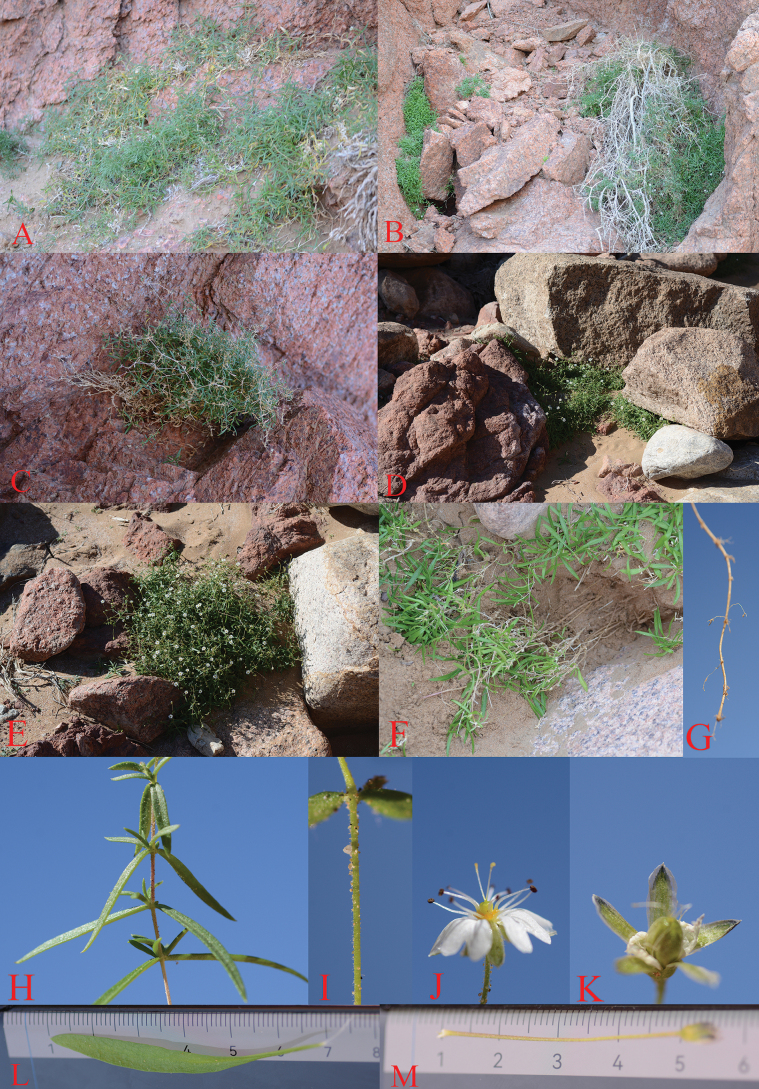 Figure 1
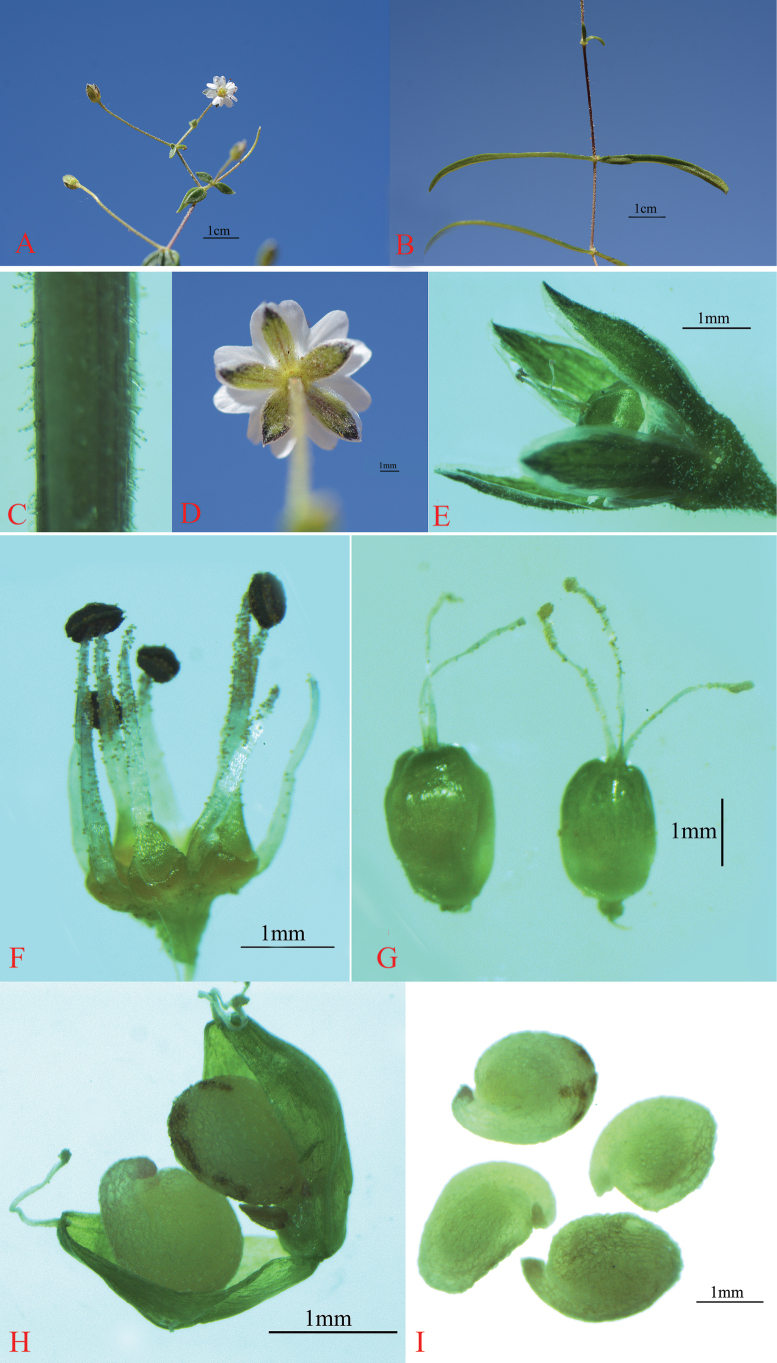 Figure 2
|
|
|
| ||
|---|---|---|---|---|
|
| 8–20 | 10–40 | 15–25 | |
|
| glandular hairy | glandular hairy | glabrous | |
|
| fibrous root slender | taproot (5–8 mm) | fibrous Root,slender | |
|
| Yes | Yes | No | |
|
| quadrangular | cylindicalr | quadrangular | |
|
|
| linear-lanceolate | ovate-lanceolate | lanceolate to oblong-lanceolate |
|
| 30–65 × 4–6 mm | 10–20 × 2–10 mm | 5–20 × 2–4 mm | |
|
| 14–40 | 3–20 | 5–20 | |
|
| ca.6 × 2 mm | 4–5 × ca. 1 mm | 2–4 × ca. 1 mm | |
|
| 5.8–6.1 mm | ca. 3 mm | 2–4 mm | |
|
| 2.3–2.7 mm | ca. 2.5 mm | subequaling or slightly longer than sepal | |
| Number of styles | 2 (3, obvious) | 2 (3, rare) | 3 (sometimes 2) | |
| Seed number | 1–3 | 1 (or 2) | More | |
Peer Reviews
No public reviews on file for this paper yet. If you reviewed it on a platform where reviews are public (OpenReview, ICLR, NeurIPS, ICML), you can paste yours below so the community can read it here.
Videos
No videos yet. Explain this paper in a talk, walkthrough, or lecture? Add one.
Taxonomy
TopicsPlant and Fungal Species Descriptions · Plant Diversity and Evolution · Phytochemistry and Biological Activities
Introduction
Stellaria L. (1753: 421) (Caryophyllaceae Juss.) is a genus containing 150–200 species occurring almost throughout the world (Hernández-Ledesma et al. 2015; POWO 2025). Stellaria is polyphyletic and many taxa have been transferred to other genera, like Adenonema Bunge (1836: 548), CerastiumLinnaeus (1753: 438), EngellariaIamonico (2021: 4), Hartmaniella M.L.Zhang & Rabeler (2017: 455), Mesostemma Vvedensky (1941: 4), MaguirellariaIamonico (2023: 240), Minuartia Linneaus (1753:89), MononeuriaReichenbach (1845: 205), Nubelaria M.T.Sharples & E.A.Tripp (2019a: 886), Pseudocherleria Dillenberger & Kadereit (2014: 451), and Rabelera M.T.Sharples & E.A.Tripp (2019b: 870). After these changes, according to Sharples and Tripp (2019b) and Iamonico (2021, 2023), Stellaria would now consist of 111 species. A worldwide revision of Stellaria is still lacking (El Mokni et al. 2023).
More than seventy Stellaria species are currently recorded in China, including some newly described in recent years (Gan and Li 2014; Xu and Ma 2018; Song et al. 2020; Wang et al.2020, 2024; Yahara et al. 2021; Li et al. 2022; Arya et al. 2024). 27 species have been reported in Inner Mongolia according to Zhao et al. (2019).
As a key taxonomic feature, the majority of Stellaria species have three styles, but a notable variation is observed in certain species in which the number of styles ranges from two to four, as seen in S.bistyla Y.Z.Zhao, S.alsine Grimm, S.vestita Kurz, S.graminea L., S.ovatifolia (M.Mizush.) M.Mizush., S.strongylosepala Hand.-Mazz., etc.
In order to investigate the florist diversity of Alashan region (western Inner Mongolia, China), we observed a population of Stellaria which cannot be ascribed to any known species. After a careful examination of Floras and other relevant literature (Ren and Di 1985; Zhao YZ 1985; Lu et al. 2001) and exsiccate preserved in numerous herbarium, we reached the conclusion that a new species can be proposed.
Materials and methods
Field surveys were carried out during the years 2023 and 2024. Morphological characters of living plants, including flowering and non-flowering individuals, were observed, measured and photographed under an SLR camera and an Olympus stereozoom microscope (OLYMPUS SZX10) and described using the terminology used by Lu et al. (2001). Stellariabistyla and S.alsine were considered for the morphological comparison according to Zhao et al. (2019). Specimens were deposited in the Herbarium FGC (acronym according to Thiers 2025). Further material is consulted through JSTOR Global Plants (2025), NSII (2025), and NPSRC (2025). Relevant literature is also analyzed (Lepsí et al. 2019; Sindhu and Singh 2024).
Taxonomic treatment
Stellaria
yabulaiensis
Taxon classificationPlantaeCaryophyllalesCaryophyllaceae
L.Liu sp. nov.
82B9EDBE-2367-5945-AB28-A4DB3E0A97F0
urn:lsid:ipni.org:names:77364104-1
Type.
China. Inner Mongolia: Alashan, Alashan Right Banner, Yabulai Town, 40°9'21"N, 104°0'12"E, 1367 m s.l.m., 8 August 2024, L.Liu GRI2023102 (holotype: FGC!, isotype: FGC!).
Diagnosis
**(Table 1).**Stellariayabulaiensis is similar to S.bistyla from which differ in having a slender fibrous root (0.3–0.5 mm in diameter vs. ca. 5–8 mm taproot), occurrence of a rhizome (vs. without rhizome), quadrangular stem (vs. cylindrical stem), linear-lanceolate leaf, 30–65 × 4–6 mm (vs. ovate-lanceolate, 10–20 × 2–10 mm), longer pedicel, 14–40 mm (vs. 3–20 mm), 3 styles (vs. usually 2 styles), and 1–3 seeds per fruit (*vs.*1–2 seeds).
Description.
Herbs perennial, 8–20 cm tall. Slender fibrous root. Rhizome quadrangular and slender (0.7–1.1 mm in diameter). Stems, quadrangular, slender with glandular hairs. Leaves sessile, smooth, oblong to oblong-lanceolate, 3.0–6.5 cm long, 4–6 mm wide, apex acuminate, base slightly narrowed, margin entire, mid-vein obviously raised. Flowers solitary in axillary cymes. Bracts foliate, oblong, 3–15 mm long, 3 mm wide, apex acuminate. Pedicel filiform, glandular hairs, 1.4–4.0 cm. Sepals 5, glandular hairs, oblong, 6 mm long, 2 mm wide, margin membranous. Petals 5, subequalling sepals, 2-lobed cleft, lobes oblong. Stamens 10, almost equal with sepals, filament widened at base, succulent, anthers fuchsia. Ovary ellipsoid, styles 2 or 3. Capsule black-brown, ellipsoid, markedly shorter than sepals, ca. 2.5 mm long. Seeds 1–3, brown, reniform, 2 mm long, 1.5 mm wide, regularly rugulose.
Stellariayabulaiensis L.Liu. A–D. Habitat; E. Plant; F Root; G. Rhizome; H. Branch; I. Stem (glandular hairs); J. Flower (style 2); K. Capsule; L. Leaf; M. Pedicel.
Etymology.
The specific epithet “yabulaiensis” refers to the Yabulai Mountain where the new species was collected.
Vernacular name
(Chinese). yǎ bù lài fán lǚ (雅布赖繁缕).
Distribution and habitat.
Stellariayabulaiensis is known from Alashan Right Banner, Inner Mongolia, China. The plants grow in humid sand at 1370 m a.s.l. For the time being, S.yabulaiensis is only known from the type locality, comprising less than 50 individuals.
Stellariayabulaiensis L.Liu. A. Inflorescence; B. Leaf; C. Stem (glandular hairs); D. Flower (glandular hairs); E. Sepal; F. Stamen; G. Ovary (styles 2, 3); H. Capsule; I. Seeds.
Phenology.
Flowering time June-July; fruiting time August-October.
Conservation status.
Stellariayabulaiensis was found only in the type locality whose population are very small, but the whole distribution area is not clear; hence, we cannot conclude if it is a relatively common or rare species. In consideration of the dry area in western Inner Mongoilia, the new species needs further investigation in its distribution area and size of population to determine the current IUCN category.
Taxonomic notes.
Due to the large number of species within the genus Stellaria, it has been further classified into six sections: Sect. Leucostemma, Sect. Fimbripetalum, Sect. Adenonema, Sect. Stellaria, Sect. Oligosperma, and Sect. Schizothecium ; subsections and series occur within Sect. Stellaria. Stellariayabulaiensis belongs to Sect. Oligosperma since it displays mainly 2 styles, 5 petals, 5 sepals, and 10 stamens.
Supplementary Material
XML Treatment for Stellaria yabulaiensis
The reference list from the paper itself. Each links out to its DOI / PubMed record.
- 1Arya S Kumar VNSA Sojan J Philip AA Suresh V (2024) Stellariamcclintockiae (Caryophyllaceae) a new species from Kerala, India.Phytotaxa 645(1): 55–65. 10.11646/phytotaxa.645.1.5 · doi ↗
- 2Bunge, Alexander von (1836) Mémoires de l’Académie impériale des sciences de St. Pétersbourg. 5e série. St.-Pétersbourg Divers Savans 2: 548.
- 3China National Specimen Information Infrastructure [NSII] (2025) China National Specimen Information Infrastructure. http://www.nsii.org.cn/2017/query.php?name=\u 7e 41\u 7f 15\u 5c 5e [accessed 22 May 2025]
- 4Chinese Virtual Herbarium [NPSRC] (2025) Chinese Virtual Herbarium. https://www.cvh.ac.cn/ [accessed 22 May 2025]
- 5Dillenberger MS Kadereit JW (2014) Corrigendum to “Maximum polyphyly: Multiple origins and delimitation with plesiomorphic characters require a new circumscription of Minuartia (Caryophyllaceae)”.Taxon 63(2): 451–451. [Taxon 63: 64–88, S 1–S 21. 2014] 10.12705/632.42 · doi ↗
- 6El Mokni R Del Guacchio E Iamonico D (2023) Further insights into the Stellariamediaaggregate (Caryophyllaceae, Alsinoideae, Alsineae) in Africa: First reports of S.ruderalis in North Africa and S.cupaniana in Tunisia, with nomenclatural notes on the name Alsinecupaniana.Phytotaxa 584(4): 264–274. 10.11646/phytotaxa.584.4.3 · doi ↗
- 7Gan QL Li XW (2014) Stellariazhuxiensis (Caryophyllaceae), a New Species from Hubei, China.Annales Botanici Fennici 51: 22–24. 10.5735/085.051.0102 · doi ↗
- 8Hernández-Ledesma P Berendsohn WG Borsch T Mering SV Akhani H Arias S Castañeda-Noa I Eggli U Eriksson R Flores-Olvera H Fuentes-Bazán S Kadereit G Klak C Korotkova N Nyffeler R Ocampo G Ochoterena H Oxelman B Rabeler RK Sanchez A Schlumpberger BO Uotila P (2015) A taxonomic backbone for the global synthesis of species diversity in the angiosperm order Caryophyllales.Willdenowia 45: 281–383. 10.3372/wi.45.45301 · doi ↗