Orthoflavivirus nilense surveillance in the State of Piauí, northeastern Brazil
Osmaikon Lisboa Lobato, Tayná da Silva Nogueira, Tobias Emílio Tavares Lima, Felipe José da Costa Andrade, Marília Gabryelle Guimarães de Macedo, Rayane de Souza Pereira, Joilson Xavier, Mariene Ribeiro Amorim, Priscilla Paschoal Barbosa, Alex Sobrinho da Rocha

TL;DR
This study investigates the presence of West Nile virus in birds, mosquitoes, and horses in Piauí, Brazil, but finds no evidence of the virus in collected samples.
Contribution
The study contributes new data on WNV surveillance in Brazil and highlights challenges in detecting the virus in healthy animals.
Findings
No positive WNV samples were found in birds, mosquitoes, or equids from 11 municipalities.
The lack of detection may be due to the difficulty of molecular detection in healthy animals and delayed human diagnosis.
Serological surveys in asymptomatic animals are recommended in areas with late human diagnoses.
Abstract
The cycle of the Orthoflavivirus nilense (West Nile virus - WNV) involves birds and mosquitoes, while humans and equids serve as terminal hosts. In 2014, the first human case in Brazil was confirmed in Piauí State. To investigate the presence of WNV in birds, mosquitoes, and equids in municipalities of Piauí. Collections were carried out following recommendations from the Ministry of Health of Brazil, in 11 municipalities (all with human cases or bird mortality), where biological samples were collected from birds, mosquitoes, and equids. The Viral RNA extraction was performed using a commercial kit, following the manufacturers’ recommendations; samples were subjected to reverse transcription and polymerase chain reaction, with specific primers for WNV. 2,706 samples were collected (636 birds, belonging to 99 species; 420 equids, and 1,650 mosquitoes, grouped into 346 pools, totaling…
Genes, proteins, chemicals, diseases, species, mutations and cell lines named across the full text — each resolved to its canonical identifier and authoritative record.
Click any figure to enlarge with its caption.
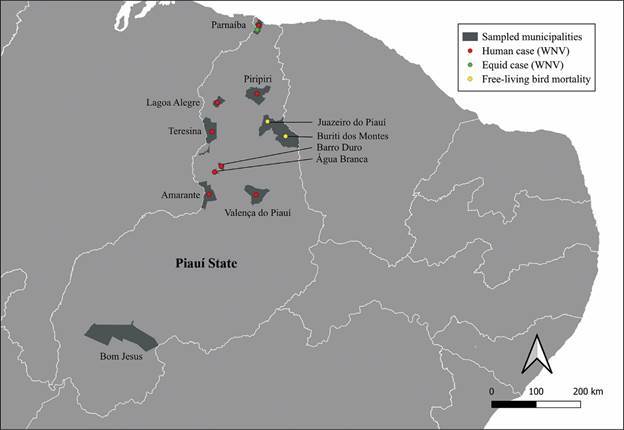 Figure 1
Peer Reviews
No public reviews on file for this paper yet. If you reviewed it on a platform where reviews are public (OpenReview, ICLR, NeurIPS, ICML), you can paste yours below so the community can read it here.
Videos
No videos yet. Explain this paper in a talk, walkthrough, or lecture? Add one.
Taxonomy
TopicsMosquito-borne diseases and control · Herpesvirus Infections and Treatments · Animal Disease Management and Epidemiology
The Orthoflavivirus nilense (West Nile virus - WNV), a member of the Flaviviridae family, Orthoflavivirus genus, primarily infects mammals and birds. Humans and equines may serve as dead end hosts. The virus was detected in the Americas at the end of the 20th century, and was first discovered in Brazil in 2005.1 ^,^ 2 ^,^ 3 ^,^ 4 ^,^ 5 The first human case in Brazil was reported in 2014 in Piaui State, northeast Brazil4 and up until 2022 all WNV human cases in Brazil were confirmed in this state. Molecular detection has previously been performed in equines,5 ^,^ 6 ^,^ 7 ^,^ 8 ^,^ 9 but the vectors and birds involved in the epidemiological cycle in Brazil remain largely unknown. Therefore, the aim of this study was to investigate the presence of the WNV in birds, equids, and mosquito vectors in municipalities where human cases and/or unexplained mortality of free-living birds have been reported in Piauí State.
SUBJECTS AND METHODS
Study area and characterization of Orthoflavivirus nilense surveillance in Piauí - A total of 11 municipalities were sampled between the years 2019 and 2022, from north to the south Piauí State, Brazil: Água Branca, Amarante, Barro Duro, Bom Jesus, Buriti dos Montes, Juazeiro do Piauí, Lagoa Alegre, Parnaíba, Piripiri, Teresina, and Valença do Piauí. These municipalities were selected based on the confirmation of human cases for WNV or high mortality of free-living birds (Figure).
Municipalities sampled in the State of Piauí, between October 2019 and August 2022. Bom Jesus was the only state without confirmed or suspected human cases of West Nile virus (WNV) and without reports of free-living bird mortalities.
Capture and collection of biological material - The collection of bird, equid and mosquito samples followed the Epizootic Surveillance Guide of the Brazilian Ministry of Health,10 and recommendations from Tolsá et al.11 For bird collection, ornithological capture nets (mist nets) were employed,12 and birds were identified according to published guides;13 ^,^ 14 ^,^ 15 up to 500 µL of blood was collected from the brachial vein using microhematocrit tubes.2 ^,^ 11 In equids, we collected up to 20 mL of blood from the jugular vein of each animal. The animals were identified by species, sex, and age, and an informed consent form was provided to the owner, granting permission for the collection. Mosquitoes were collected in all municipalities, except in Bom Jesus, Buriti dos Montes, and Juazeiro do Piauí. CDC light traps were used for collection,16 identification was conducted following Consoli et al. and Forattini,17 ^,^ 18 and pools were formed with up to 15 mosquitoes of the same species per collection point. All collected samples were refrigerated in liquid nitrogen until laboratory processing.
Molecular biology tests for viral detection
Bird and mosquito samples - Genetic material extraction was carried out using silica column kits (Bioclin^®^) and magnetic beads (Zymo^®^), following the manufacturer’s recommendations. The samples subjected to a reverse transcription reaction following Kuno and Catenacci et al.,19 ^,^ 20 and the polymerase chain reaction (PCR) following Lanciotti et al.21 The reaction products were observed following electrophoresis on a 1% agarose gel stained with ethidium bromide.
Equid samples - Extraction of genetic material was performed using magnetic bead kits (Zymo^®^). For real-time PCR (RT-PCR), the samples were grouped into pools, each containing 10 distinct samples from the same location. A set of specific primers was used to amplify the complete viral genome of the WNV.5 The PCR result was observed using an E-Gel (Thermo Fisher^®^).
Ethical considerations - The research complied with the relevant laws governing research conducted in Brazil. Approval for the study was obtained from the Ethics Committee for the Use of Animals in Research of the Federal University of Piauí (CEUA/UFPI, Approval No. 605/19). Additionally, authorization was granted by the Institute Chico Mendes de Conservação da Biodiversidade (ICMBio), a division of the Brazilian Environmental Agency (ICMBio-SISBIO, Permit No. 75734-1), and the National System for the Management of Genetic Heritage and Associated Traditional Knowledge (SISGEN, Registration No. AF40BCA).
RESULTS AND DISCUSSION
Between October 2019 and August 2022, we collected a total of 2,706 samples, including 636 birds belonging to 99 species, 420 equids, including donkeys, mules, and horses, and 1,650 mosquitoes grouped into 346 pools, totaling 18 species (Table I). All 2,706 samples underwent reverse transcription followed by WNV RT-PCR testing, but none yielded positive results. All the procedures followed the recommendations of the Ministry of Health of Brazil, both for the diagnosis and for the epidemiological surveillance of birds, equids, and vectors.22
TABLE INumber of animals collected in each municipalityMunicipalitiesABAMBDBJBMJPLAPAPITEVATotalBirds62564726353063766412651636Equids484854---4565605743420Mosquitoes^^ 3171---281253214-346Total141111102263530136153177397941,402TE: Teresina; PI: Piripiri; LA: Lagoa Alegre; AB: Água Branca; AM: Amarante; PA: Parnaíba; VA: Valença; BD: Barro Duro; BJ: Bom Jesus; JP: Juazeiro do Piauí; BM: Buriti dos Montes. ^^Value refers to the mosquito pool.
The most well-represented bird families were Thraupidae (24.69%; n = 157), Phasianidae (11.79%; n = 75), and Columbidae (11.79%; n = 75) (Table II). Despite the sampling effort and the diversity of birds collected, only 3.3% considered potential sentinels for WNV based on previous studies with confirmed detection:23 ^,^ 24 Passer domesticus (Passeridae), with 13 specimens sampled (Água Branca n = 6, Teresina n = 6, and Amarante n = 1); Cyanocorax cyanopogon (Corvidae), with four specimens sampled (Valença n = 2, Bom Jesus n = 1, and Piripiri n = 1); Glaucidian brasilianum (Strigidae), with two specimens sampled (Piripiri n = 1, Valença n = 1); Megacops choliba (Strigidae), with one (1) specimen collected (Barro Duro); and Rupornis magnirostris (Accipitridae), with one (1) specimen collected (Piripiri). Based on the lists of dead birds detected with WNV in the United States,25 we can also add the Anatidae family, the most abundant among the 332 species reported; only one representative of the family was collected in Piauí: Anas platyrhynchos domesticus, with five specimens, all collected in Barro Duro, which does not significantly alter the percentage of potential sentinels collected in the state, which would remain below 5%.
TABLE IIBird species captured during investigation of the Orthoflavivirus nilense circulation in the State of Piauí, Brazil, during the period from October 2019 to August 2022MunicipalitiesABAMBDBJBMJPLAPAPITEVATotalThraupidae214322323830132316157Phasianidae899---920-12875Columbidae180727555419375Tyrannidae15881307197362Furnariidae60310120925451Icteridae07000020010028Turdidae01412000031122Troglodytidae4111006004320Scolopacidae00000001700017Rhynchocyclidae0400001032313Passeridae6100000006013Thamnophilidae0300000008112Cuculidae0200000052110Dendrocolaptidae200100002207Galbulidae012001002107Parulidae021100200208Passerellidae021000003006Alcedinidae000000022105Anatidae005000000005Polioptilidae000000001405Ardeidae001000002104Corvidae000100001024Bucconidae010000000023Caprimulgidae100000000203Strigidae001000001013Estrildidae000000000202Mimidae000100000012Picidae010000000001Vireonidae000000200002Accipitridae000000001001Charadriidae000000010001Hirundinidae010000000001Jacanidae000000001001Pipridae000000001001Rallidae000100000001Not identified001220000128Total62584726353062766412551636TE: Teresina; PI: Piripiri; LA: Lagoa Alegre; AB: Água Branca; AM: Amarante; PA: Parnaíba; VA: Valença; BD: Barro Duro; BJ: Bom Jesus; JP: Juazeiro do Piauí; BM: Buriti dos Montes.
However, 6.1% (n = 6) of bird species collected in this study were previously reported with antibodies to WNV in Brazil:26 ^,^ 27 ^,^ 28 ^,^ 29 76 specimens of Gallus gallus domesticus (Água Branca n = 8, Amarante n = 9, Barro Duro n = 9, Lagoa Alegre n = 9, Parnaíba n = 20, Teresina n = 12, and Valença n = 8), 38 specimens of Columbina talpacoti (Água Branca n = 16, Barro Duro n = 7, Lagoa Alegre n = 2, Piripiri n = 4, Teresina n = 7, and Valença n = 2), 15 specimens of Furnarius figulos (Água Branca n = 5, Barro Duro n = 1, Bom Jesus n = 1, Lagoa Alegre n = 1, Piripiri n = 3, Teresina n = 2, and Valença n = 2), 13 specimens of Passer domesticus (Água Branca n = 6, Teresina n = 6, and Amarante n = 1), five specimens of Coryphospingus pileatus (Lagoa Alegre), and one (1) specimen of Arenaria interpres (Parnaíba).
Among the potential wild bird hosts for WNV collected, all have a wide distribution across Brazil. Passer domesticus, for example, is an exotic bird present throughout the Americas, with records of occurrence in all Brazilian states, generally associated with anthropogenic environments and highly adaptable.30 ^,^ 31 The species C. cyanopogon, on the other hand, is one of the eight species of corvids that occur in Brazil, mainly related to the Northeast region but also present in the North and Central-West regions.32 ^,^ 33 The representatives of the Strigidae family collected have different characteristics. Glaucidian brasilianum has a diurnal habit and is the largest representative of its genus in Brazil; its distribution, according to occurrence records, is more associated with the Northeast region, while M. chiliba has a nocturnal habit.34 ^,^ 35 Its distribution is similar to that of P. domesticus, but it prefers areas with more vegetation cover and is a species difficult to spot.36 ^,^ 37 Meanwhile, Rupornis magnirostris, the only species of the Accipitridae family, is considered the largest hawk in Brazil, with a wide distribution across the Americas, mainly in the South; it is present throughout the country, inhabiting open areas (with sufficient tree cover), forest edges, and urbanized environments.38 ^,^ 39
Regarding the characteristics and distribution of the birds collected that have already been reported with WNV exposure,26 ^,^ 27 ^,^ 28 ^,^ 29 we have Columbina talpacoti, distributed throughout the Cerrado, being a typical species of the Cerrado and could be considered a bioindicator of environmental quality due to its abundance in areas with little anthropogenic alteration;40 ^,^ 41 F. figulos, an endemic species of Brazil;42 Coryphospingus pileatus, found in South America, in countries like Venezuela, Colombia, and French Guiana, in addition to Brazil, in the Northeast, Central-West, and Southeast regions;43 and Arenaria interpres is one of the few migratory species collected, nesting in the far north of North America, Europe, and Asia, migrating to the southern Hemisphere and almost all of the Southern Hemisphere, with reports of occurrence in all regions of Brazil.44 The migration of birds in Brazil, coming from the Northern Hemisphere, is one of the most accepted hypotheses for the introduction of WNV in the country, since the WNV epidemiological cycle has not yet been elucidated in the country. Thus, it is still unknown which vectors and hosts exist for the virus in Brazilian territories.45 ^,^ 46 Therefore, there is great importance and necessity for investigating bird populations, vectors, and equids, whether through direct or indirect diagnostic techniques, in order to understand the transmission dynamics and the main agents involved.
Among the sampled equids, 76.67% (n = 322) were horses, followed by 9.76% donkeys (n = 41), and 5.71% mules (n = 24) (Table III). These species are considered excellent sentinels for WNV, since they often precede human cases.6 ^,^ 47 ^,^ 48 Unlike birds, there are reports of WNV circulation in equids, both by serological detection26 ^,^ 27 ^,^ 49 ^-^ 52 and molecular methods6 ^,^ 7 ^,^ 8 ^,^ 9 ^,^ 29 in the State of Piauí.5
TABLE IIIEquid species physically contained during investigation of the circulation of the Orthoflavivirus nilense in the State of Piauí, Brazil, during the period from October 2019 to August 2022MunicipalitiesABAMBDLAPAPITEVATotal Equus caballus (Horse)4628293765562635322 Equus asinus (Donkey)-3195--13141Mule-632-48124Not identified21131--10633Total4848544565605743420TE: Teresina; PI: Piripiri; LA: Lagoa Alegre; AB: Água Branca; AM: Amarante; PA: Parnaíba; VA: Valença; BD: Barro Duro.
Regarding vectors, all mosquito pools belonged to the potential vector of WNV: mosquitoes in the Culicidae family. The genera Culex spp. (47.40%, n = 164), Mansonia spp. (20.81%; n = 72), Coquillettidia spp. (9.25%; n = 32), Aedes spp. (8.67%; n = 30), and Anopheles spp. (7.23%; 25) were the most sampled (Table IV). There is still much to explore regarding potential WNV vectors in Brazil. There remains just one confirmed detection of WNV in vectors in Brazil from the Amazon region, and identified as a mosquito in the Culex genus,53 which was the most well-represented in the present study.
TABLE IVMosquito pools sampled during investigation of the Orthoflavivirus nilense circulation in the State of Piauí, Brazil, during the period from October 2019 to August 2022MunicipalitiesABAMBDLAPAPITETotal Culex (Culex) sp.61-15613123164 Mansonia sp.1331-4123972 Anopheles sp.32-1-91025 Coquillettidia (Rhynchotaenia) sp.6--1-4718 Aedes scapularis 11-4-7417 Coquillettidia (Rhynchotaenia) venezuelensis -----2911 Uranotaenia sp.1-----78 Culex (Melanoconion) sp.---313-7 Aedes (Stegomyia) aegypti ------55 Uranotaenia hystera ---3-1-4 Aedes albopictus -----123 Aedes sp.------33 Coquillettidia (Rhynchotaenia) nigricans ------33 Aedes serratus -----112 Aedeomyia sp.----1--1 Haemagogus (Haemagogus) sp.---1---1 Limatus sp.------11 Wyeomya sp.1------1Total3171281253214346TE: Teresina; PI: Piripiri; LA: Lagoa Alegre; AB: Água Branca; AM: Amarante; PA: Parnaíba; BD: Barro Duro.
Despite the extensive effort in sample collection, the non-detection of WNV in this study may be related to delayed diagnosis between human infections in the State of Piauí and the study (up to four years).
In conclusion - We strongly recommend carrying out local surveys in animals and vectors at the time of any suspected WNV infections in humans. Additionally, in case of a delay between a WNV diagnosis in humans, serological tests should be performed in animals instead of molecular tests, as antibodies will better inform of viral circulation as a monitoring tool. We also suggest that free-living birds with neurological symptoms rescued from wildlife rehabilitation centers be tested as part of any survey, as this will increase the sample size of potential natural hosts of WNV in Brazil. In addition to understanding the importance of using official notification systems, which can lead to early detection of outbreaks, we recommend the development of mitigation strategies, both of which will be strengthened through the collaboration between different government and health sectors in the prevention of zoonoses. Lastly, we recommend testing of any neurological equids that were negative on rabies testing since WNV should be a differential diagnosis.54 ^,^ 55 ^,^ 56
The reference list from the paper itself. Each links out to its DOI / PubMed record.
- 1de Castro-Jorge LA Siconelli MJL Ribeiro BDS de Moraes FM de Moraes JB Agostinho MR West Nile virus infections are here Are we prepared to face another flavivirus epidemic?Rev Soc Bras Med Trop 201952 e 201900893094226310.1590/0037-8682-0089-2018 · doi ↗ · pubmed ↗
- 2Figueiredo LTM West Nile virus infection in Brazil Rev Soc Bras Med Trop 201952 e 201902263116649210.1590/0037-8682-0226-2019 · doi ↗ · pubmed ↗
- 3Lorenz C de Azevedo TS Chiaravalloti-Neto F Impact of climate change on West Nile virus distribution in South America Trans R Soc Trop Med Hyg 202211611104310533564000510.1093/trstmh/trac 044 · doi ↗ · pubmed ↗
- 4Vieira MACS Romano APM Borba AS Silva EVP Chiang JO Eulálio KD Case report West Nile virus encephalitis: the first human case recorded in Brazil Am J Trop Med Hyg 20159323773792605574910.4269/ajtmh.15-0170 PMC 4530764 · doi ↗ · pubmed ↗
- 5CostaÉA Giovanetti M Catenacci LS Fonseca V Aburjaile FF Chalhoub FLL West Nile virus in Brazil Pathogens 20211078968963435804610.3390/pathogens 10070896 PMC 8308589 · doi ↗ · pubmed ↗
- 6De Siqueira RF Hansen VS Martins MFM Leal MLR Bondan EF Infecção pelo vírus da febre do Nilo Ocidental em equinos no Estado de São Paulo Acta Sci Vet 202250737737
- 7Martins LC da Silva EVP Casseb LMN da Silva SP Cruz ACR Pantoja JAS First isolation of West Nile virus in Brazil Mem Inst Oswaldo Cruz 20191141 e 1803323067298010.1590/0074-02760180332 PMC 6343470 · doi ↗ · pubmed ↗
- 8Siconelli MJL Jorge DMM de Castro-Jorge LA Fonseca-Júnior AA Nascimento ML Floriano VG Evidence for current circulation of an ancient West Nile virus strain (NY 99) in Brazil Rev Soc Bras Med Trop 202154 e 0687 e 20203368193310.1590/0037-8682-0687-2020 PMC 8008906 · doi ↗ · pubmed ↗