Multiple and Alternative Sites Make Tau Protein an Adaptable Sticky Surface for the SH3 Domain of Fyn Kinase
Roberto Tira, Giulia Leo, Laura Prandini, Carlo Giorgio Barracchia, Mariapina D'Onofrio, Luca Mollica, Stefano Capaldi, Michael Assfalg, Francesca Munari

TL;DR
This study explores how the Tau protein interacts with the Fyn kinase in Alzheimer's disease, revealing that Tau's multiple binding sites allow it to function even when some sites are missing.
Contribution
The study identifies a novel non-canonical binding site in Tau and shows that multiple sites enable adaptable recognition by Fyn-SH3.
Findings
Fyn-SH3 interacts with multiple hot spot regions across 85 residues in Tau.
A novel non-canonical binding site was identified at the microtubule binding domain of Tau.
Tau remains functional for recognition even when single consensus motifs are deleted.
Abstract
The interaction between the microtubule associated protein Tau and the tyrosine kinase Fyn is believed to play a pivotal role in the early stage of Alzheimer's disease. Previous studies have identified the SRC Homology 3 (SH3) domain of Fyn as the binding receptor of several proline‐rich motifs in Tau. However, the role of each proline‐rich motif and their interplay in molecular recognition are still unclear. In this work, we investigated the mechanism of Fyn‐SH3 recognition by the multiple PxxP sites inserted within the full‐length Tau protein by using nuclear magnetic resonance (NMR) spectroscopy combined with computational, calorimetric and in‐cell FRET (Förster resonance energy transfer) methods. Both in vitro and in‐cell experiments revealed no single binding site strictly necessary for the binding. Instead, Fyn‐SH3 contacts full‐length Tau on multiple hot spot regions, located…
Genes, proteins, chemicals, diseases, species, mutations and cell lines named across the full text — each resolved to its canonical identifier and authoritative record.
Click any figure to enlarge with its caption.
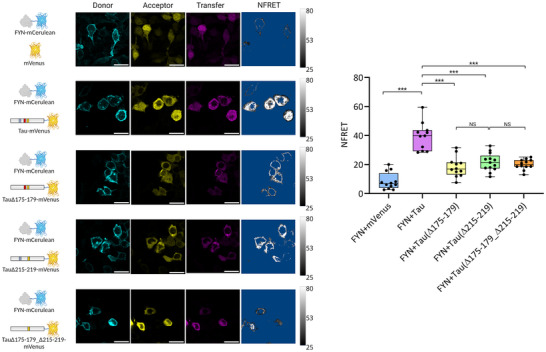 Figure 1
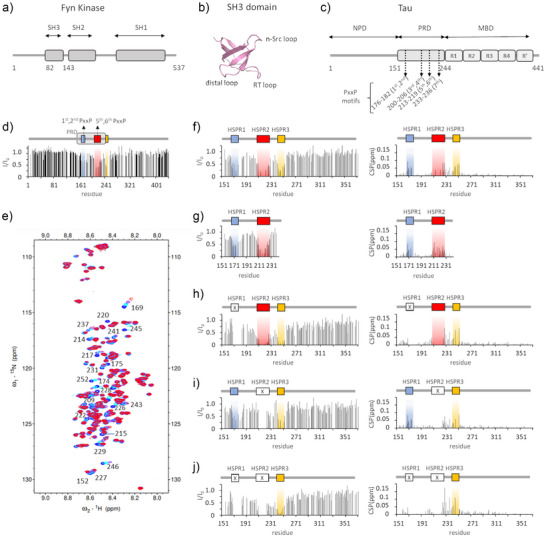 Figure 2
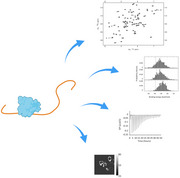 Figure 3
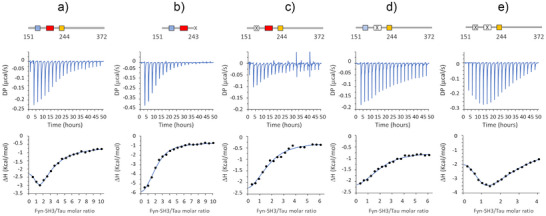 Figure 4
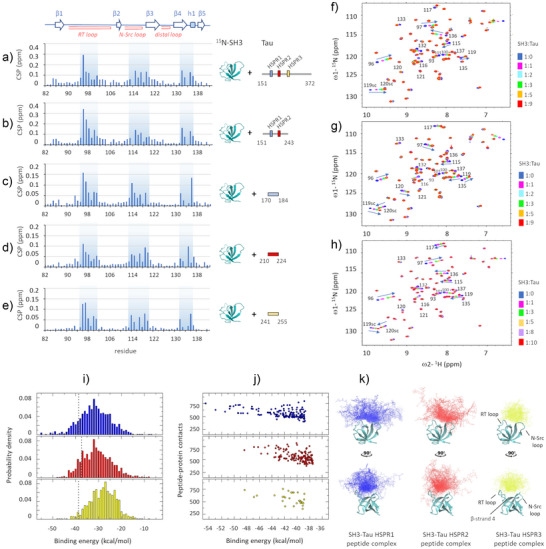 Figure 5
Peer Reviews
No public reviews on file for this paper yet. If you reviewed it on a platform where reviews are public (OpenReview, ICLR, NeurIPS, ICML), you can paste yours below so the community can read it here.
Videos
No videos yet. Explain this paper in a talk, walkthrough, or lecture? Add one.
Taxonomy
TopicsComputational Drug Discovery Methods · Protein Kinase Regulation and GTPase Signaling · Enzyme Structure and Function