From childhood to adolescence: Development of binge eating and the prospective role of self-regulation
Nele Westermann, Annette M. Klein, Robert Busching, Petra Warschburger

TL;DR
This study tracks how binge eating changes from childhood to adolescence and finds that self-regulation skills like planning and impulse control help prevent it.
Contribution
The study provides longitudinal evidence on the development of binge eating and identifies specific self-regulation skills as predictors.
Findings
Binge eating decreases in middle childhood, stabilizes, and increases during adolescence.
Better planning, inhibitory control, and cognitive flexibility reduce binge eating in middle childhood.
Higher satiety responsiveness is linked to increased binge eating during adolescence.
Abstract
Research shows that binge eating often starts in childhood or adolescence, but its development remains largely unexplored. Additionally, while cross-sectional studies link self-regulation to binge eating, longitudinal research is lacking. Therefore, this study examined the development of binge eating and self-regulation as a potential predictor for this development in a community sample. A total of N = 1660 children were assessed at four time points spanning ages 6–11, 7–11, 9–13, and 16–21. The assessment of self-regulation encompassed emotional reactivity, working memory updating, cognitive flexibility, inhibition, inhibitory control, planning behavior, affective decision-making, anger regulation, and as appetite self-regulation, satiety responsiveness, emotional overeating, food responsiveness, and external eating, using computerized tasks, teacher- and parent-reports. Binge eating…
Genes, proteins, chemicals, diseases, species, mutations and cell lines named across the full text — each resolved to its canonical identifier and authoritative record.
Click any figure to enlarge with its caption.
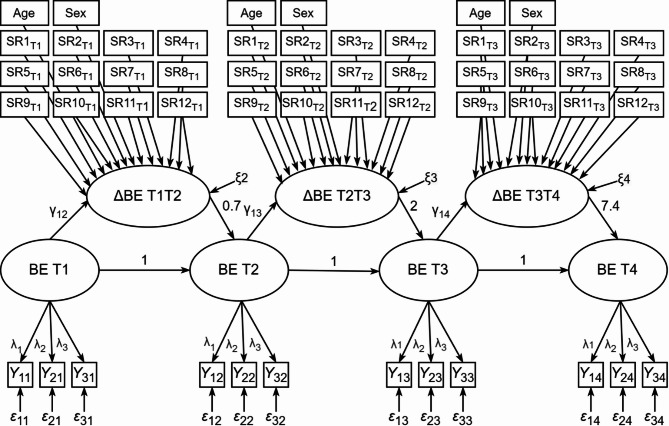 Figure 1
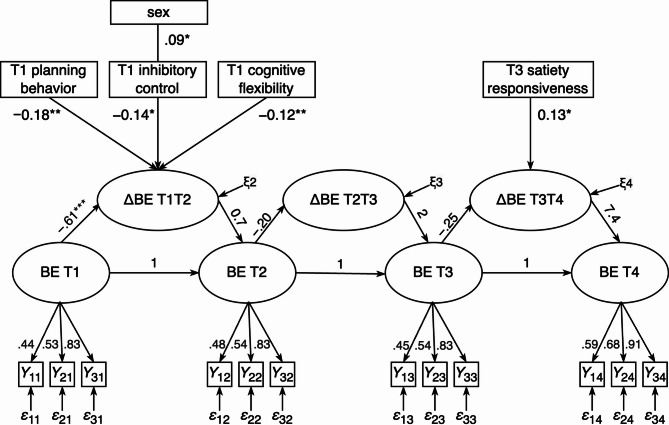 Figure 2
Peer Reviews
No public reviews on file for this paper yet. If you reviewed it on a platform where reviews are public (OpenReview, ICLR, NeurIPS, ICML), you can paste yours below so the community can read it here.
Videos
No videos yet. Explain this paper in a talk, walkthrough, or lecture? Add one.
Taxonomy
TopicsEating Disorders and Behaviors · Obesity, Physical Activity, Diet · Behavioral Health and Interventions