Performance of GPT-4 for automated prostate biopsy decision-making based on mpMRI: a multi-center evidence study
Ming-Jun Shi, Zhi-Xiang Wang, Shuang-Kun Wang, Xuan-Hao Li, Yan-Lin Zhang, Ying Yan, Ran An, Li-Ning Dong, Lei Qiu, Tian Tian, Jia-Xin Liu, Hong-Chen Song, Ya-Fan Wang, Che Deng, Zi-Bing Cao, Hong-Yin Wang, Zheng Wang, Wei Wei, Jian Song, Jian Lu, Xuan Wei, Zhen-Chang Wang

TL;DR
This study shows that GPT-4 can help reduce unnecessary prostate biopsies by analyzing MRI data, especially for cases with moderate scores.
Contribution
The study introduces a multi-center evaluation of GPT-4 for automated prostate biopsy decisions using the largest Chinese population sample.
Findings
GPT-4 could help avoid 20.8% of unnecessary prostate biopsies in the subset-of-interest with moderate PI-RADS scores.
The AI performed better in the most heterogeneous subgroup with PI-RADS score 3, avoiding 28.8% of unnecessary biopsies.
A ProstAIGuide platform was developed to make GPT-4's biopsy recommendations accessible to doctors and patients.
Abstract
Multiparametric magnetic resonance imaging (mpMRI) has significantly advanced prostate cancer (PCa) detection, yet decisions on invasive biopsy with moderate prostate imaging reporting and data system (PI-RADS) scores remain ambiguous. To explore the decision-making capacity of Generative Pretrained Transformer-4 (GPT-4) for automated prostate biopsy recommendations, we included 2299 individuals who underwent prostate biopsy from 2018 to 2023 in 3 large medical centers, with available mpMRI before biopsy and documented clinical-histopathological records. GPT-4 generated structured reports with given prompts. The performance of GPT-4 was quantified using confusion matrices, and sensitivity, specificity, as well as area under the curve were calculated. Multiple artificial evaluation procedures were conducted. Wilcoxon’s rank sum test, Fisher’s exact test, and Kruskal–Wallis tests were…
Genes, proteins, chemicals, diseases, species, mutations and cell lines named across the full text — each resolved to its canonical identifier and authoritative record.
Click any figure to enlarge with its caption.
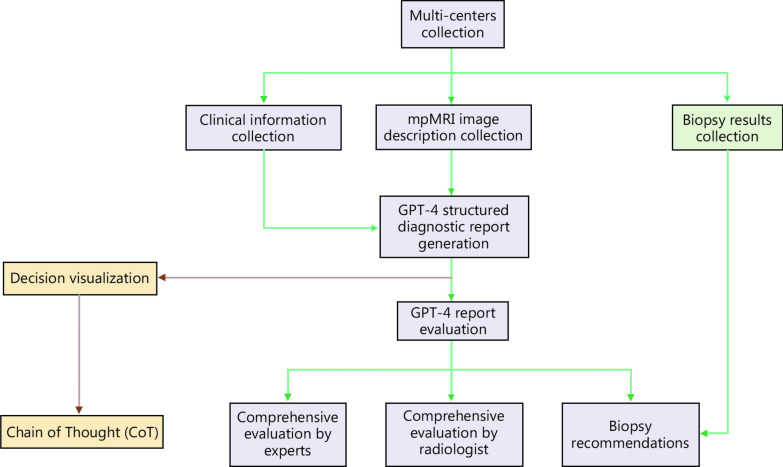 Figure 1
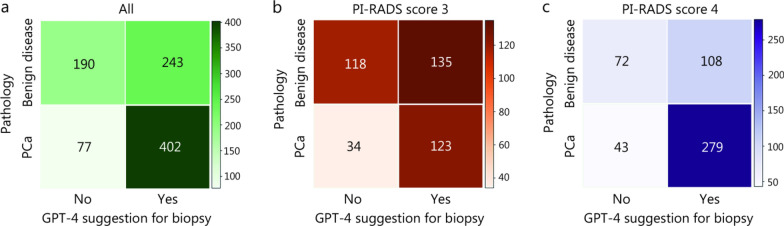 Figure 2
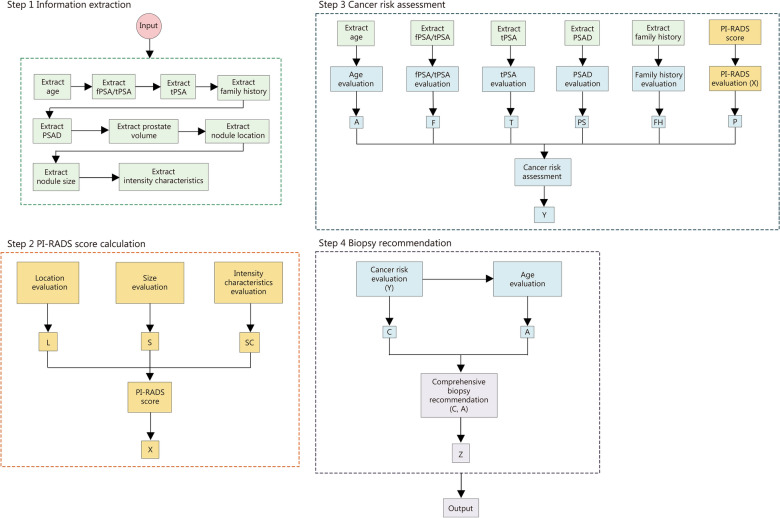 Figure 3
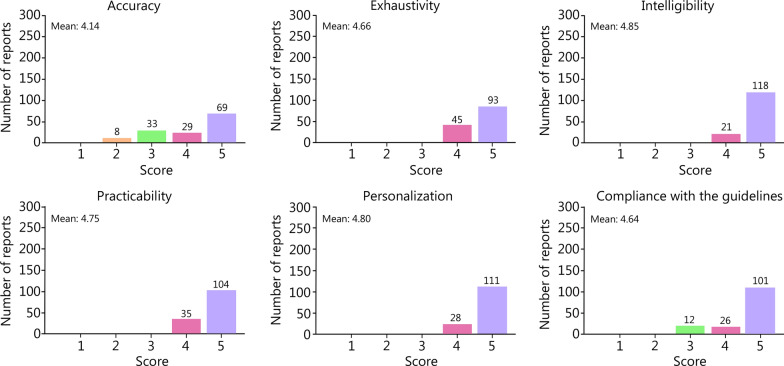 Figure 4
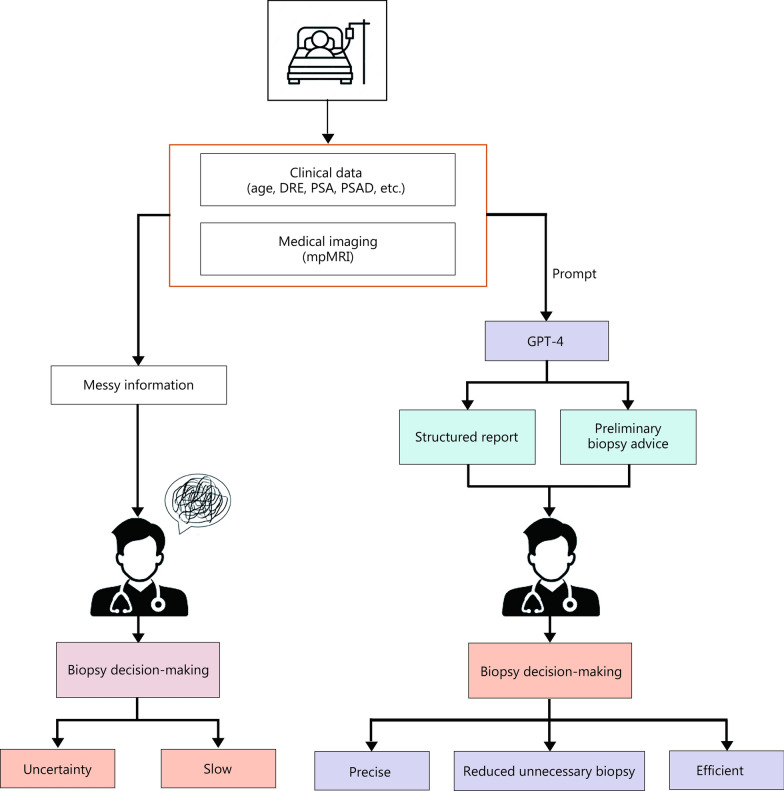 Figure 5
Peer Reviews
No public reviews on file for this paper yet. If you reviewed it on a platform where reviews are public (OpenReview, ICLR, NeurIPS, ICML), you can paste yours below so the community can read it here.
Videos
No videos yet. Explain this paper in a talk, walkthrough, or lecture? Add one.
Taxonomy
TopicsProstate Cancer Diagnosis and Treatment · Prostate Cancer Treatment and Research · Autopsy Techniques and Outcomes