Limited association between HRR gene alterations and HRD in molecular tumor board cancer samples: Who should be tested for HRD?
Christoph Schubart, Lars Tögel, Maria Giulia Carta, Philip Hetzner, Lina Helbig, Charlotte Zaglas, Maria Ziegler, Robert Stöhr, Annett Hölsken, Juliane Hoyer, Fulvia Ferrazzi, Clemens Neufert, Sebastian Lettmaier, Marianne Pavel, Henriette Golcher, Sarina K. Mueller

TL;DR
This study shows that HRD testing in cancer patients outside of clinical trials can reveal HRD in some cases without HRR gene mutations, suggesting broader use of HRD as a biomarker for PARP inhibitor treatment.
Contribution
First study to analyze HRD testing in the context of molecular tumor boards, revealing limited association between HRR gene alterations and HRD.
Findings
38.1% of BRCA1/2-mutated cancers had elevated HRD scores, but not all inactivating BRCA1/2 mutations correlated with HRD.
HRD was observed in 4.3% of cancers without HRR gene mutations, suggesting HRD may be an independent biomarker.
HRD testing should be included in comprehensive genomic profiling to guide PARP inhibitor treatment decisions.
Abstract
Alterations in Homologous Recombination Repair (HRR) Pathway genes have been found to be associated with HR‐Deficiency (HRD), which is an approved biomarker for PARP Inhibitor (PARPi) treatment. The aim of a Molecular Tumor Board (MTB) is to identify molecular alterations in cancer patients with advanced tumors that may suggest off‐label treatment options. So far, few studies have analyzed the presence of HRR gene mutations and their association with HRD outside of clinical studies. Currently, no data on HRD testing in the setting of a MTB have been published. For the present study, a cohort of 237 patients encompassing 24 different tumor entities was collected from the MTB of the Comprehensive Cancer Center Erlangen‐EMN. We show that an elevated Genomic Instability Score (GIS ≥42) can occur in samples with and without mutations in HRR‐related genes. Overall, 38.1% of cancer samples…
Genes, proteins, chemicals, diseases, species, mutations and cell lines named across the full text — each resolved to its canonical identifier and authoritative record.
Click any figure to enlarge with its caption.
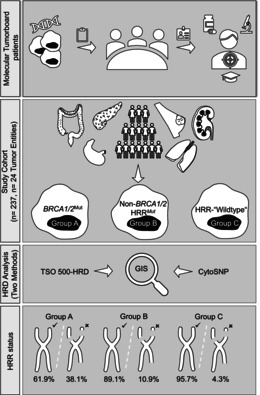 Figure 1
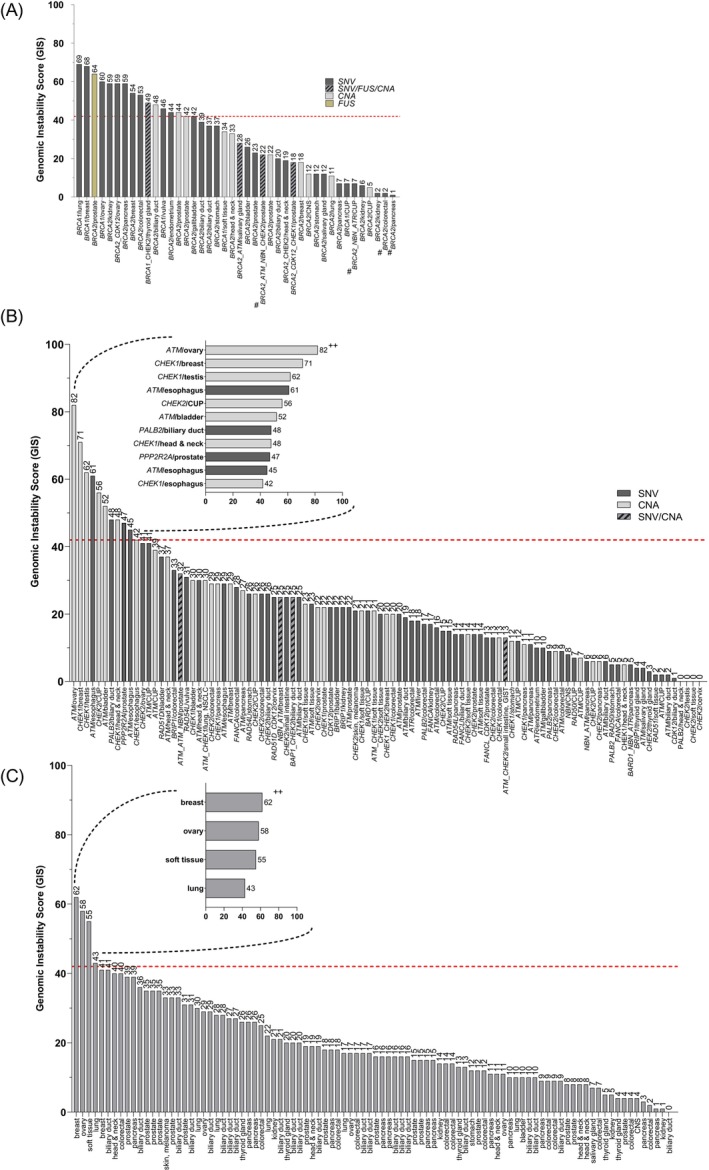 Figure 2
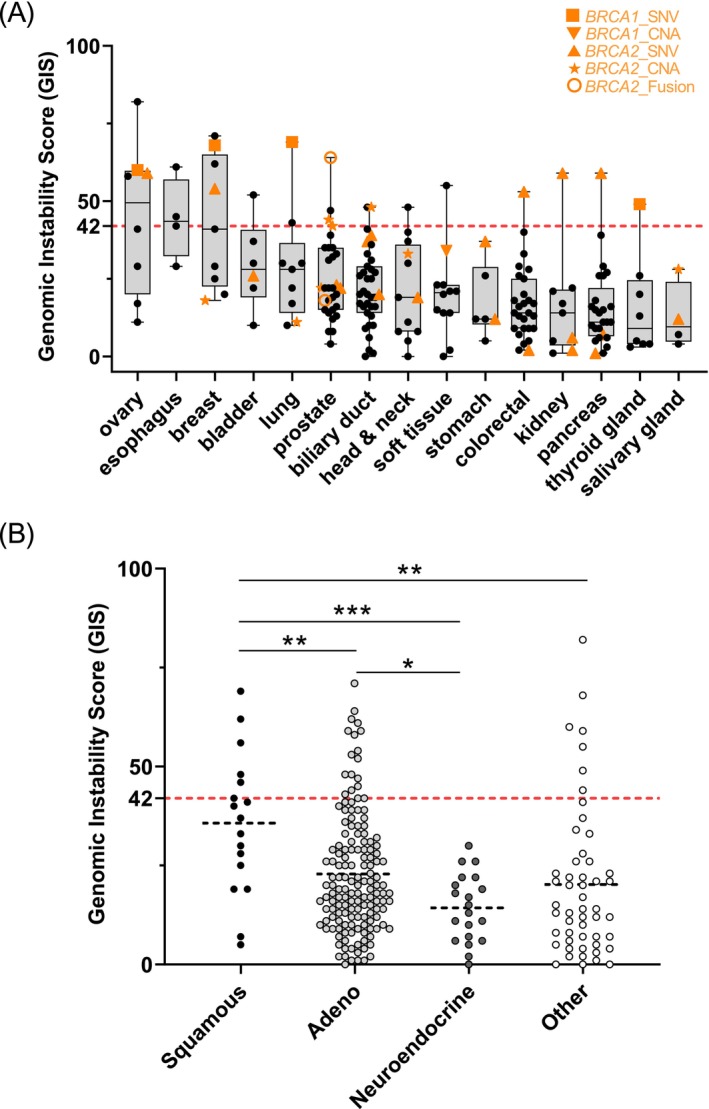 Figure 3
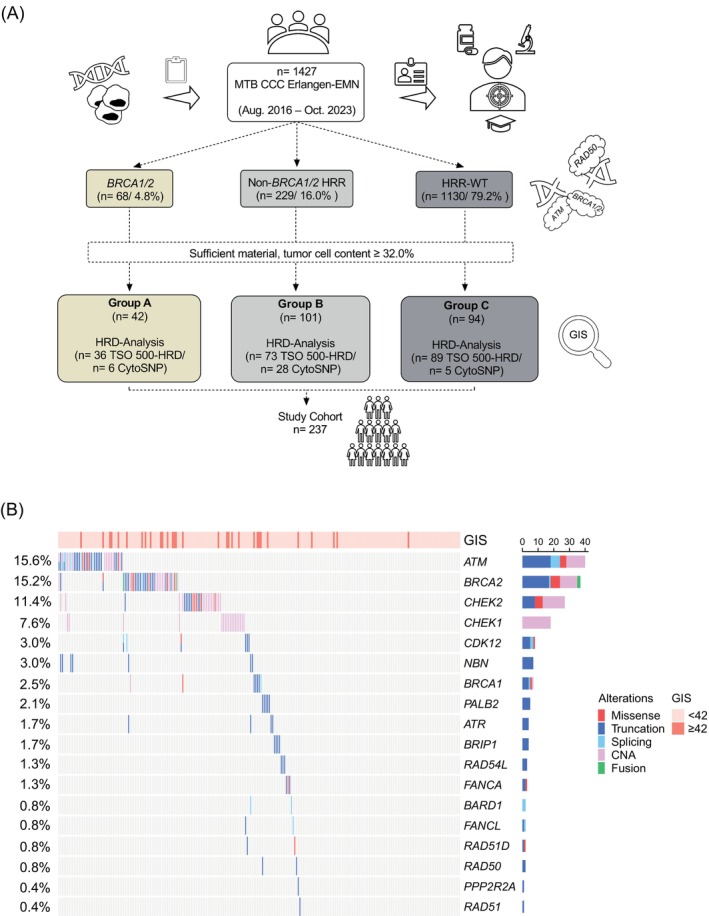 Figure 4
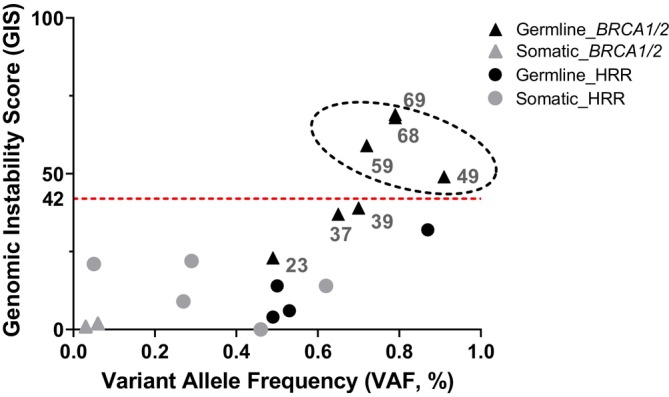 Figure 5
Peer Reviews
No public reviews on file for this paper yet. If you reviewed it on a platform where reviews are public (OpenReview, ICLR, NeurIPS, ICML), you can paste yours below so the community can read it here.
Videos
No videos yet. Explain this paper in a talk, walkthrough, or lecture? Add one.
Taxonomy
TopicsPARP inhibition in cancer therapy · DNA Repair Mechanisms · BRCA gene mutations in cancer