Progesterone Luteal Support in Natural Cycles for Unexplained Infertility: A Randomised Controlled Trial (The PiNC Trial)
Claudia Raperport, Elpiniki Chronopoulou, Aviva Petrie, Roy Homburg, Elizabeth Timlick, Sheetal Barhate, Kristina Sackett, Priya Bhide

TL;DR
This study tested if adding progesterone during the luteal phase in natural cycles improves live birth rates for couples with unexplained infertility.
Contribution
The study is the first to evaluate luteal-phase progesterone supplementation in natural cycles for unexplained infertility in a randomized controlled trial.
Findings
Livebirth rates were higher in the progesterone group (15.3%) compared to the control group (7.0%), though not statistically significant.
Progesterone treatment showed a trend toward lower total miscarriage rates, including biochemical losses.
The study highlights the potential of a simple, low-cost treatment for unexplained infertility that merits further investigation.
Abstract
To compare the effect of luteal‐phase progesterone supplementation in natural cycles to expectant management on live birth rates in women with unexplained infertility (UI). An open‐label, parallel‐arm, single‐centre randomised controlled trial. One tertiary NHS‐funded fertility unit. Couples with UI for at least 1 year. A comparison of luteal phase micronised vaginal progesterone treatment (400 mg bd) with timed intercourse and timed intercourse alone for 3 cycles. Primary outcome: Livebirth rate. Secondary Outcomes: Biochemical pregnancy, clinical pregnancy, mid‐luteal serum progesterone and pregnancy loss. One hundred and forty‐three couples were randomised. Livebirth rates were 11/72 (15.3%) in the treatment group versus 5/71 (7.0%) in the control group (RR 2.17, 95% CI 0.79–5.93). Biochemical pregnancy rates were 15/72 (20.8%) versus 10/71 (14.1%), (RR 1.48, 95% CI 0.72–3.07)…
Genes, proteins, chemicals, diseases, species, mutations and cell lines named across the full text — each resolved to its canonical identifier and authoritative record.
Click any figure to enlarge with its caption.
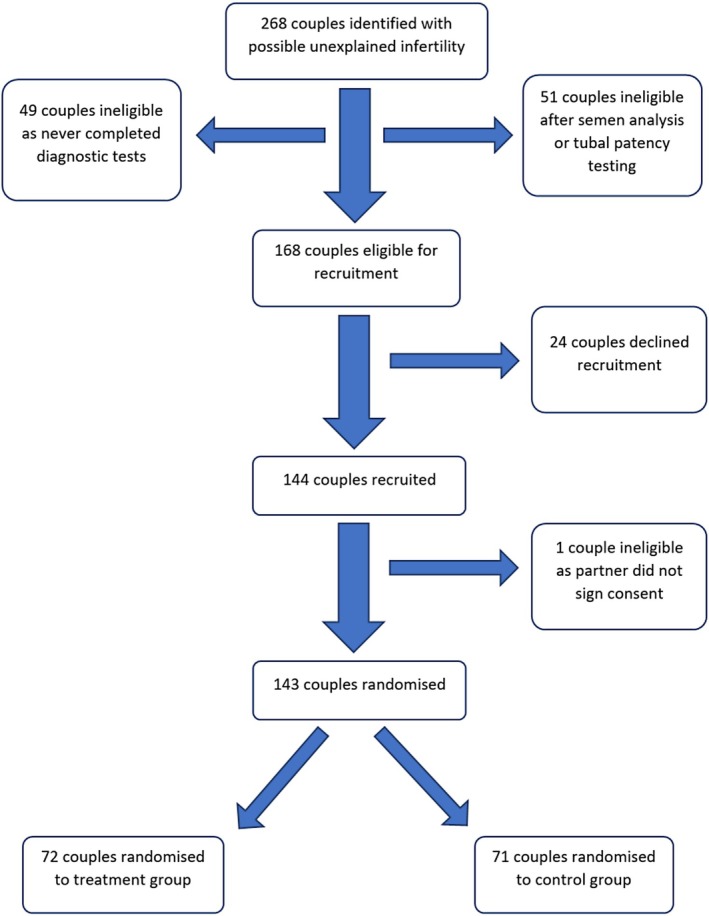 Figure 1
Peer Reviews
No public reviews on file for this paper yet. If you reviewed it on a platform where reviews are public (OpenReview, ICLR, NeurIPS, ICML), you can paste yours below so the community can read it here.
Videos
No videos yet. Explain this paper in a talk, walkthrough, or lecture? Add one.
Taxonomy
TopicsOvarian function and disorders · Assisted Reproductive Technology and Twin Pregnancy · Endometriosis Research and Treatment