Long‐term outcomes following alternative second‐line oral glucose‐lowering treatments: Results from the real‐world progression in type 2 diabetes mellitus United Kingdom (RAPIDS‐UK) model
Orlagh U. Carroll, Patrick Bidulka, Anirban Basu, Amanda I. Adler, Stephen O'Neill, Andrew H. Briggs, David G. Lugo‐Palacios, Kamlesh Khunti, Richard Grieve

TL;DR
This study compares long-term diabetes complications when using different second-line treatments, finding that SGLT2i drugs reduce risks more than other options.
Contribution
The study introduces a real-world microsimulation model to compare long-term outcomes of second-line diabetes treatments in routine clinical practice.
Findings
SGLT2i treatment reduces the predicted probability of end-stage kidney disease more than sulphonylureas and DPP4i.
SGLT2i also lowers the risk of heart failure hospitalization and diabetic eye disease compared to other treatments.
Lower-extremity amputation risks remain similar across all treatment types.
Abstract
To compare long‐term complications for people with type 2 diabetes mellitus (T2DM) following second‐line treatment in routine practice with sulphonylureas (SU), dipeptidyl peptidase‐4 inhibitors (DPP4i), or sodium‐glucose co‐transporter‐2 inhibitors (SGLT2i) added to metformin. We used the RAPIDS microsimulation model to predict diabetes complications over 5 years after second‐line treatment initiation. We combined information on ‘real‐world’ treatment duration in England from the Clinical Practice Research Datalink with evidence on treatment effectiveness from Randomised Controlled Trials (RCTs). We estimated between‐treatment differences in the probabilities of end‐stage kidney disease (ESKD), heart failure hospitalisation (HF), diabetic eye disease, myocardial infarction (MI), and lower‐extremity amputation (LEA). The predicted probabilities of complications within 5 years were…
Genes, proteins, chemicals, diseases, species, mutations and cell lines named across the full text — each resolved to its canonical identifier and authoritative record.
Click any figure to enlarge with its caption.
 Figure 1
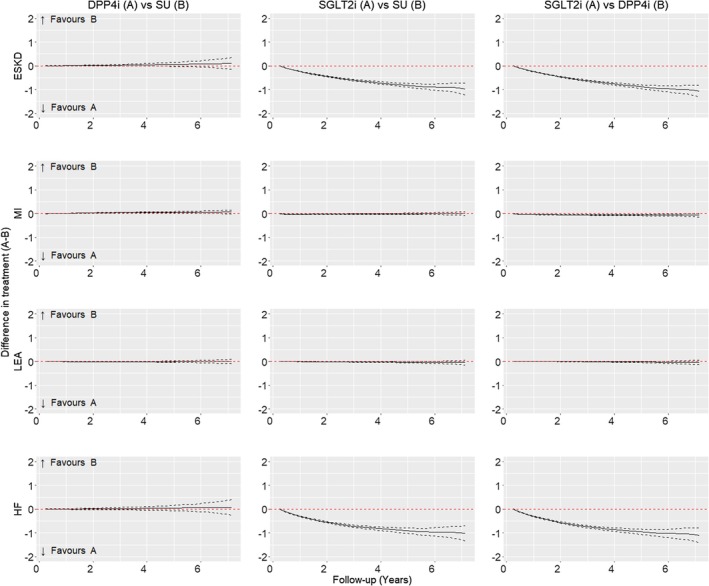 Figure 2
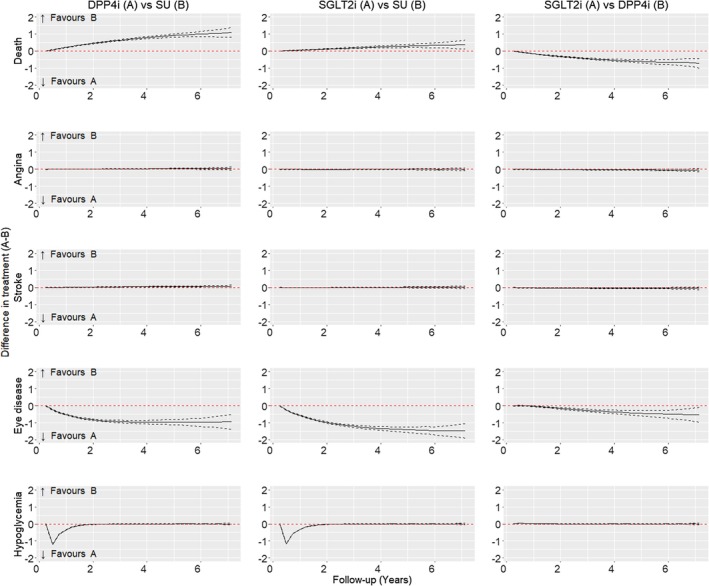 Figure 3
 Figure 4
Peer Reviews
No public reviews on file for this paper yet. If you reviewed it on a platform where reviews are public (OpenReview, ICLR, NeurIPS, ICML), you can paste yours below so the community can read it here.
Videos
No videos yet. Explain this paper in a talk, walkthrough, or lecture? Add one.
Taxonomy
TopicsDiabetes Treatment and Management · Diabetes Management and Research · Metabolism, Diabetes, and Cancer