Single-Layer and Stack Dielectric Elastomer Actuators Using Polysiloxanes Modified with Ethylsulfonyl Groups
Cansu Zeytun Karaman, Thulasinath Raman Venkatesan, Frank A. Nüesch, Dorina M. Opris

TL;DR
This paper introduces a new type of soft actuator material that requires lower voltage and performs better than existing options.
Contribution
A novel high-permittivity polysiloxane material with ethylsulfonyl groups is developed for efficient dielectric elastomer actuators.
Findings
The new material achieved a dielectric permittivity of 16.2 at 10 kHz and 25 °C.
It enabled a lateral actuation strain of 13% at a low electric field of 8.2 V μm–1.
A stack of five actuators showed stable performance over 4000 cycles at 1 Hz.
Abstract
Dielectric elastomer actuators (DEAs) are soft transducers well-suited to precise motion applications in robotics and prosthetics. However, low dielectric permittivity or very soft elastomers result in a high operating voltage or low force output. These issues can be mitigated using high dielectric permittivity elastomers in a stack actuator. To optimize electromechanical performance, we synthesized high-permittivity polysiloxanes with varying ratios of ethyl sulfonyl thioether and butane thioether groups. The best material exhibited a dielectric permittivity of 16.2 at 10 kHz and 25 °C, a low conductivity of 1.8 × 10⁻¹⁰ S cm–1, and a large lateral actuation strain of 13% at a low electric field of 8.2 V μm–1 (1 Hz, 900 V), whereas state-of-the-art nitrile- and methyl sulfonyl-functionalized polysiloxane required electric fields exceeding 20 V μm–1 for the same actuation. A stack of…
Genes, proteins, chemicals, diseases, species, mutations and cell lines named across the full text — each resolved to its canonical identifier and authoritative record.
Click any figure to enlarge with its caption.
 Figure 1
 Figure 2
 Figure 3
 Figure 4
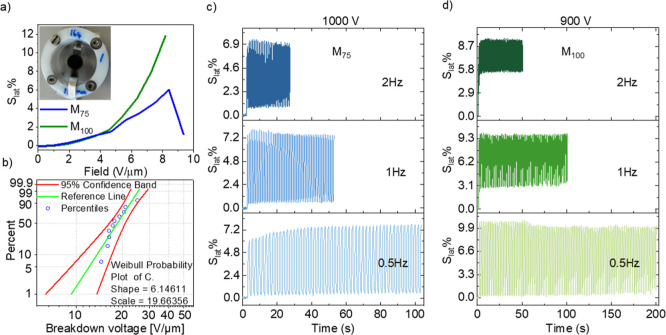 Figure 5
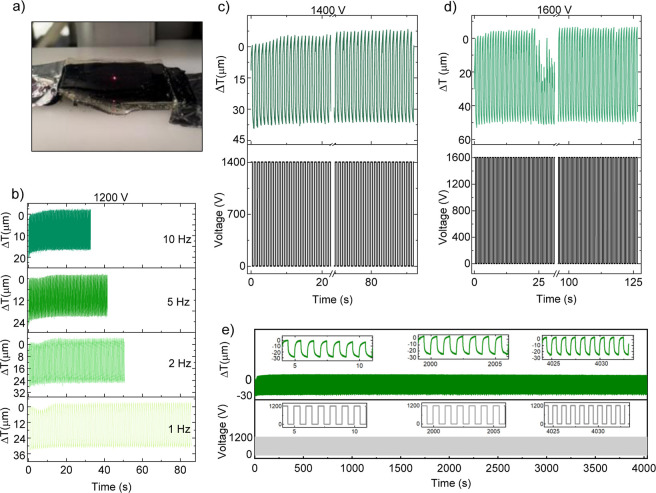 Figure 6
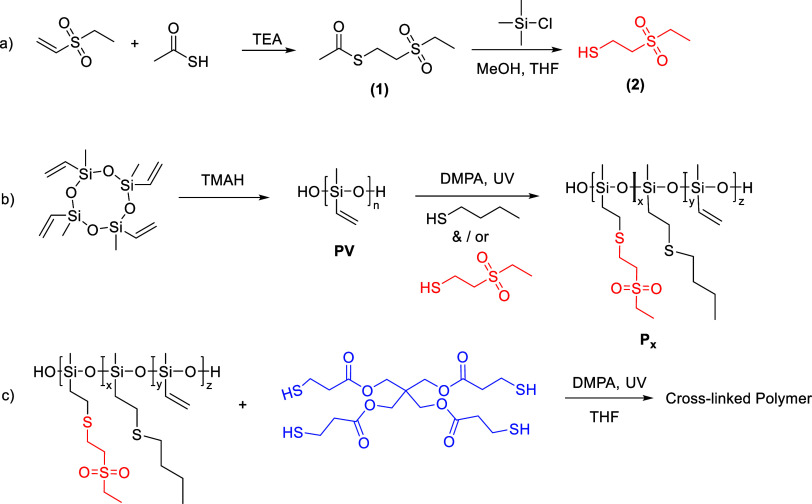 Figure 7
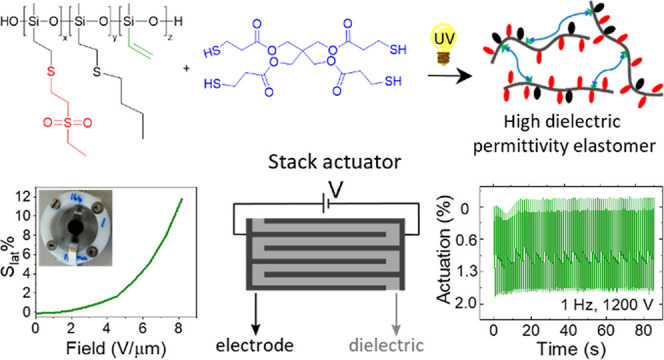 Figure 8
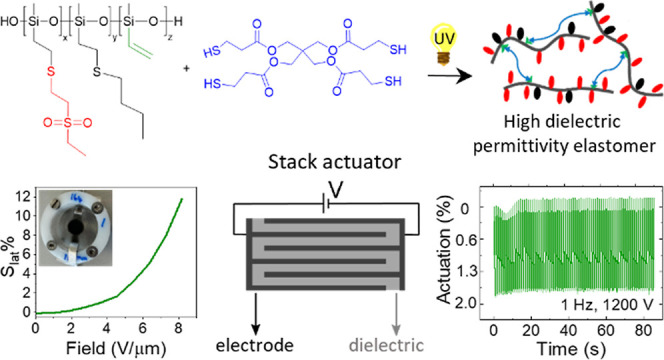 Figure 9
 Figure 10
Peer Reviews
No public reviews on file for this paper yet. If you reviewed it on a platform where reviews are public (OpenReview, ICLR, NeurIPS, ICML), you can paste yours below so the community can read it here.
Videos
No videos yet. Explain this paper in a talk, walkthrough, or lecture? Add one.
Taxonomy
TopicsDielectric materials and actuators · Advanced Sensor and Energy Harvesting Materials · Ferroelectric and Piezoelectric Materials