The evaluation of shotgun sequencing and rpoB metabarcoding for taxonomic profiling of bacterial communities
Karine Durand, Jean-Claude Ogier, Kiwoong Nam

TL;DR
This study compares shotgun sequencing and rpoB metabarcoding for analyzing bacterial communities, finding that shotgun sequencing offers better taxonomic resolution and more accurate abundance estimates.
Contribution
The study provides a direct comparison of shotgun sequencing and rpoB metabarcoding for microbial profiling, highlighting the advantages of shotgun sequencing in resolution and quantification.
Findings
Shotgun sequencing using the Assembly-Binning-Method achieved comparable sensitivity and higher precision than rpoB metabarcoding.
Shotgun sequencing provided better taxonomic resolution by identifying species-level taxa compared to genus-level identification with rpoB.
Shotgun sequencing outperformed rpoB metabarcoding in quantifying microbial abundance with higher correlation and lower dissimilarity.
Abstract
The importance of microbial community profiling has been increasingly recognized in biological and environmental research. While metabarcoding has been widely used for such analysis by targeting specific DNA sequences as markers, shotgun sequencing has been proposed as an alternative method because the analysis of whole genomes can potentially reduce biases introduced by targeted approaches. However, it is largely unknown whether shotgun sequencing may provide improved precision for qualitative taxonomic identification and quantitative abundance estimation compared with metabarcoding with housekeeping gene markers, such as the rpoB gene. Furthermore, the comparative performance of various bioinformatics pipelines for shotgun data analysis remains uncertain. In this study, we evaluated the performance of rpoB metabarcoding and shotgun sequencing coupled to various bioinformatic pipelines…
Genes, proteins, chemicals, diseases, species, mutations and cell lines named across the full text — each resolved to its canonical identifier and authoritative record.
Click any figure to enlarge with its caption.
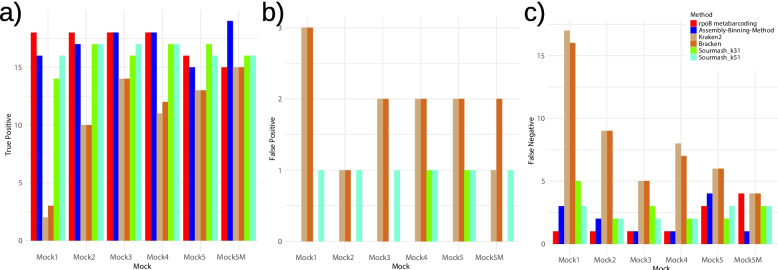 Figure 1
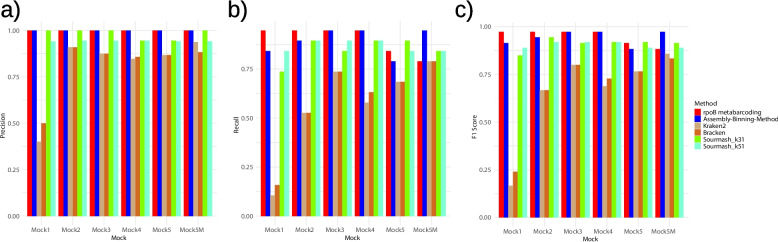 Figure 2
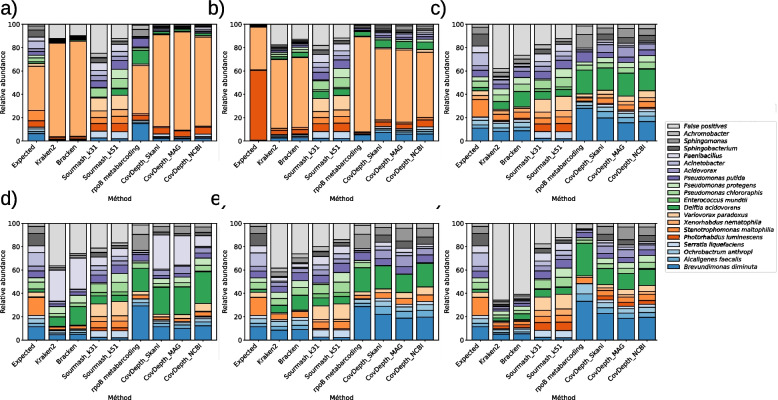 Figure 3
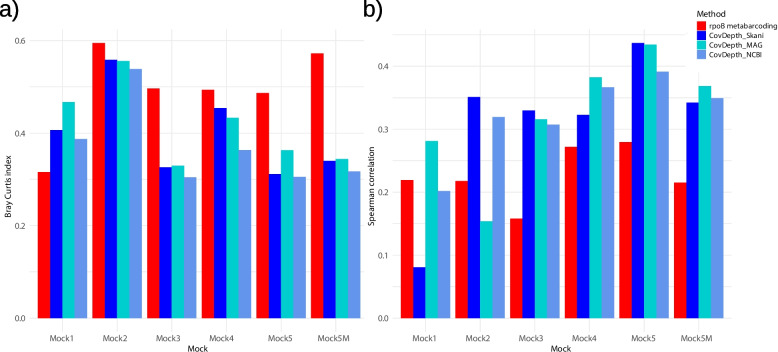 Figure 4
Peer Reviews
No public reviews on file for this paper yet. If you reviewed it on a platform where reviews are public (OpenReview, ICLR, NeurIPS, ICML), you can paste yours below so the community can read it here.
Videos
No videos yet. Explain this paper in a talk, walkthrough, or lecture? Add one.
Taxonomy
TopicsEnvironmental DNA in Biodiversity Studies · Microbial Community Ecology and Physiology · Genomics and Phylogenetic Studies