Joint association of polysocial risk score and lifestyle with incident essential hypertension: a prospective cohort study in the UK biobank
Yumei Zhao, Yingbai Wang, Zihan Xu, Jiaofeng Xiang, Chuxun Zhou, Xiaolin Li, Shicai Ye, Suru Yue, Xuefei Hou, Jia Wang, Jiayuan Wu

TL;DR
This study finds that both social vulnerability and unhealthy lifestyles increase the risk of developing essential hypertension, with the highest risk for those facing both.
Contribution
The study introduces a novel analysis of the joint and synergistic effects of social vulnerability and lifestyle on hypertension risk.
Findings
High polysocial risk scores (PsRS) are linked to a 15% increased risk of essential hypertension.
Unfavorable lifestyle scores are associated with a 23% reduced risk of hypertension compared to the worst lifestyle.
The combination of high PsRS and poor lifestyle leads to a 47% higher risk of hypertension due to synergistic effects.
Abstract
The polysocial risk score (PsRS) estimates cumulative social vulnerability. While social factors and lifestyles are linked to essential hypertension (EH), their combined effects are unclear. This study aims to explore the independent and joint associations of social vulnerability and lifestyle with EH in the UK Biobank Study. The study included 131,154 UK Biobank participants without EH at baseline. PsRS was calculated from 14 social determinants across three risk categories: socio-economic, psychological, and environmental factors, all significantly linked to EH development after Bonferroni adjustment. The healthy lifestyle score was based on smoking, alcohol, physical activity, diet, and sleep. The Cox proportional hazards model with HR and 95% CI analyzed PsRS and lifestyle effects on EH incidence, and interactions between PsRS and lifestyle score were assessed additively and…
Genes, proteins, chemicals, diseases, species, mutations and cell lines named across the full text — each resolved to its canonical identifier and authoritative record.
Click any figure to enlarge with its caption.
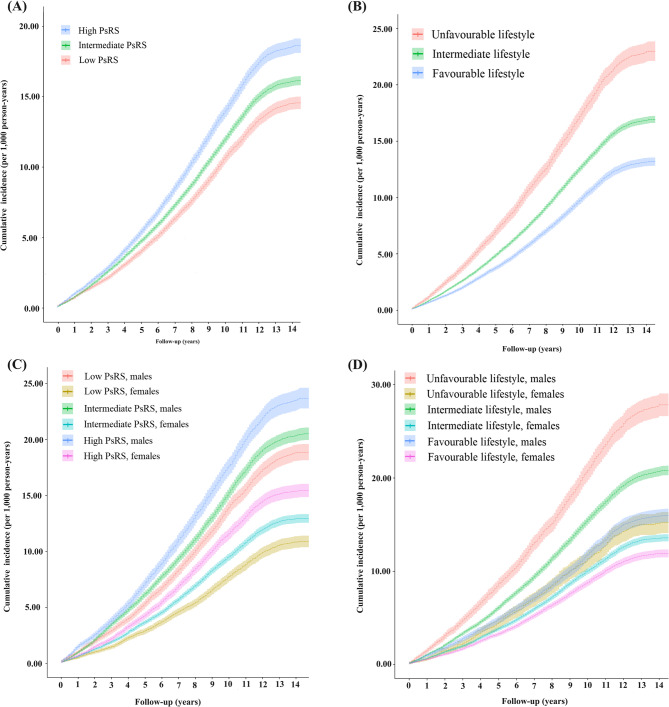 Figure 1
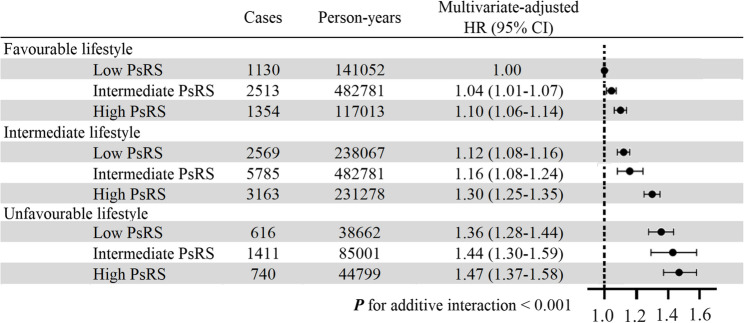 Figure 2
Peer Reviews
No public reviews on file for this paper yet. If you reviewed it on a platform where reviews are public (OpenReview, ICLR, NeurIPS, ICML), you can paste yours below so the community can read it here.
Videos
No videos yet. Explain this paper in a talk, walkthrough, or lecture? Add one.
Taxonomy
TopicsHealth Promotion and Cardiovascular Prevention · Health disparities and outcomes · Climate Change and Health Impacts