Cold-raising unmasks sleep disruption in a Drosophila Alzheimer’s disease model
Ananya Nair, Allison J. Yearwood, Brandi N. Besednjak, Mikayla M. Cully, Reece Turner, Joseph L. Bedont

TL;DR
Raising fruit flies in cold temperatures reveals sleep problems in a model of Alzheimer's disease, offering a new way to study the link between sleep and the disease.
Contribution
Cold-raising reveals sleep deficits in a Drosophila Alzheimer's model, enabling new studies on sleep-AD interactions.
Findings
Cold-raising unmasks sleep duration deficits in a Drosophila Alzheimer's model.
Sleep fragmentation and latency are also increased in the cold-raised model.
The model can be used to study metabolic and proteostatic links between sleep and AD.
Abstract
Chronic sleep loss is a risk factor for Alzheimer's disease (AD), and reduced and fragmented sleep is increasingly appreciated as an early-onset diagnostic and potential therapeutic target for AD. However, robustly modeling AD-like sleep deficits in fruit flies has often been challenging. We report that cold-raising unmasks deficits in sleep duration, fragmentation, and latency in one such model pan-neuronally expressing a highly pathogenic AD-associated amyloid species. This sensitized model provides a promising platform for identifying potential metabolic, proteostatic, glymphatic, and other candidate mediators bidirectionally linking sleep and AD.
Genes, proteins, chemicals, diseases, species, mutations and cell lines named across the full text — each resolved to its canonical identifier and authoritative record.
Click any figure to enlarge with its caption.
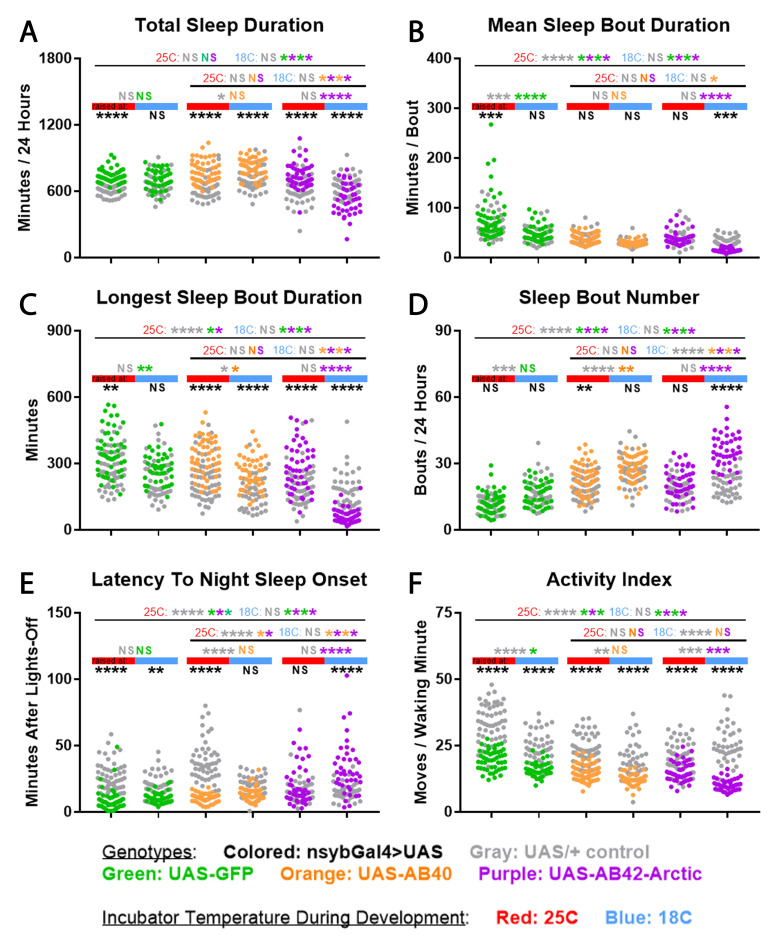 Figure 1
Peer Reviews
No public reviews on file for this paper yet. If you reviewed it on a platform where reviews are public (OpenReview, ICLR, NeurIPS, ICML), you can paste yours below so the community can read it here.
Videos
No videos yet. Explain this paper in a talk, walkthrough, or lecture? Add one.
Taxonomy
TopicsSleep and Work-Related Fatigue