Inpatient Outcomes of Tricuspid Transcatheter Edge-to-Edge Repair in the United States Based on Sex
Amanda Nguyen, Muhammad Zia Khan, Waleed Alruwaili, Sameh Nassar, Zahoor Khan, Price Thomas, Sherif Elhosseiny, Juan Siordia, Richard Kovach, Muhammad Raza

TL;DR
This study finds that female patients undergoing a specific heart repair procedure have better inpatient outcomes and lower mortality compared to male patients in the US.
Contribution
The study is one of the first to analyze national inpatient outcomes of tricuspid transcatheter edge-to-edge repair based on sex in the United States.
Findings
Female patients had lower inpatient mortality, major complications, and cost of stay compared to male patients after T-TEER.
Female patients were older but had fewer comorbidities than male patients undergoing the procedure.
After adjusting for variables, female sex remained independently associated with better outcomes.
Abstract
Tricuspid transcatheter edge-to-edge repair (T-TEER) has emerged as an effective and safe option for the repair of tricuspid regurgitation in select patients. Prior studies on invasive and percutaneous cardiac interventions have shown differential outcomes based on sex, but specific studies investigating T-TEER outcomes on a national level are limited. The National Inpatient Sample and International Classification of Diseases, Tenth Revision codes were used to identify patients who underwent T-TEER in the US from 2018 to 2021. The study group was then stratified based on sex. Study end points assessed included inpatient complications, outcomes, and resource utilization after T-TEER. A multivariable logistic regression model was used to assess the independent association of sex with study outcomes. A total of 1960 T-TEER procedures were identified, of which 1210 occurred in female…
Genes, proteins, chemicals, diseases, species, mutations and cell lines named across the full text — each resolved to its canonical identifier and authoritative record.
Click any figure to enlarge with its caption.
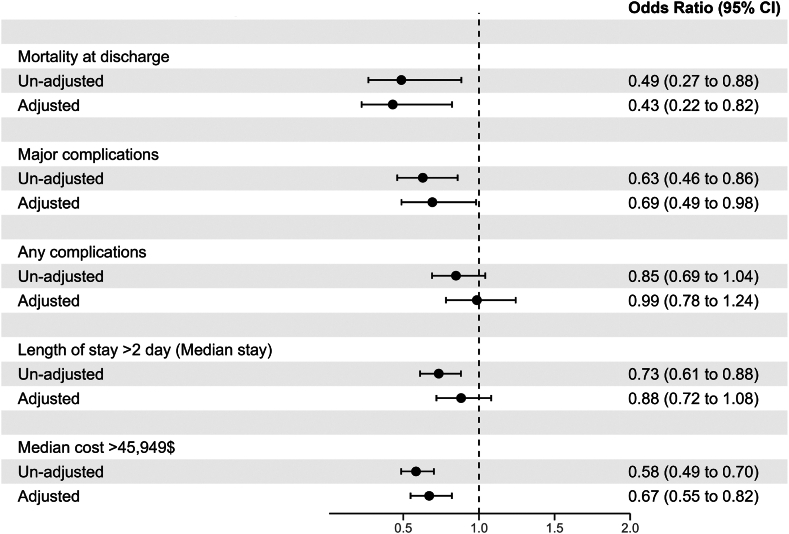 Figure 1
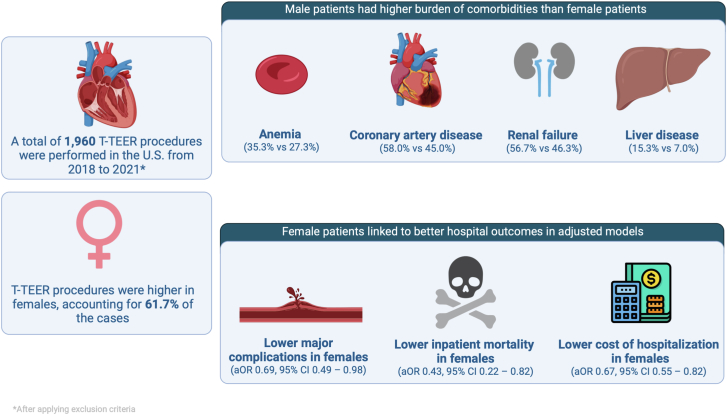 Figure 2
Peer Reviews
No public reviews on file for this paper yet. If you reviewed it on a platform where reviews are public (OpenReview, ICLR, NeurIPS, ICML), you can paste yours below so the community can read it here.
Videos
No videos yet. Explain this paper in a talk, walkthrough, or lecture? Add one.
Taxonomy
TopicsCardiac Valve Diseases and Treatments · Cardiovascular Function and Risk Factors · Coronary Interventions and Diagnostics