Part I: consensus statements and expert recommendations for HER2-negative early breast cancer in the Asia-Pacific region: diagnosis and risk assessment
Soo Chin Lee, Yeon Hee Park, Christian F. Singer, Judith Balmaña, Rebecca Alexandra Dent, Veronique Kiak-Mien Tan, Nadia Ayu Mulansari, Mastura Md Yusof, Frances Victoria F. Que, Yen-Shen Lu, Napa Parinyanitikul, Cam Phuong Pham, Nur Aishah Taib, Sun-Young Kong, Yoland Antill

TL;DR
This paper provides expert consensus on managing HER2-negative early breast cancer in the Asia-Pacific region, focusing on genetic counseling and testing practices.
Contribution
The study identifies gaps in genetic counseling and testing practices and proposes standardized recommendations for HER2-negative early breast cancer management.
Findings
Experts reached high consensus on pretest genetic counseling and optimal timing for genetic testing.
Significant gaps were found between recommended practices and real-world implementation in the region.
Genetic testing for BRCA variants is emphasized for triple-negative breast cancer patients regardless of age or family history.
Abstract
In the Asia-Pacific region, there is increasing contention on the practical challenges involved in managing human epidermal growth factor receptor 2 (HER2)-negative early breast cancer (eBC). This modified Delphi consensus explores gaps in genetic counselling (GC) and genetic testing (GT), and clinical risk assessment for HER2-negative eBC. An expert panel of 16 Asia-Pacific medical oncologists, geneticists, and breast cancer surgeons arrived at 33 statements. The level of statement consensus was considered high at ≥75%. A survey of 134 healthcare practitioners (HCPs) (breast cancer surgeons, geneticists, oncologists, molecular biologists/pathologists) explored the real-world practices in this region. A consensus was reached for 88% of the statements (29/33) and aligned with international guidelines. Experts reached 100% consensus on offering pretest GC, obtaining consent before GT,…
Genes, proteins, chemicals, diseases, species, mutations and cell lines named across the full text — each resolved to its canonical identifier and authoritative record.
Click any figure to enlarge with its caption.
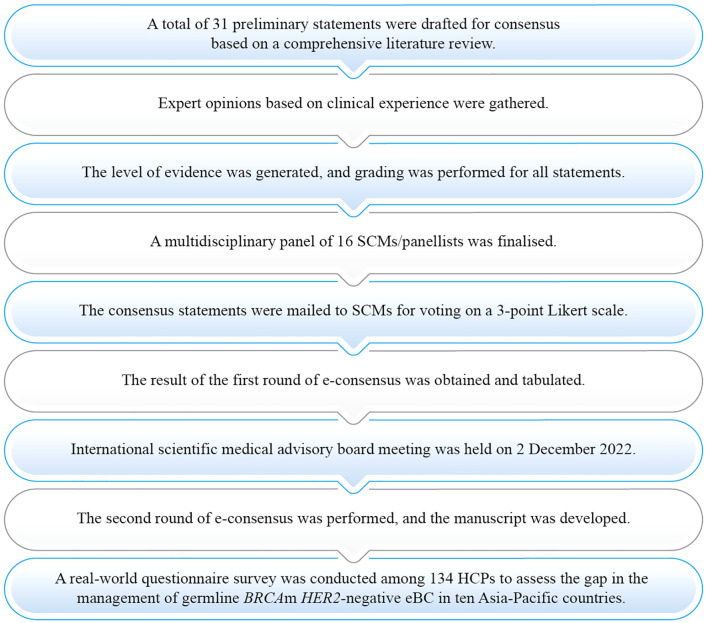 Figure 1
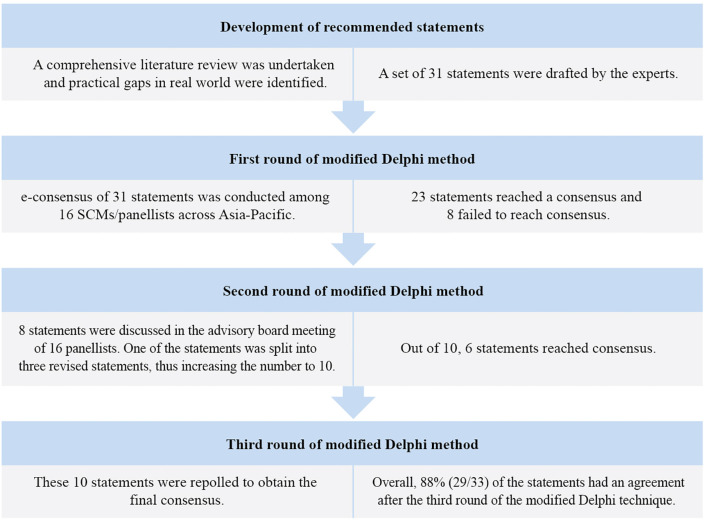 Figure 2
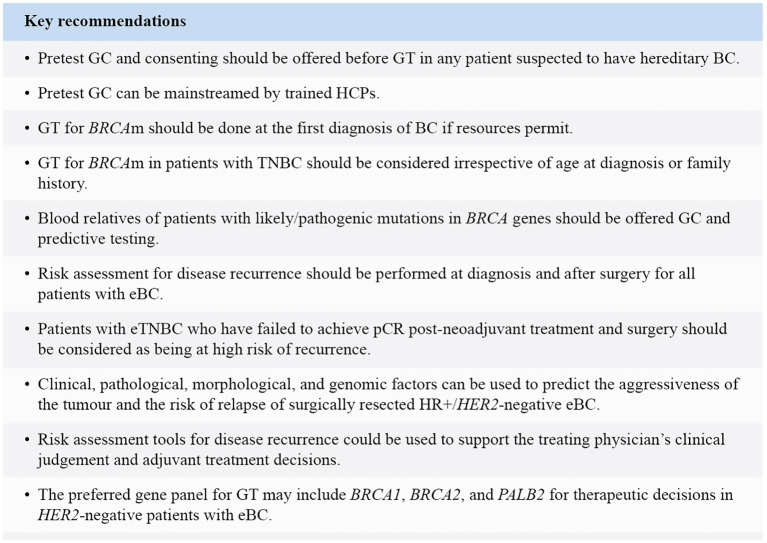 Figure 3
Peer Reviews
No public reviews on file for this paper yet. If you reviewed it on a platform where reviews are public (OpenReview, ICLR, NeurIPS, ICML), you can paste yours below so the community can read it here.
Videos
No videos yet. Explain this paper in a talk, walkthrough, or lecture? Add one.
Taxonomy
TopicsBreast Cancer Treatment Studies · HER2/EGFR in Cancer Research · Advanced Breast Cancer Therapies