Loss of Paired Weapons Leads to Larger Testes and a Lighter Load for Dispersal
James C. Boothroyd, Steve M. Smit, Niko S. Zlotnik, Christine W. Miller

TL;DR
Male cactus bugs that lose their leg weapons grow larger testes and may fly farther due to reduced weight.
Contribution
The study reveals a direct, quantity-specific trade-off between weapon loss and testes growth in cactus bugs.
Findings
Testes size increased by 9% with one lost hindleg and 20% with two lost hindlegs.
Males without weapons did not increase flight muscle investment but may disperse farther due to reduced weight.
Abstract
Reproduction is often costly for males, as it may require the growth of structural traits that aid in dispersal to find females, competition over mating opportunities, and ejaculate production. The growth of such traits can be energetically demanding, and these demands often arise concurrently during development. As such, these traits may be especially prone to resource allocation trade‐offs. Yet, such traits are rarely studied in tandem. We designed a study to improve understanding of investment dynamics in flight muscle, a dispersal trait; a sexually selected weapon used in mate competition; and testes used for sperm production. We used the leaf‐footed cactus bug, Narnia femorata (Hemiptera: Coreidae), a species where males use their hindleg as weapons to compete for matings. Males can naturally drop their limbs, and when hindlegs are lost during development, adult males do not grow…
Genes, proteins, chemicals, diseases, species, mutations and cell lines named across the full text — each resolved to its canonical identifier and authoritative record.
Click any figure to enlarge with its caption.
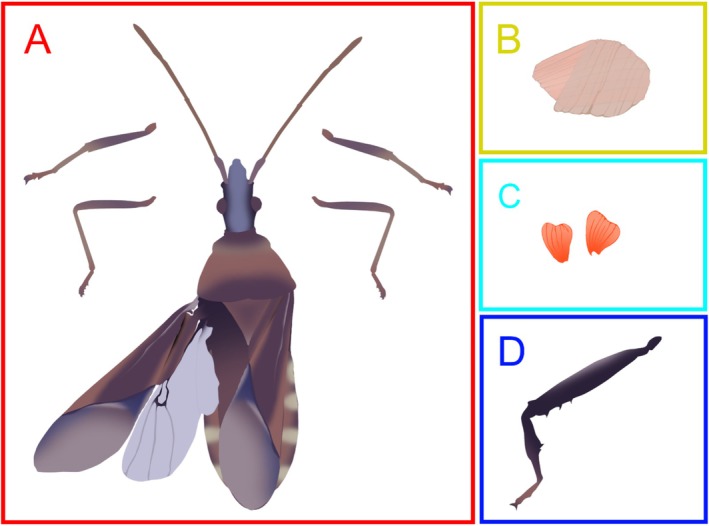 Figure 1
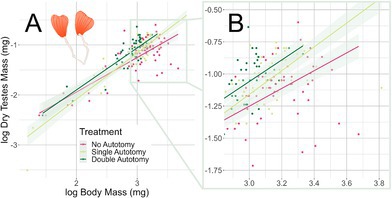 Figure 2
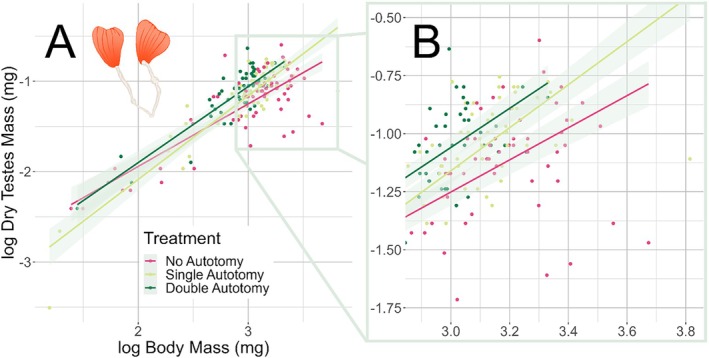 Figure 3
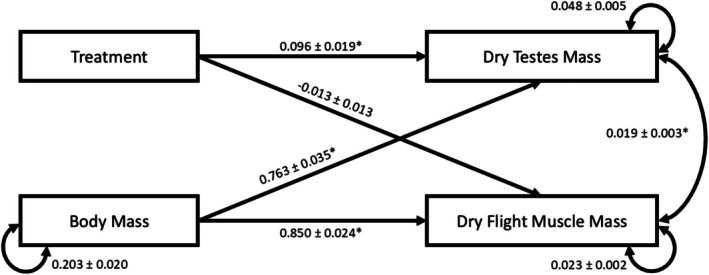 Figure 4
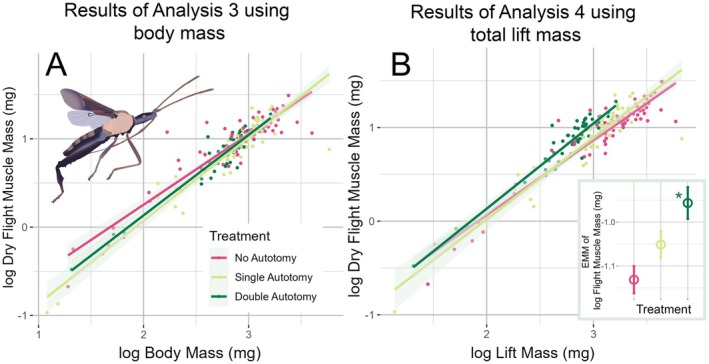 Figure 5
Peer Reviews
No public reviews on file for this paper yet. If you reviewed it on a platform where reviews are public (OpenReview, ICLR, NeurIPS, ICML), you can paste yours below so the community can read it here.
Videos
No videos yet. Explain this paper in a talk, walkthrough, or lecture? Add one.
Taxonomy
TopicsAnimal Behavior and Reproduction · Insect and Arachnid Ecology and Behavior · Plant and animal studies