Impact on the microstructure of deep gray matter in unvaccinated patients after moderate-to-severe COVID-19: insights from MRI T1 mapping
Masia Fahim, Elke Hattingen, Alina Jurcoane, Jan R. Schüre, Svenja Klinsing, Julia Koepsell, Kolja Jahnke, Michael W. Ronellenfitsch, Ulrich Pilatus, Maria J. G. T. Vehreschild, Ralf Deichmann, Christophe T. Arendt

TL;DR
The study found microstructural brain changes in unvaccinated individuals aged 40+ after moderate-to-severe COVID-19 using MRI T1 mapping.
Contribution
Identified specific deep gray matter T1 relaxation time changes in older unvaccinated post-COVID-19 patients.
Findings
Higher qT1 values in caudate, accumbens, putamen, and hippocampus in hospitalized ≥40-year-old COVID-19 patients.
No correlations found between qT1 changes and hospitalization duration or neurological test results.
Microstructural changes observed in striatal and hippocampal regions in post-COVID-19 individuals.
Abstract
To determine changes in quantitative T1 relaxation times (qT1) in deep gray matter in patients recovered from coronavirus disease 2019 (COVID-19). Unvaccinated COVID-19 participants ≥ 3 months after seropositivity and age- and sex-matched controls were examined using 3-T magnetic resonance imaging. Bilateral measures of thalamus, pallidum, putamen, caudate and accumbens nuclei, and hippocampus were extracted from qT1 maps after automated segmentation. Baseline characteristics and results of tests assessing neurological functions (standardized exam), ability to smell (4-Item Pocket Smell Test), depression (Beck Depression Inventory-II), sleepiness (Epworth Sleepiness Scale), sleep quality (Pittsburgh Sleep Quality Index), health-related quality of life (EQ-5D), and cognitive performance (Montreal Cognitive Assessment) were evaluated. One hundred forty-five subjects (median age, 46…
Genes, proteins, chemicals, diseases, species, mutations and cell lines named across the full text — each resolved to its canonical identifier and authoritative record.
Click any figure to enlarge with its caption.
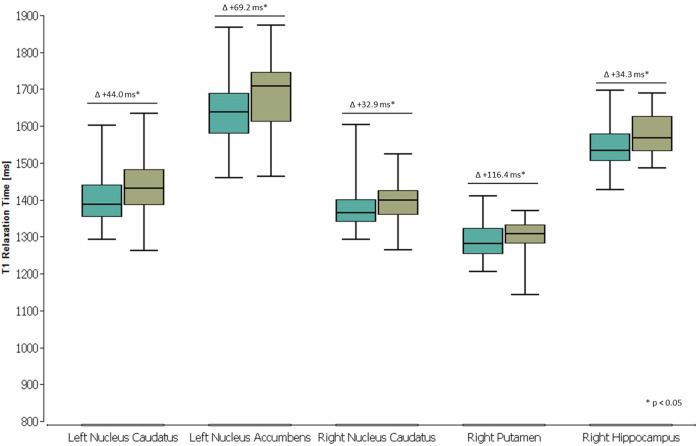 Figure 1
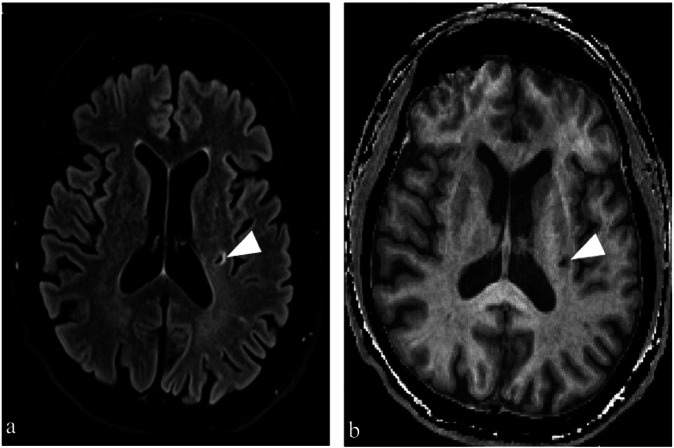 Figure 2
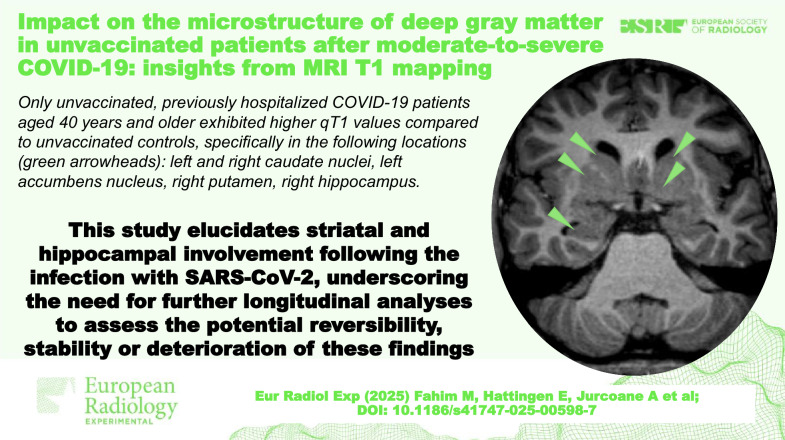 Figure 3
Peer Reviews
No public reviews on file for this paper yet. If you reviewed it on a platform where reviews are public (OpenReview, ICLR, NeurIPS, ICML), you can paste yours below so the community can read it here.
Videos
No videos yet. Explain this paper in a talk, walkthrough, or lecture? Add one.
Taxonomy
TopicsLong-Term Effects of COVID-19 · Infectious Encephalopathies and Encephalitis · Advanced Neuroimaging Techniques and Applications