Muscle inversion closure technique with novel clips minimizes submucosal dead space after colorectal endoscopic submucosal dissection
Taisuke Inada, Yorinobu Sumida, Tatsuya Matsumoto, Shin-ichiro Fukuda, Kosuke Maehara, Hirotada Akiho, Eikichi Ihara

Abstract
Genes, proteins, chemicals, diseases, species, mutations and cell lines named across the full text — each resolved to its canonical identifier and authoritative record.
Click any figure to enlarge with its caption.
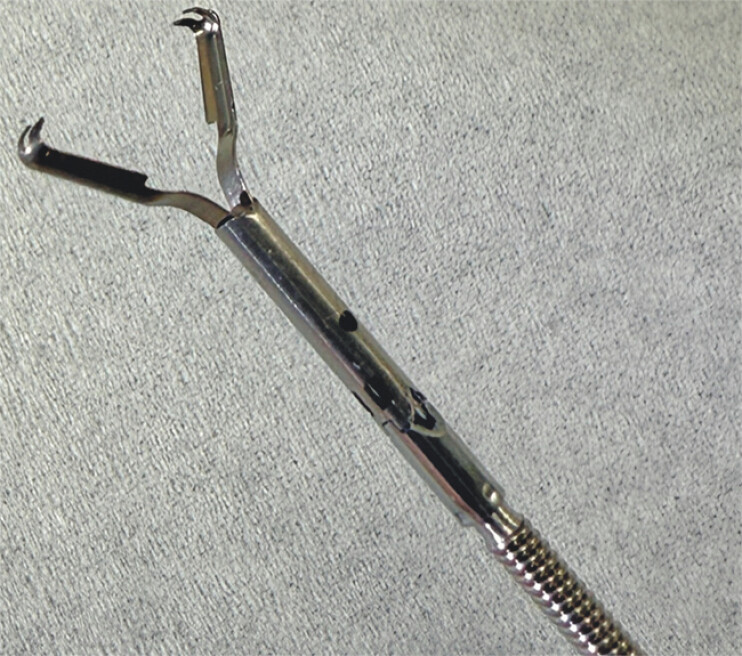 Fig. 1
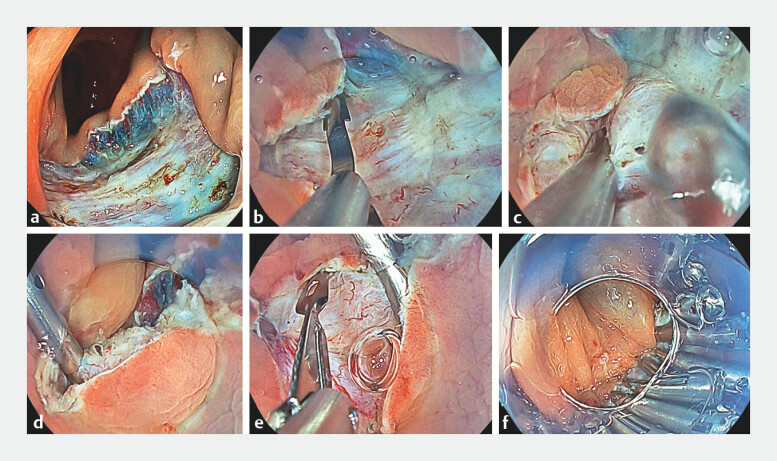 Fig. 2
Peer Reviews
No public reviews on file for this paper yet. If you reviewed it on a platform where reviews are public (OpenReview, ICLR, NeurIPS, ICML), you can paste yours below so the community can read it here.
Videos
No videos yet. Explain this paper in a talk, walkthrough, or lecture? Add one.
Taxonomy
TopicsGastric Cancer Management and Outcomes · Metastasis and carcinoma case studies · Esophageal and GI Pathology
Endoscopic submucosal dissection (ESD) of the colorectum is technically demanding, with postoperative complications such as delayed perforation and bleeding necessitating reliable closure of the resection site 1 . Although various closure methods have been developed 2 , many focus solely on approximating the mucosal layer, often resulting in submucosal dead space (SDS), which may increase the risk of adverse events.
We previously reported a novel gastric closure method using a specialized clip with sharp claws and a strong gripping force to directly approximate the muscle layer, effectively reducing SDS 3 ( Fig. 1 ). In the present case, we applied this approach to the colorectum ( Video 1 ).
A new clip with sharp claws and strong gripping force to close the muscle layer.
Muscle layer closure with novel clips minimizes SDS after colorectal ESD.Video 1
A 72-year-old man underwent ESD of a 35-mm rectosigmoid neoplasm ( Fig. 2 a ). The muscle layer at one edge of the wound was first hooked to the claw of the clip underwater and guided to the opposite muscle layer ( Fig. 2 b ). After confirming alignment, strong suction was used to pull the tissue into the hood, followed by clip deployment ( Fig. 2 c ). This maneuver inverted and securely approximated the muscle layers, thereby eliminating SDS ( Fig. 2 d ). Additional conventional clips were used to close residual gaps ( Fig. 2 e, f ). The procedure was completed in 19 min without complications, and the patient was discharged uneventfully.
a The rectal colon tumor was resected without intraoperative incidents. b, c, d The clip’s sharp claws firmly engaged the muscle layers on both edges of the wound, effectively securing the tissue in a single deployment. By repeating the same technique, the wound was closed with minimal submucosal dead space. e, f Additional regular clips were placed to close gaps between the previously positioned clips, ensuring complete fixation of the muscle layer.
Several reports have described double-layered closure techniques in which both the muscle and mucosal layers are approximated 4 5 . These techniques share conceptual similarities with our proposed approach. We acknowledge that our method was partially inspired by these prior techniques. However, unlike double-layered methods, our approach prioritizes the secure closure of the muscle layer alone, minimizing the need for additional mucosal closure. We are currently conducting a prospective observational study to assess the safety and efficacy of this technique.
Endoscopy_UCTN_Code_TTT_1AQ_2AK
The reference list from the paper itself. Each links out to its DOI / PubMed record.
- 1Harada H Suehiro S Murakami D Clinical impact of prophylactic clip closure of mucosal defects after colorectal endoscopic submucosal dissection Endosc Int Open 20175 E 1165 E 117110.1055/s-0043-11874329201999 PMC 5698008 · doi ↗ · pubmed ↗
- 2Nomura T Sugimoto S Temma T Suturing techniques with endoscopic clips and special devices after endoscopic resection Dig Endosc 20233528730135997063 10.1111/den.14427 · doi ↗ · pubmed ↗
- 3Inada T Sumida Y Homma H Novel clip method for endoscopic submucosal dissection defect closure reducing submucosal dead space in antithrombotic gastric patients Endoscopy 202456 E 45E 4610.1055/a-2223-447538232769 PMC 10794086 · doi ↗ · pubmed ↗
- 4Tanaka S Toyonaga T Obata D Endoscopic double-layered suturing: a novel technique for closure of large mucosal defects after endoscopic mucosal resection (EMR) or endoscopic submucosal dissection (ESD)Endoscopy 20124402 E 153E 15410.1055/a-2304-321922622717 · doi ↗ · pubmed ↗
- 5Masunaga T Kato M Sasaki M Modified double-layered suturing for a mucosal defect after colorectal endoscopic submucosal dissection (Origami method) (with video)Gastrointest Endosc 20239796296936642200 10.1016/j.gie.2023.01.005 · doi ↗ · pubmed ↗