On the move, direction matters: Polar localization of OsLsi1 for differential uptake of metalloids in rice
Munkhtsetseg Tsednee

Abstract
Genes, proteins, chemicals, diseases, species, mutations and cell lines named across the full text — each resolved to its canonical identifier and authoritative record.
Click any figure to enlarge with its caption.
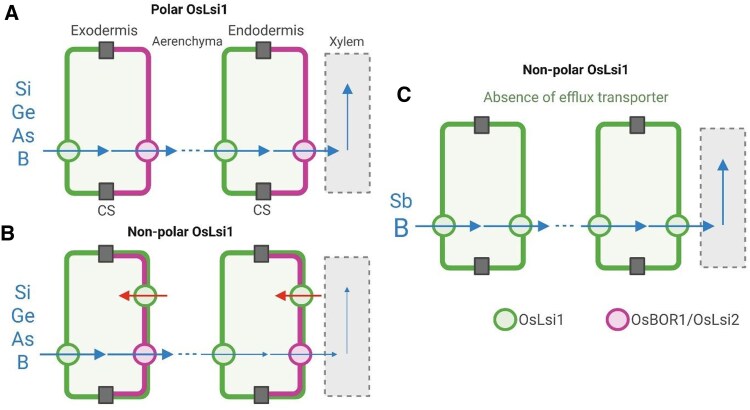 Figure 1
Peer Reviews
No public reviews on file for this paper yet. If you reviewed it on a platform where reviews are public (OpenReview, ICLR, NeurIPS, ICML), you can paste yours below so the community can read it here.
Videos
No videos yet. Explain this paper in a talk, walkthrough, or lecture? Add one.
Taxonomy
TopicsMagnetic and Electromagnetic Effects · Plant Micronutrient Interactions and Effects
Plants acquire mineral nutrients from soil via plasma membrane–localized transporters. Thereafter, transport occurs across sequential layers of cells, including the epidermis, exodermis, and endodermis, and engages both influx and efflux pathways (Huang et al. 2024). However, some transporters, such as the silicon (Si) transporter in rice (OsLsi1) and boron (B) transporters in Arabidopsis (AtNIP5;1 and AtBOR1), display polar localizations at either the distal or the proximal side of the specific cell layers (Yoshinari et al. 2016; Wang et al. 2017; Konishi et al. 2023). Although these gene products are well-known to facilitate metalloid transport, the impact of their polar localizations on the transport of different metalloids is unclear.
In this issue of Plant Physiology, Konishi et al. (2025) investigated the role of the polar localization of OsLsi1 transporter for multiple metalloid uptake and revealed its critical requirement in a coordinated and directional transport of metalloids. It is common for metalloid transporters to pass several different elements because of their similar chemical properties. For example, OsLsi1 transports germanic acid (Ge), arsenite (As), selenite (Se), antimonite (Sb), and boric acid in addition to silicic acid in the form of noncharged molecules at pH below 9.0 (Ma and Yamaji 2015). The iron transporter AtIRT1 also transports zinc, cadmium, manganese, and cobalt besides iron (Barberon et al. 2014).
Konishi et al. (2025) made use of rice lines that they previously generated with OsLsi1 expressed in different polar distributions (Konishi et al. 2023). They first observed a full recovery of the reduced accumulation of metalloids, including B, As, Ge, Sb, and Se, in lsi1-3 mutant shoots by the introduction of polar-localized OsLsi1. The nonpolar localized OsLsi1 resulted in varied accumulations of metalloids in shoots, with a decrease (for B, As, and Ge), an increase (for Sb), and no change (for Se). This observation suggested that the polar localization of OsLsi1 differentially affects the transport of different metalloids.
The authors focused on B and detected varying levels of B uptake in lines harboring nonpolar localized OsLsi1, depending on the B supply. As observed in the polarly localized OsLsi1 lines, rice maintains its internal B levels in response to fluctuations in external B. However, nonpolar localized OsLsi1 lines exhibited a loss of such internal B maintenance, showing reduced and increased B accumulations in shoots under low and high B, respectively. B transport activity was similar in both OsLsi1 variants (Konishi et al. 2025). Therefore, the authors proposed that the alternations in B uptake and accumulation in nonpolar localized OsLsi1 lines might have resulted from the contributions of the cooperating efflux transporter and their expression levels.
In rice roots, the OsBOR1 efflux transporter partners with OsLsi1 to mediate B transport toward central vasculature (Ma and Yamaji 2015). At the transcriptional level, neither OsLsi1 nor OsBOR1 genes respond to external B levels (Ma and Yamaji 2015). However, the OsBOR1 protein degrades in response to high B, while the OsLsi1 protein abundance remains unchanged under different B supplies (Ma and Yamaji 2015; Yoshinari et al. 2016).
In all OsLsi1 lines, the authors observed comparable mRNA accumulations for both OsLsi1 and OsBOR1 genes and similar protein abundance for OsLsi1 under low and high B. The OsBOR1 protein abundance decreased with increasing B supplies and was not detected in all lines under high B. As expected, the OsLsi1 showed polar distributions at the distal side of root exodermis and endodermis in polar localized OsLsi1 lines, but not in nonpolar localized OsLsi1 lines. The OsBOR1 was also located polarly at the proximal side of exodermis and endodermis in both OsLsi1 variants under low B. These results indicated that the loss of polar localization of OsLsi1 did not affect the OsBOR1 polar localization and its degradation under high B.
Since the B transport activity of OsLsi1 as well as the mRNA and protein abundances of 2 transporters remains similar between polar and nonpolar localized OsLsi1 lines, it is plausible that the presence or absence of OsBOR1 might itself have contributed to the altered B uptake and accumulation in nonpolar localized OsLsi1 variants. Moreover, OsLsi1 exhibits bidirectional transport activity for metalloids depending on their gradient concentrations (Mitani et al. 2008).
Polarly localized OsLsi1, at the distal side of the exodermis and endodermis, forms a directional transport pathway with efflux transporters (OsBOR1 for B and OsLsi2 for Si, Ge, and As) and facilitates the uptake of metalloids (Figure. A). However, when OsLsi1 loses its polar localization and locates also at the proximal side, it reimports the metalloids, transported by the efflux transporters to the apoplastic space, and thereby decreases the efficiency of the uptake (Figure. B). In the cases of Sb and high B, due to a lack of an efflux transporter or downregulation of OsBOR1, nonpolar localized OsLsi1 at the proximal side facilitates the flow of Sb and B toward the stele side, resulting in increased uptake of these metalloids (Figure. C).
In summary, Konishi et al. (2025) have revealed the critical role of the polar localization of OsLsi1 for the directional uptake of metalloids in rice, depending on the presence and absence of the cooperating efflux transporters. This finding highlights the importance of precise polar localization of the transporter for metalloid transport in plants.
The reference list from the paper itself. Each links out to its DOI / PubMed record.
- 1Barberon M, Dubeaux G, Kolb C, Isono E, Zelazny E, Vert G. Polarization of IRON-REGULATED TRANSPORTER 1 (IRT 1) to the plant-soil interface plays crucial role in metal homeostasis. Proc Natl Acad Sci U S A. 2014:111(22):8293–8298. 10.1073/pnas.140226211124843126 PMC 4050562 · doi ↗ · pubmed ↗
- 2Huang S, Yamaji N, Ma JF. Metal transport systems in plants. Annu Rev Plant Biol. 2024:75(1):1–25. 10.1146/annurev-arplant-062923-02142438382903 · doi ↗ · pubmed ↗
- 3Konishi M, Mitani-Ueno M, Ma J. Role of polar localization of the silicon transporter Os Lsi 1 in metalloid uptake by rice roots. Plant Physiol. 2025:198(1);kiaf 196. 10.1093/plphys/kiaf 19640341966 PMC 12089981 · doi ↗ · pubmed ↗
- 4Konishi N, Mitani-Ueno N, Yamaji N, Ma JF. Polar localization of a rice silicon transporter requires isoleucine at both C- and N-termini as well as positively charged residues. Plant Cell. 2023:35(6):2232–2250. 10.1093/plcell/koad 07336891818 PMC 10226592 · doi ↗ · pubmed ↗
- 5Ma JF, Yamaji N. A cooperative system of silicon transport in plants. Trends Plant Sci. 2015:20(7):435–442. 10.1016/j.tplants.2015.04.00725983205 · doi ↗ · pubmed ↗
- 6Mitani N, Yamaji N, Ma JF. Characterization of substrate specificity of a rice silicon transporter, Lsi 1. Pflugers Arch. 2008:456(4):679–686. 10.1007/s 00424-007-0408-y 18214526 · doi ↗ · pubmed ↗
- 7Wang SL, Yoshinari A, Shimada T, Hara-Nishimura I, Mitani-Ueno N, Ma JF, Naito S, Takano J. Polar localization of the NIP 5;1 boric acid channel is maintained by endocytosis and facilitates boron transport in arabidopsis roots. Plant Cell. 2017:29(4):824–842. 10.1105/tpc.16.0082528341806 PMC 5435427 · doi ↗ · pubmed ↗
- 8Yoshinari A, Fujimoto M, Ueda T, Inada N, Naito S, Takano J. DRP 1-Dependent endocytosis is essential for polar localization and boron-induced degradation of the borate transporter BOR 1 in. Plant Cell Physiol. 2016:57(9):1985–2000. 10.1093/pcp/pcw 12127449211 · doi ↗ · pubmed ↗