Divide and survive: PuZFP1 coordinates dual root developmental pathways for drought adaptation in Populus
Héctor H Torres-Martínez

Abstract
Genes, proteins, chemicals, diseases, species, mutations and cell lines named across the full text — each resolved to its canonical identifier and authoritative record.
Click any figure to enlarge with its caption.
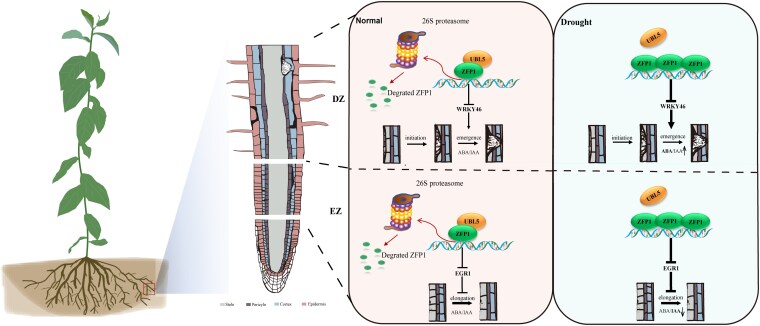 Figure 1
Peer Reviews
No public reviews on file for this paper yet. If you reviewed it on a platform where reviews are public (OpenReview, ICLR, NeurIPS, ICML), you can paste yours below so the community can read it here.
Videos
No videos yet. Explain this paper in a talk, walkthrough, or lecture? Add one.
Taxonomy
TopicsPlant nutrient uptake and metabolism · Bioenergy crop production and management · Plant Molecular Biology Research
Composition of root systems may vary in a species- and environmental context–dependent manner (Ramachandran et al. 2025). Root system architecture (RSA) is shaped throughout a plant's life in response to environmental cues, resulting in a broad diversity of adaptation mechanisms (Viana et al. 2022). Populus species trees develop root systems composed of primary, lateral, and adventitious roots. While much is known about how RSA adapts to external signals in model species like Arabidopsis thaliana, the mechanisms used by trees remain less explored.
Despite the economic significance of Populus species, relatively few studies have addressed their intrinsic stress resilience mechanisms. However, evidence does suggest links between RSA and stress resistance. For instance, a basic leucine zipper transcription factor (ZIP1-like) promotes lateral root formation under high osmotic stress (Dash et al. 2017), while MYELOBLASTOSIS ONCOGENE HOMOLOG 40 (MYB40) and WRKY DNA-BINDING PROTEIN 75 (WRKY75) transcriton factors regulate adventitious root development under low phosphorus conditions (Wang et al. 2022). Nonetheless, the regulatory networks orchestrating lateral and adventitious root development in Populus under abiotic stress remain largely unknown.
Cys2/His2 (C2H2)-type zinc finger proteins (ZFPs), a family of transcription factors, have been widely implicated in regulating root development and stress responses (Han et al. 2020a). In A. thaliana, the transcriptional repressors ARABIDOPSIS ZINC FINGER PROTEIN 2 (AZF2) and SALT TOLERANCE ZINC FINGER PROTEIN (STZ) are expressed predominantly in roots under normal conditions, but their expression is strongly induced by salt, dehydration, and abscisic acid (ABA) treatments. Notably, overexpression of STZ leads to inhibited plant growth but increased drought tolerance (Sakamoto et al. 2004). Similarly, inducible overexpression of AZF1 and AZF2 downregulates ABA- and osmotic stress–responsive genes, severely limiting plant growth (Kodaira et al. 2011). AtZP1, another A. thaliana C2H2-type ZFP, is highly expressed in root hairs and negatively regulates basic helix-loop-helix (bHLH) transcription factors involved in root hair initiation and elongation (Han et al. 2020b). Furthermore, expression of IbZFP1 from drought-tolerant sweet potato in A. thaliana improves salt and drought tolerance, with transgenic plants exhibiting enhanced root growth under stress conditions (Wang et al. 2016). Whether C2H2-type ZFPs play a role in shaping RSA to enhance stress tolerance in Populus species has not been addressed until now.
In this issue of Plant Physiology, Zhao et al. (2025) reveal that PuZFP1, a C2H2-type ZFP from Populus ussuriensis, regulates both lateral and adventitious root development under drought conditions, thus shaping an adaptive RSA (Figure).
Real-time quantitative PCR (RT-qPCR) showed that PuZFP1 is upregulated in roots upon drought and ABA treatment. PuZFP1 promoter-GUS fusion assays confirmed expression in the differentiation zone, and a PuZFP1-GFP translational fusion revealed nuclear and cytoplasmic localization. Transactivation assays using the GAL4-GUS/LUC system demonstrated that PuZFP1 acts as a transcriptional repressor, and mutations in its conserved EAR repression motif abolished this activity.
Functional analyses of transgenic lines revealed the impact of PuZFP1 on root architecture. Under drought, PuZFP1-overexpressing lines developed significantly longer adventitious roots but fewer lateral roots. In contrast, RNAi knockdown lines exhibited shorter adventitious roots and increased lateral root formation. Notably, PuZFP1-overexpressing plants appeared healthier under drought, whereas wild-type and RNAi lines showed signs of wilting, highlighting PuZFP1's role in drought adaptation.
Yeast 2-hybrid, bimolecular fluorescence complementation, and pull-down assays allowed to identify UBIQUITIN-LIKE PROTEIN 5 (PuUBL5) (Chen et al. 2020) as a direct interactor of PuZFP1. RT-qPCR indicated that PuUBL5 is highly expressed in roots under nonstressed conditions, but it declined during drought. Protein degradation assays demonstrated that PuUBL5 mediates PuZFP1 turnover via the 26S proteasome, an effect repressed by the proteasome inhibitor MG132. PuZFP1 degradation was accelerated in PuUBL5-overexpressing lines, and it was reduced in RNAi lines. Correspondingly, PuUBL5 overexpression increased lateral root formation, whereas RNAi lines showed enhanced adventitious root development, mirroring the opposite effects of PuZFP1.
Transcriptomic analysis of PuZFP1-RNAi lines roots, combined with DNA affinity purification sequencing, identified the transcription factors PuWRKY46 and PuEGR1 as direct targets of PuZFP1. Consistently, expression analysis of PuWRKY46 and PuEGR1 showed that these 2 genes are downregulated in the PuZFP1-overexpressing genotype and upregulated in PuZFP1-RNAi lines under drought conditions. The regulation of PuWRKY46 and PuEGR1 by PuZFP1 was further confirmed by transactivation assays in Nicotiana benthamiana leaves through luciferase activity. Overexpression of PuWRKY46 increased lateral root number, while RNAi lines showed fewer lateral roots. Conversely, PuEGR1 overexpression promoted longer adventitious roots, with RNAi lines showing the opposite effect.
Spatial expression analysis via RT-qPCR and anatomical observations showed PuWRKY46 is expressed in the differentiation zone, influencing lateral root primordia development, while PuEGR1 localizes to the elongation zone, where it regulates cell elongation. Indeed, PuEGR1-overexpressing plants exhibited shorter cells in this zone. Interestingly, hormone profiling revealed that in the differentiation zone of PuZFP1-overexpressing plants, ABA levels were elevated while indole-3-acetic acid (IAA) was reduced. The opposite pattern was seen in PuEGR1-RNAi lines. In the elongation zone, ABA was lower in PuZFP1-overexpressing plants whereas it was increased in *PuZFP1-*RNAi plants, with auxin level behaving in the opposite direction (Figure).
In summary, Zhao et al. (2025) uncover a sophisticated regulatory mechanism in which PuZFP1 acts as a drought-responsive transcriptional repressor, modulating distinct aspects of root system architecture through zone-specific gene regulation and hormone balance. PuZFP1 promotes adventitious root elongation while repressing lateral root initiation via PuEGR1 and PuWRKY46, respectively. The regulation of PuZFP1 by PuUBL5 adds another layer of control, linking environmental cues to proteasome-mediated protein turnover (Figure). This study offers critical insights into how trees adapt their RSA under stress, paving the way for genetic strategies to engineer drought-resilient root systems in woody species and beyond.
The reference list from the paper itself. Each links out to its DOI / PubMed record.
- 1Chen B, Lin L, Lu Y, Peng J, Zheng H, Yang Q, Rao S, Wu G, Li J, Chen Z, et al Ubiquitin-like protein 5 interacts with the silencing suppressor p 3 of rice stripe virus and mediates its degradation through the 26S proteasome pathway. PLOS Pathog. 2020:16(8):e 1008780. 10.1371/journal.ppat.100878032866188 PMC 7485977 · doi ↗ · pubmed ↗
- 2Dash M, Yordanov YS, Georgieva T, Tschaplinski TJ, Yordanova E, Busov V. Poplar Ptab ZIP 1-like enhances lateral root formation and biomass growth under drought stress. Plant J. 2017:89(4):692–705. 10.1111/tpj.1341327813246 · doi ↗ · pubmed ↗
- 3Han G, Lu C, Guo J, Qiao Z, Sui N, Qiu N, Wang B. C 2h 2 zinc finger proteins: master regulators of abiotic stress responses in plants. Front Plant Sci. 2020 a:11:115. 10.3389/fpls.2020.0011532153617 PMC 7044346 · doi ↗ · pubmed ↗
- 4Han G, Wei X, Dong X, Wang C, Sui N, Guo J, Yuan F, Gong Z, Li X, Zhang Y, et al Arabidopsis ZINC FINGER PROTEIN 1 acts downstream of GL 2 to repress root hair initiation and elongation by directly suppressing b HLH genes. Plant Cell. 2020 b:32(1):206–225. 10.1105/tpc.19.0022631732703 PMC 6961634 · doi ↗ · pubmed ↗
- 5Kodaira K-S, Qin F, Tran L-SP, Maruyama K, Kidokoro S, Fujita Y, Shinozaki K, Yamaguchi-Shinozaki K. Arabidopsis cys 2/his 2 zinc-finger proteins AZF 1 and AZF 2 negatively regulate abscisic acid-repressive and auxin-inducible genes under abiotic stress conditions. Plant Physiol. 2011:157(2):742–756. 10.1104/pp.111.18268321852415 PMC 3192566 · doi ↗ · pubmed ↗
- 6Ramachandran P, Ramirez A, Dinneny JR. Rooting for survival: how plants tackle a challenging environment through a diversity of root forms and functions. Plant Physiol. 2025:197(1):kiae 586. 10.1093/plphys/kiae 586PMC 1166357039657006 · doi ↗ · pubmed ↗
- 7Sakamoto H, Maruyama K, Sakuma Y, Meshi T, Iwabuchi M, Shinozaki K, Yamaguchi-Shinozaki K. Arabidopsis cys 2/his 2-type zinc-finger proteins function as transcription repressors under drought, cold, and high-salinity stress conditions. Plant Physiol. 2004:136(1):2734–2746. 10.1104/pp.104.04659915333755 PMC 523337 · doi ↗ · pubmed ↗
- 8Viana WG, Scharwies JD, Dinneny JR. Deconstructing the root system of grasses through an exploration of development, anatomy and function. Plant Cell Environ. 2022:45(3):602–619. 10.1111/pce.1427035092025 PMC 9303260 · doi ↗ · pubmed ↗