Popliteal Arteriovenous Fistula Diagnosed Eight Years after Total Knee Arthroplasty. Endovascular Treatment with Viabahn® Endoprosthesis and Five-Year Follow-Up
Francisco Santiago Lozano-Sánchez, Jesús García-Alonso, Roberto Salvador-Calvo, Luis Velasco-Pelayo, María Begoña García-Cenador

TL;DR
A woman developed a rare blood vessel abnormality in her knee eight years after surgery and was treated with a special stent, which remained effective for five years.
Contribution
This paper presents a rare case of a long-delayed arteriovenous fistula after knee surgery and its successful endovascular treatment.
Findings
A popliteal arteriovenous fistula was diagnosed eight years after total knee arthroplasty.
Endovascular treatment with a Viabahn® stent was effective and remained intact for five years.
Early detection of pseudoaneurysms and fistulas is emphasized for better outcomes.
Abstract
Background: Orthopedic surgery, while it rarely cause iatrogenic vascular lesions, leads to significant clinical, social, and economic consequences when it does. The knee is particularly susceptible to these injuries. Case Description: This case study presents the clinical case of a 71-year-old woman with a history of left total knee replacement. Eight years after the initial procedure, a popliteal—popliteal arteriovenous fistula was identified in the same knee. Given the location and caliber of the fistula, and despite the absence of symptoms, an endovascular prosthesis (Viabahn®) was deployed in the popliteal artery to cover the fistula. The prosthesis remained intact for the remainder of the patient’s life, who succumbed to metastatic cancer five years later. Additionally, a review of the literature was conducted. Conclusion: This brief report describes an exceptional case of…
Genes, proteins, chemicals, diseases, species, mutations and cell lines named across the full text — each resolved to its canonical identifier and authoritative record.
Click any figure to enlarge with its caption.
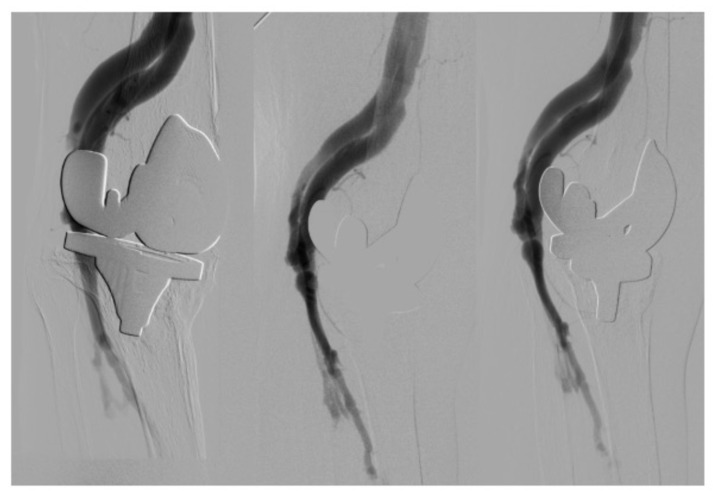 Figure 1
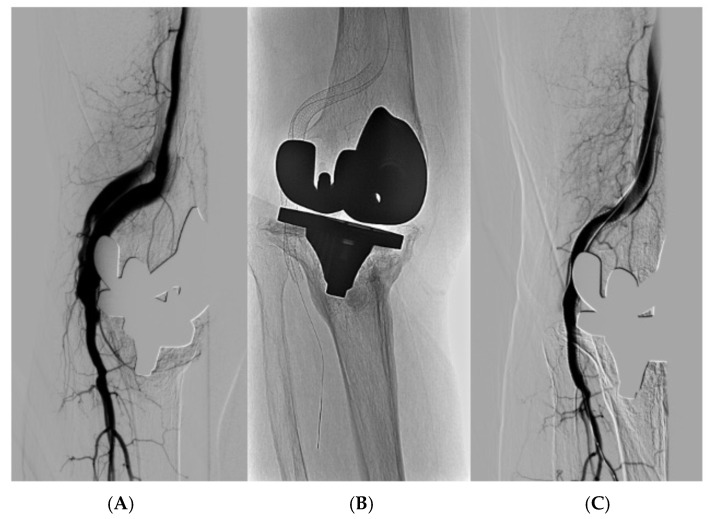 Figure 2
Peer Reviews
No public reviews on file for this paper yet. If you reviewed it on a platform where reviews are public (OpenReview, ICLR, NeurIPS, ICML), you can paste yours below so the community can read it here.
Videos
No videos yet. Explain this paper in a talk, walkthrough, or lecture? Add one.
Taxonomy
TopicsVascular Procedures and Complications · Total Knee Arthroplasty Outcomes · Venous Thromboembolism Diagnosis and Management
1. Introduction
Orthopedic surgery infrequently leads to iatrogenic vascular lesions, which have profound clinical, social, and economic impacts. The knee is the part of the anatomy that is most prone to damage [1,2].
At the beginning of this century, a literature review reported a rate of vascular complications of 0.03–0.2% following total knee arthroplasty (TKA) [3]. The same review also reported 40 acute limb ischemia, 10 pseudoaneurysms, 9 direct lesions, and 1 arteriovenous fistula [3].
More extensive and more recent data provide greater precision. Thus, out of 1,419,557 TKAs, there have been 54 cases of major vascular lesions per 100,000 procedures (0.05%), with 21% amputations or permanent neurological deficits [4]. A systematic review (and meta-analysis) reports 66 major vascular lesions following TKA between 1998 and 2018, where the popliteal artery is the one most affected (58 cases), with the most frequent kind of injury being a pseudoaneurysm (26 cases), followed by arterial thrombosis (19 cases), arterial section (eight cases) and arteriovenous fistula (five cases) [4].
The literature reveals that the average time between a TKA and the diagnosis of an iatrogenic vascular lesion ranges from immediately/hours for a hemorrhage, days for arterial thrombosis, and weeks/months for pseudoaneurysms and arteriovenous fistulas [5].
This research describes an exceptional case of popliteal arteriovenous fistula, diagnosed eight years after a TKA, treated endovascularly and followed up over five years.
2. Case Description
On 13 March 2013, a 71-year-old woman presented with edema in her right leg. Her medical record involved arterial hypertension, type 2 diabetes mellitus, and hypothyroidism. She had three normal births and one miscarriage, no toxic habits and no known allergies.
In 2005, TKA of the right leg. In 2006, pertrochanteric fracture of the right leg (gamma nail). In 2009, breast cancer (tumorectomy) with pulmonary metastasis (lobectomy). Subsequent radiotherapy.
The patient had been attending the doctor for a period of eight years, during which time she had undergone a number of check-ups in relation to her knee prosthesis. It was not until she noticed a “throbbing” sensation in her right knee that she sought further medical attention. This was identified by the doctor as a thrill, at which point the diagnosis and treatment of the fistula were carried out.
At the level of the right knee, a thrill (fremitus) is palpated and a systolic reinforcement murmur is heard. Normal popliteal pulse and weak pedial and posterior tibial pulses. Ankle-Brachial Index (ABI) = 0.70.
A physical examination finds a thrill (fremitus) and a murmur in the right knee. Palpable popliteal pulse, weak distal pulses. Iliotibial band (ITB) = 0.70. Normal lower left leg. The eco-Doppler reveals an arteriovenous fistula. An arteriography (Figure 1) confirms the presence of popliteal—popliteal arteriovenous fistula in the second portion, with a high flow.
Informed of the therapeutic options (open and endovascular surgery), the patient chose an endovascular treatment, which was performed on 3 May 2013, with the successful insertion of a Viabahn^®^ (WL Gore and Associates) (Figure 2).
The patient was released from hospital after four days, with no complications. In the first check-up (13 June 2013), there is no palpable thrill and no audible murmur; ITB, ABI, 0.93 > 1. In subsequent check-ups, the endoprosthesis remains permeable. The last check-up is held on 5 April 2018 (five years after the endoprosthesis), when the patient records pulmonary, bone and hepatic metastases.
3. Discussion
Traumatic arteriovenous fistulas are a rare complication of TKA, occurring less frequently than other injuries such as arterial lacerations, thrombosis, and pseudoaneurysms [3,4]. We have found only five cases [5,6,7].
The average age of these patients was 75 (ranging from 62 to 79), involving three women and two men. They were all diagnosed after the first 24 h of the postop period, with one patient even being diagnosed three years after the TKA for presenting a persistent oedema (similar to our case) [7]. The clinical situation in all of them was non-specific: pain (two cases), pulsatile mass (one case), weak pulse (one case), and oedema (one case).
Ultrasounds were useful only in one case, while the remaining four cases required arteriography. They were all treated. Three patients initially received endovascular treatment. In the end, three required an open surgery procedure, and one patient underwent an amputation, with an average follow-up time of seven months (ranging from 3 to 12 months).
Iatrogenic arteriovenous fistulas in the popliteal region have also been reported as a complication of a knee arthroscopy. A review (1985-2014) describes 62 vascular lesions following a knee arthroscopy, mainly after meniscectomies, where isolated arteriovenous fistulas (three cases) or those associated with pseudoaneurysm (eight cases) were also the rarest type of injury [8]. Out of the 11 cases, only 3 received endovascular treatment, with a highlights being the cases of the Spanish surgeon and radiologist, respectively, Taboada and Capel (2009) [9], who used a similar prosthesis to the one used in our study. They clearly explain the limitations of stents in this area of flexion (compression, bending, migration, breakage, intimal hyperplasia, thrombosis, etc.); nonetheless, they highlight the properties of the self-expanding endoprosthesis Viabahn^®^, which is more flexible and resistant to bending.
TKA and arthroscopy are procedures in which the instruments are routinely placed near the knee’s posterior capsule, and, therefore, very close to the vascular bundles. Orthopedic surgeons are well aware of this. While early kinds of lesions (thrombosis, hemorrhaging) are easier to detect sooner, the more delayed kinds (pseudoaneurysms and arteriovenous fistulas) also need to be considered for their early screening.
It is not possible to recommend systematic follow-up for this rare complication. However, given the high volume of this surgery (total knee arthroplasty), it is advisable to request bloodless studies (eco-Doppler) for monitoring in cases of clinical suspicion of this or other vascular complications (e.g., technical complexity, re-interventions, etc.).
4. Conclusions
This case uniquely highlights the successful long-term resolution of a rare and serious vascular complication following orthopedic knee surgery using endovascular treatment alone.
The reference list from the paper itself. Each links out to its DOI / PubMed record.
- 1Hans S.S. Shepard A.D. Reddy P. Rama K. Romano W. Iatrogenic arterial injuries of spine and orthopedic operations J. Vasc. Surg.20115340741310.1016/j.jvs.2010.08.08421055898 · doi ↗ · pubmed ↗
- 2Avisar E. Elvey M.H. Bar-Ziv Y. Tamir E. Agar G. Severe vascular complications and intervention following elective total hip and knee replacement: A 16-year retrospective analysis J. Orthop.20151215115510.1016/j.jor.2015.01.00826236119 PMC 4501517 · doi ↗ · pubmed ↗
- 3Langkamer V.G. Local vascular complications after knee replacement: A review with illustrative case reports Knee 2001825926410.1016/S 0968-0160(01)00103-X 11706687 · doi ↗ · pubmed ↗
- 4Sundaram K. Udo-Inyang I. Mont M.A. Molloy R. Higuera-Rueda C. Piuzzi N.S. Vascular Injuries in Total Knee Arthroplasty: A Systematic Review and Meta-Analysis JBJS Rev.20208 e 005110.2106/JBJS.RVW.19.0005132105241 · doi ↗ · pubmed ↗
- 5Pal A. Clarke J.M. Cameron A.E. Case series and literature review: Popliteal artery injury following total knee replacement Int. J. Surg.2010843043510.1016/j.ijsu.2010.04.00820452472 · doi ↗ · pubmed ↗
- 6Thomas R. Agarwal M. Lovell M. Welch M. An unusual presentation of a popliteal arteriovenous fistula after primary total knee arthroplasty J. Arthroplast.20082394594810.1016/j.arth.2007.06.01618534527 · doi ↗ · pubmed ↗
- 7Pydisetty R.V. Gillies R.M. Popliteal A-V Fistula with Pseudo-aneurysm: A Complication following Total Knee Arthroplasty Eur. J. Trauma Emerg. Surg.20083441441710.1007/s 00068-008-7119-826815820 · doi ↗ · pubmed ↗
- 8Neagoe R.M. Bancu S. Muresan M. Sala D. Major vascular injuries complicating knee arthroscopy Videosurgery Miniinvasive Tec.20151026627410.5114/wiitm.2015.5255926240627 PMC 4520854 · doi ↗ · pubmed ↗