Bullying and the Effectiveness of a Health Education Program Among Female Middle School Students in Riyadh, Saudi Arabia: An Application of Social Cognitive Theory
Amani A Alghamdi, Khlood H Almutairi, Nada A Bin Ateeq, Sara A Alsuhaibani

TL;DR
This study examines bullying among female middle school students in Saudi Arabia and evaluates a health education program's impact on changing bullying attitudes using social cognitive theory.
Contribution
The study applies social cognitive theory to assess the effectiveness of a health education program in reducing bullying attitudes among female students in Saudi Arabia.
Findings
97.7% of students did not consider themselves bullies, and 70.7% had a neutral attitude toward bullying.
The health education program significantly improved students' attitudes toward bullying (p=0.000).
Bullying was significantly associated with attitude (p=0.000) but not with the social environment.
Abstract
Bullying is a significant issue that poses various health concerns, particularly in school environments. The study aimed to determine bullying practices and assess the health education program's effectiveness in changing bullying attitudes among female middle school students using the social cognitive theory (SCT). An interventional one-group pretest/post-test design study was conducted among 304 female middle school students in Riyadh. The primary outcome was the change in students’ attitudes toward bullying after the intervention. This study revealed that 97.7% (n=297) of the students did not consider themselves bullies, and 70.7% (n=215) had a neutral attitude toward bullying. Regarding the SCT conceptual elements, a relationship was found between bullying and bullying's attitude (p = 0.000); there was also a significant association between bullying and the social environment (p =…
Genes, proteins, chemicals, diseases, species, mutations and cell lines named across the full text — each resolved to its canonical identifier and authoritative record.
Click any figure to enlarge with its caption.
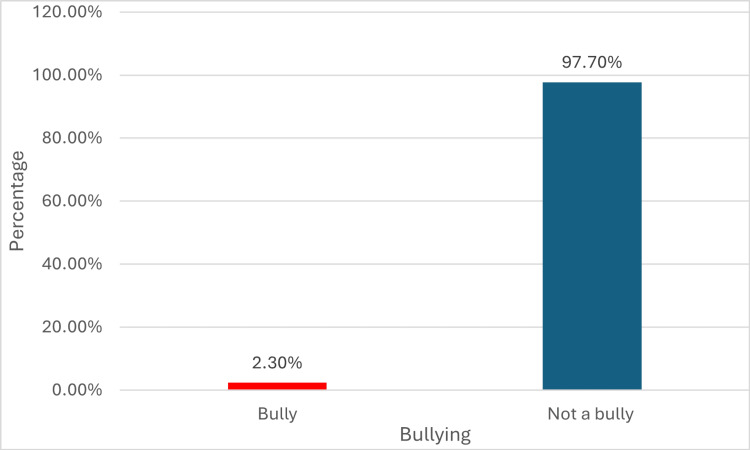 Figure 1
| Variable | Categories | n | (%) |
| School type | |||
| Public | 238 | 78.3 | |
| Private | 66 | 21.7 | |
| Educational level | |||
| First level | 75 | 33.5 | |
| Second level | 74 | 33 | |
| Third level | 75 | 33.5 | |
| Previous semester grade | |||
| Pass | 7 | 3 | |
| Good | 19 | 8.2 | |
| Very good | 82 | 35.2 | |
| Excellent | 125 | 53.6 | |
| Mother’s educational level | |||
| Not educated | 10 | 3.4 | |
| Primary school | 25 | 8.5 | |
| Middle school | 32 | 10.9 | |
| High school | 81 | 27.6 | |
| Bachelor's degree | 99 | 33.7 | |
| Higher than bachelor’s degree | 47 | 16 | |
| Father’s educational level | |||
| Not educated | 4 | 1.4 | |
| Primary school | 13 | 4.5 | |
| Middle school | 26 | 9 | |
| High school | 92 | 31.7 | |
| Bachelor's degree | 73 | 25.2 | |
| Higher than bachelor degree | 82 | 28.3 | |
| Siblings (brothers) | |||
| Has no brothers | 25 | 8.2 | |
| One brother | 65 | 21.4 | |
| Two brothers | 93 | 30.6 | |
| Three brothers | 63 | 20.7 | |
| Four brothers | 22 | 7.2 | |
| Five brothers | 20 | 6.6 | |
| Six brothers or more | 16 | 5.3 | |
| Siblings (sisters) | |||
| Has no sisters | 35 | 11.5 | |
| One sister | 62 | 20.4 | |
| Two sisters | 70 | 23 | |
| Three sisters | 64 | 21.1 | |
| Four sisters | 40 | 13.2 | |
| Five sisters | 18 | 5.9 | |
| Six sisters or more | 15 | 4.9 | |
| Birth order | |||
| First | 85 | 28.1 | |
| Second | 73 | 24.2 | |
| Third | 50 | 16.6 | |
| Fourth | 26 | 8.6 | |
| Fifth | 31 | 10.3 | |
| Six | 11 | 3.6 | |
| Seventh or more | 26 | 8.6 | |
| Parents’ status | |||
| Living together at home | 278 | 92.4 | |
| Divorced | 13 | 4.3 | |
| Separated | 1 | 0.3 | |
| Widow | 5 | 1.7 | |
| Other | 4 | 1.3 | |
| Total | 304 | 100 | |
| Bullying practice | Social environment | Total | P-value by Fisher's exact test | |
| Good environment | Bad environment | |||
| Not bully | 188 | 3 | 191 | 0.000* |
| Bully | 2 | 3 | 5 | |
| Total | 190 | 6 | 196 | |
| Attitude toward bullying | Bullying practice | Total | P-value by chi-square test | |
| Bully | Not a bully | |||
| Negative | 2 | 64 | 66 | 0.0001* |
| Neutral | 3 | 153 | 156 | |
| Positive | 2 | 4 | 6 | |
| Total | 7 | 221 | 228 |
| Variable | Attitude toward bullying | Social environment | ||
| Spearman's rho | Attitude toward bullying | Correlation Coefficient | 1.000 | -0.024 |
| Sig. (2-tailed) | . | 0.756 | ||
| N | 249 | 175 | ||
| Social environment | Correlation Coefficient | -0.024 | 1.000 | |
| Sig. (2-tailed) | 0.756 | . | ||
| N | 175 | 208 | ||
| Variable | N | Mean rank | Sum of ranks | Z | P-value by Wilcoxon | |
| Pre- and post-intervention attitude toward bullying | Negative ranks | 79a | 47.58 | 3758.50 | -4.725b | 0.000* |
| Positive ranks | 19b | 57.50 | 1092.50 | |||
| Ties | 0c | |||||
| Total | 98 | |||||
Peer Reviews
No public reviews on file for this paper yet. If you reviewed it on a platform where reviews are public (OpenReview, ICLR, NeurIPS, ICML), you can paste yours below so the community can read it here.
Videos
No videos yet. Explain this paper in a talk, walkthrough, or lecture? Add one.
Taxonomy
TopicsBullying, Victimization, and Aggression · Workplace Violence and Bullying · Child and Adolescent Psychosocial and Emotional Development
Introduction
Bullying has become an ongoing topic of interest and has cultivated major concerns in the last couple of decades [1]. Also known as “victimisation,” bullying is defined as the misuse of power [2]. For a person to be identified as a bully, certain characteristics have to be presented: an imbalance in power between the bully and victim(s), the act of bullying has to be done with repeated exposure from the bully to the victim over time, and the intent to inflict harm on the victim. [3]. A study suggested that bullies are at high risk for several short- and long-term consequences, such as dropping out of school and engaging in criminal actions [4].
The bullying cycle involves different parties, including victims, bully-victims, bullies, and bystanders. Bullies who have never bullied others are known as victims [5]. They are more likely to become depressed and anxious [6]; studies indicated that victims are more likely to attempt suicide and have suicidal thoughts compared to those who have never faced bullying [7]. Bully-victims are individuals who have been bullied and subsequently become bullies, whereas bullies are those who harm others without having experienced bullying themselves. Bully-victims are more likely to face psychosomatic symptoms such as abdominal pain, headache, and decreased appetite than those who are never involved in bullying incidents [6].
In addition, individuals who witness bullying can significantly influence bullying behaviour in either a negative or positive way [8]. These witnesses are referred to as bystanders and can take on four different roles in the bullying cycle: the defender (e.g., helping the victim), the outsider (e.g., avoiding participation in the bullying situation), the supporter (e.g., laughing and clapping), and the assistant (e.g., supporting the bully) [9]. A study reported that observing bullying can be associated with mental health issues [10].
There are two types of bullying: direct and indirect [11]. Direct bullying, as the name suggests, occurs when the bully directly confronts the victim. Bullying can be physical, like tripping, hitting, or stealing [12]. Verbal bullying can also occur through taunting, mocking, or name-calling [13]. On the other hand, indirect bullying occurs when the victim is excluded intentionally from a social group [13], gossiped or rumoured about behind his/her back [13], or even cyberbullied, where bullying messages are sent via the internet [9]. Moreover, the incidence of either type of bullying differs between males to females. Studies have indicated that females favour verbal and relational bullying more than any other form of bullying. On the other hand, males typically engage in physical bullying [14].
Bullying exists in places with inadequate supervision, including school, the workplace, or even home [15]. However, bullying in school is a global phenomenon, as it occurs with most adolescents internationally [16]. As bullying behavior is a cognitive-behavioral phenomenon related to attitude, it is indicated that there is a need to apply social cognitive theory to health education interventions [17]. Therefore, to fill this gap, this was a theory-based study targeting bullying attitudes in adolescents from female middle schools.
Research question
How does a health education program impact middle school adolescents' attitudes towards bullying and their likelihood to engage in such behaviour?
Objectives
The aim of this study is to measure self-perception of bullying practice among middle school adolescents in Riyadh, KSA. It also seeks to assess the attitude toward bullying among middle school adolescents in Riyadh, to identify the effect of the social environment on bullying, and to identify the effect of internal stimulation on bullying among middle school adolescents.
Materials and methods
Study design
The study was an interventional one-group pretest/post-test design conducted through three phases. The first phase was assessing self-perception of bullying practice and the students' attitude. The second phase involved implementing a health education program. The last phase was reassessing students' attitudes toward bullying.
Place and duration
The study was carried out in four schools, between private and public female middle schools in Riyadh, and it lasted for three months, from January until April of 2019.
Participants
The study's population included adolescent students in both private and public female middle schools. The study included students who were registered at least for one semester in the school because part of the questionnaire investigates the school's environment; therefore, a semester was considered the minimum timeframe to witness or experience any aggressive behaviour.
Sampling
A multi-staged technique was used to recruit participants; the first stage was stratifying middle schools in Riyadh into private and public schools, then from each stratum, two schools were selected by a simple random sampling lottery, depending on a list from the Ministry of Education (MOE) website. Finally, from each selected school, classes were chosen based on a lottery and taken as a cluster. The sample size was 152, however, we increased it to 304 to overcome the missing information.
OpenEpi website version 3.01 (Dean et al., 2013) was used to calculate the sample size depending on three parameters; the unexposed to the Health Education Program (HEP) was 31% (Al-Qahtani, 2013), the exposed to the HEP was calculated to be 11%, and the confidence interval was 95%. By using the proportional allocation calculation, the total sample size of 304 was divided into 239 students for public schools and 65 students for private schools.
Proportional allocation: \begin{document}nh=Nh/δN×n \end{document}
Data collection tools
This study used a self-reported standard questionnaire from the Centers for Disease Control and Prevention (CDC) [18] to gather necessary information about bullying and attitudes towards it based on social cognitive theory.
A standard questionnaire from the CDC was provided, composed of four sections (Exposure to Violence and Violent Behaviour Checklist, Adolescent Peer Relations Instrument, and Bully survey) in addition to the sociodemographic section. However, the last section was distributed to the participants twice before and after the intervention. Further, it was translated from English into the Arabic language by the "Sultan for Certified Translation" centre.
The first section included 11 questions, which requested information on the participant’s nickname, birthdate, grade, educational level of parents, the number of brothers and sisters, the student's order between her siblings, and her parents' marital status.
The second section was a 4-point Likert scale (1=never, and 4=often), and the items were divided into three domains at school, family(home), and community (neighborhood), which were considered as the social environment. The highest scores reflected more bullying experience. However, the social environment was divided into two categories: any participant who scored an average of 32 to 80 had a good environment, and any participant who scored an average of 80.1 to 128 indicated that she had a bad environment.
The third section was used to measure the verbal, social, and physical bullying using a 6-point Likert scale (1=never, 2= sometimes, 3= once or twice a month, 4= once a week, 5= several times a week, and 6= every day). The cutoff scores were as follows: any participant who scored 18 to 63 as a total was considered to be “never bullied others,” and any participants who scored 63.1 to 108 were considered as “bullies.” Further, for the subscales, any participant who scored an average of 6 to 21 points was considered to have never bullied, while a score of 21.1 to 36 points indicated the participant was considered a bully.
The fourth section was used to assess the attitude toward bullying, as well as to measure internal stimulation as an element of social cognitive theory. The questionnaire was given to the participants pre- and post-intervention to assess the effectiveness of the intervention. The survey was a 5-point Likert scale (1= totally false, 2=sort of false, 3=both true and false, 4= sort of true, and 5= totally true). The range for the scale was (15-80), where a score of 55.1 and more indicated a positive pro-bullying attitude, scores of 35.1 to 55 indicated a neutral pro-bullying attitude, and scores of 16 to 35 indicated a negative pro-bullying attitude
Health education program (HEP)
The intervention for this study was an audio-visual HEP, which continued for a week for each school between the field and social network channels. In each school, the program included a lecture to introduce the topic of the study, followed by videos about bullying. The program was concluded by activities that mainly focused on presenting case scenarios and engaging the audience by asking them to vote if they agree/disagree or do not know, followed by discussing their point of view and arguments. Additionally, there were posters hung on the walls of the classes and hallways of schools. Multiple flyers about bullying were distributed to the students. The program also displayed different messages through social media applications (X (formerly Twitter) and Snapchat) to enhance the anti-bullying attitude. After a week of implementing the program, post-questionnaires were distributed to the students.
Primary outcome
The primary outcome of this study was the change in students’ attitudes toward bullying after implementing the health education program, as measured by pre- and post-intervention responses to a validated attitude scale based on the Social Cognitive Theory framework.
Reliability
We conducted a pilot test by recruiting 10 participants before distributing the questionnaire to the main sample. The questionnaire’s reliability was tested by Cronbach’s alpha (α), which is used to test the questionnaire's internal consistency. Cronbach’s alpha (α) of the Exposure to Violence and Violent Behavior Checklist was (α =0.834), for the Adolescent Peer Relations Instrument it was (α=0.861) and for the bully survey after the removal of item (I) "I can understand why someone would bully other kids" it increased to be (α =0.726) after it was (α = 0.678).
Statistical analysis
The data was conducted, coded, and tabulated using Statistical Package for Social Science (SPSS) version 23 (IBM Corp., Armonk, NY), and alpha error was set at 0.05. The data was presented in inferential and descriptive tables in frequencies and figures. Socio-demographic characteristics were displayed in a frequency table. Fisher's exact test was used to analyse the association between bullying practice and social environment, due to the small, expected cell counts in some contingency tables, which makes it more appropriate than the chi-square test in such cases. Chi-square test was used to analyse the association between bullying practice and attitude toward bullying, as both variables were categorical and met the assumptions for this test. Spearman’s correlation was employed to assess the relationship between students’ attitudes toward bullying and their perceived social environment, as both variables were ordinal and the data did not meet the assumptions for parametric correlation (e.g., Pearson’s). Finally, the Wilcoxon signed-rank test was used to compare students’ attitude scores before and after the health education program because the data were paired, non-normally distributed, and measured at an ordinal level. These statistical methods were chosen to ensure appropriate handling of the data type and distribution, enhancing the reliability of the findings. Additionally, the prevalence of bullying practice, bullying types, and students' attitudes toward bullying were detected and presented in percentages. Additionally, the prevalence of bullying practice, bullying types, and students' attitudes toward bullying were detected and presented in percentages.
Results
Descriptive statistics
Table 1 demonstrates the sociodemographic characteristics of the sample. The recruited students from public schools were 78.3% (n=238), whereas 21.7% (n=66) were from private schools, and almost all students were evenly distributed within middle school grades.
Moreover, this study examined bullying and bullying types. It was found that 2.3% (n=7) of the sample considered themselves bullies, as illustrated in Figure 1. Regarding bullying types, 3.8% (n=11) of the participants were verbally bullied. In terms of attitude toward bullying, the study used three categories: negative, neutral, and positive attitude; it appeared that 70.7% (n=215) of the sample had a neutral attitude toward bullying. When asking the students to assess their social environment, the results revealed that the majority of the participants had a good social environment.
Bullying among female's middle school students in Riyadh
Table 2: Relationship between bullying practice and social environment of female middle school students in Riyadh*p-value is highly significant < 0.01
Relationships
Table 2 represents the relationship between practising bullying and the social environment, which shows a highly significant association between the two variables (p=0.000). Table 3 demonstrates that there is a relationship between participants' attitudes toward bullying and their bullying practice (p = 0.0001). However, Table 4 suggests no correlation between students' attitude toward bullying and their social environment (p=0.756).
Table 3: Relationship between attitude toward bullying and practice bullying of female middle school students in Riyadh*p-value is significant < .05; degrees of freedom = 2; effect size = 0.25
The results in Table 5 confirmed the change in students' attitudes toward bullying after implementing a health education program. It shows a highly significant difference in students' attitude toward bullying before and after the intervention (p=0.000, Z=-4.725).
Table 5: Change in female student’s attitude toward bullying after the Health Education Program*p value is highly significant < 0.01a. post attitude < pre attitudeb. post attitude > pre attitudec. post attitude = pre attitude
Discussion
This study attempts to assess students' bullying practices and attitudes toward bullying, identify the effect of the social environment and internal stimulation on bullying, implement a health education program, and then identify the intervention's effectiveness by reassessing students' attitudes.
Bullying
When asking students if they consider themselves to be practicing bullying, the majority revealed their disengagement from bullying behavior. This phenomenon could be attributed to the student's misconception of bullying, which is commonly referred to as joking and playing with peers in a rough way [19]. In this study, verbal bullying appeared as the most common type among the sample compared to the other types, which can be explained by the gender differences, suggesting that girls are more likely to be involved in verbal bullying [3]. Although the study found a low prevalence of self-reported bullying among participants, this result should be interpreted with caution. It is possible that underreporting occurred due to social desirability bias, where students may have responded in ways they believed were socially acceptable or favorable rather than truthful. Given the sensitive and stigmatized nature of bullying behavior, some students might have been reluctant to admit engaging in such actions, especially in a school setting.
Attitude toward bullying
The study's findings showed that more than half of the participants had a neutral attitude toward bullying. A recent study assumed that a neutral state "arises when positive and negative effects are absent or minimal"; in other words, people tend to identify as neutral when they have an average feeling, are unmotivated, or feel indifferent about the examined situation [20]. However, people express their attitude by using several terms, such as values, preferences, intentions, expectations, opinions, judgments, feelings, and beliefs [21]. When people are asked to make a judgment about an entity, they usually ask themselves, "How do I feel about it?" If their feelings are salient and work as a source of relevant information, judgments will be shaped. For illustration, if neutral affection is noticed and indicated indifference, this acts as relevant information that creates a neutral effect, leading to a neutral judgment [20].
Social cognitive theory elements and bullying
Bullying and Social Environment
Bullying and social environments had a highly significant association in this study. This finding can be attributed to the fact that the majority of students reported not being bullies, in addition to having a positive and considerably safe social environment. A similar study that used SCT shows that the social environment has a clear impact on bullying; in the same way, these findings support the idea of SCT, which suggests that if a person sees aggression around them, they are more likely to bully others.
Bullying and Attitudes
The current study found a significant association between bullying and attitude toward bullying. Almost one-third of the participants had a negative attitude toward bullying, and concurrently, they were not practicing bullying; this can be explained by the SCT concept, which suggests a continuous interaction between the theory's elements [17]. This aligns with a study conducted in Northern California, which found that having a pro-bullying attitude can increase the likelihood of adopting bullying behavior and vice versa [22].
Attitude Toward Bullying and Social Environment
This study revealed no correlation between attitude toward bullying and the social environment, which contradicts the SCT that indicates the effect of the social environment in developing an attitude toward bullying [17]. However, the results may be explained by different factors that can affect developing an attitude other than the social environment, such as the person's moral judgments, which are the acceptability of the behavior [22].
The effectiveness of the Health Education Program
There was a highly significant difference between pre- and post-intervention attitudes toward bullying. A similar pattern of results was obtained in a previous study, which found a significant difference in attitude toward bullying after the intervention; this can be due to the intervention's method, which mainly focused on engaging the audience in the program by asking for and arguing their opinions in different case scenarios, which was proven as an effective strategy for changing attitudes [23].
Limitations
One limitation of the health education program was its potential failure to adequately address the root causes of pro-bullying sentiments in Saudi Arabia. To effectively address bullying, it is advised that future interventions include developing an anti-bullying curriculum for schools, hosting frequent parent meetings to foster a secure social environment, and putting in place a thorough health education program that reaches all levels of the community. Further qualitative theory-based research would also be helpful in examining the elements influencing the nation's pro-bullying sentiments. The one-group pretest/post-test design, while practical, has methodological limitations that can affect the validity and generalizability of results. These include the absence of a control group, repeated exposure to the same questionnaire, selection bias, and the risk of researcher and participant biases. The study may also include participants with specific characteristics who were not representative of the general population. Additionally, reliance on self-reported data introduces the possibility of social desirability bias. These limitations weaken internal validity and limit the extent to which findings can be attributed to the intervention alone. The small sample size within certain subgroups, particularly those self-identified as bullies, reduces the statistical power to detect significant differences or draw reliable inferences.
Conclusions
The findings indicate that most participants did not identify as bullies and had a neutral attitude toward bullying. The SCT conceptual elements revealed an association between bullying behavior and both attitudes toward bullying and the social environment. However, no significant relationship was observed between attitude and the social environment. Lastly, due to the effectiveness of the health education program, building a curriculum is necessary to promote an anti-bullying attitude in schools, besides carrying out further qualitative theory-based studies to explore the factors influencing pro-bullying attitudes in Saudi Arabia.
There is a need to build a school curriculum to reinforce anti-bullying attitudes and decrease tolerance toward bullying. Besides, it is necessary to establish regular meetings for students' parents with their teachers to promote a safe social environment and anti-bullying attitude. In addition, implementing a health education program targeting all community levels is a major requirement for tackling bullying. Further qualitative theory-based studies should be conducted to explore the factors under the pro-bullying attitude in Saudi Arabia. Future research should use a controlled experimental design, such as a randomized controlled trial, to accurately determine the causal impact of health education interventions on bullying attitudes and behaviours. Qualitative methods like focus groups or in-depth interviews can provide deeper insights into students' perceptions and motivations, enabling the design of interventions that are culturally and contextually appropriate. Longitudinal studies are also recommended to assess the long-term sustainability of attitude changes.
The reference list from the paper itself. Each links out to its DOI / PubMed record.
- 1Bullying in higher education: an endemic problem?Tert Educ Manag Tight M 123137292023
- 2Eliminating bullying in the University: the University of Wisconsin-Madison’s hostile & intimidating behavior policy Diversity and Discrimination in Research Organizations Sheridan J Dimond R Klumpyan T Daniels HM Bernard-Donals M Kutz R Wendt AE 235258 Leeds Emerald Publishing Limited 2022
- 3Nouran HF. Teachers' knowledge about bullying in elementary schools in Saudi Arabia. Master's thesis. SUNY at Fredonia 6 2025 Nouran HF http://hdl.handle.net/20.500.12648/1252015 http://hdl.handle.net/20.500.12648/125
- 4Annual Research Review: The persistent and pervasive impact of being bullied in childhood and adolescence: implications for policy and practice J Child Psychol Psychiatry Arseneault L 4054215920182913465910.1111/jcpp.12841 PMC 6542665 · doi ↗ · pubmed ↗
- 5Prevalence and factors associated with bullying: differences between the roles of bullies and victims of bullying J Pediatr (Rio J) Silva GR Lima ML Acioli RM Barreira AK 6937019620203170704110.1016/j.jped.2019.09.005PMC 9432314 · doi ↗ · pubmed ↗
- 6Explaining physical, verbal, and social bullying among bullies, victims of bullying, and bully-victims: Assessing the integrated approach between social control and lifestyles-routine activities theories Child Youth Serv Rev Cho S Lee JM 372382912018
- 7Youth bullying and suicide: Risk and protective factor profiles for bullies, victims, bully-victims and the uninvolved Int J Environ Res Public Health Kwan C Wong C Chen Z Yip PS 28281920223527052110.3390/ijerph 19052828 PMC 8910292 · doi ↗ · pubmed ↗
- 8The effects of workplace bullying on witnesses: violation of the psychological contract as an explanatory mechanism? Int J Hum Resourc Manag Salin D Notelaers G 23192339312020