An unusual cause of recurrent urinary tract infection in a male patient and diagnostic challenge: a case report
Said Darwesh, Hilary Chipongo

TL;DR
A 42-year-old man with recurring urinary tract infections was found to have giant bladder stones, highlighting the need for thorough diagnostics in male UTI cases.
Contribution
This case report presents a rare instance of male UTI caused by bladder stones without prostate enlargement in a resource-limited setting.
Findings
Recurrent UTI in a male patient was caused by two giant bladder stones.
Proper imaging is crucial for diagnosing UTI in males with persistent symptoms.
Bladder stones can be an overlooked cause of UTI in adult males.
Abstract
Approximately 5 % of all urological stones are attributed to bladder stones. Several risk factors are associated with the development of bladder stones including urinary stasis. Conditions such as benign prostate hypertrophy may cause bladder stones to develop in males. This is a unique cause of urinary tract infection without prostate enlargement resulting in a giant bladder stone in male patient. A 42-year-old male patient presented with complaints of on and off lower abdominal pains for more than 2 months associated with frequent urination. He has been treated multiple times for urinary tract infection without success. Urinary tract infection in male patients, especially adults is a rare entity. This is a case of recurrent UTI resulting from two giant bladder stones in resource-limited settings. Urinary tract infections in males should not be overlooked. Hidden predisposing…
Genes, proteins, chemicals, diseases, species, mutations and cell lines named across the full text — each resolved to its canonical identifier and authoritative record.
Click any figure to enlarge with its caption.
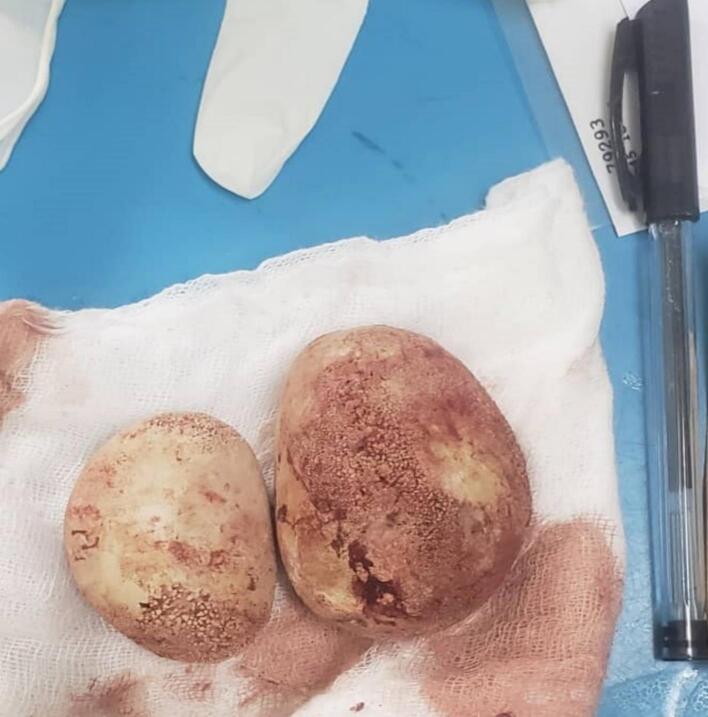 Figure 1
Peer Reviews
No public reviews on file for this paper yet. If you reviewed it on a platform where reviews are public (OpenReview, ICLR, NeurIPS, ICML), you can paste yours below so the community can read it here.
Videos
No videos yet. Explain this paper in a talk, walkthrough, or lecture? Add one.
Taxonomy
TopicsUrinary Tract Infections Management · Pediatric Urology and Nephrology Studies · Urinary Bladder and Prostate Research
Introduction
1
Bladder stones constitute approximately 5 % of all urinary tract stones, and stones larger than 4 cm in diameter are considered rare [1]. The etiology of bladder stones is vast and the common predisposing factors which are known to date from the literature are, urinary stasis, neurogenic bladder disorder, urinary tract infections and foreign body [1,2]. Recurrent infection can be one of the notable causes of bladder stones which may be overlooked in males. There is a two-way relationship between bladder stones and the risk of developing urinary tract infections and vice versa as reported in the literature [2,3]. We report a case of complicated cystitis resulting from a huge bladder stone missed by normal conventional ultrasonography.
This case report has been reported in line with the SCARE Criteria [8].
Case presentation
2
A 42-year-old male patient presents in the outpatient clinic with a complaint of lower abdominal pain for the past 2 months. This condition is on and off for the entire period associated with increased urinary frequency and episodes of nausea. He has been treated in periphery health centres with a diagnosis of urinary tract infections where he was prescribed several antibiotics without any success. Renal function test was normal, random blood glucose was 4.7 mmol and he had no history of any other chronic illness. Urinalysis done showed leukocyte+++ in urine, KUB-ultrasound showed features of chronic cystitis and other structures were uneventful. The patient was planned for elective cystoscopy which initially failed thus open cystostomy was done and the findings were two large stones shown in Fig. 1.Fig. 1. Showing two giant bladder stones extracted from a patient after performing a cystostomy due to failure of conventional cystoscopy.Fig. 1
Follow up
3
After surgery, the patient voided per SPC (supra-pubic catheter) to enable healing and was uneventfully followed for 8 weeks in the urology clinic. No complications resulted from the procedure, and the patient had normal renal functions.
Discussion
4
Literature shows that bladder stones are less common and usually weigh less than 100 g [1]. This pathology accounts for about 5 % of all urinary tract infections and 1.5 % of all admitted urological cases [1]. In endemic areas, it results from poor nutritional and socio-economic status where it mostly affects children [2]. In sub-Saharan countries, bladder stones are expected to be more prevalent in children compared to the adult population. In this case, we present a male patient of old age who had a history of recurrent urinary tract infections as a result of two giant bladder stones for more than 3-months.
The presentation usually mimics features of irritative and obstructive lower urinary tract symptoms which may include dysuria, recurrent urinary tract infections, urinary retention and in complicated cases haematuria [3]. Literature shows that they are usually single but in some rare cases, multiple stones may be present up to 30 % of cases [3]. Our patient presented with a history of on-and-off lower abdominal pain for more than 2 months associated with recurrent urinary tract infections which were treated multiple times with antibiotics without success.
Bladder stones are usually diagnosed by clinical evaluation of the obstructive and irritative voiding symptoms which in males are confused with features of prostate enlargement [3]. Recurrent urinary tract infection is one of the notable risk factors for bladder stones, but sometimes chronic urinary tract infections may be a result of obstructive uropathy caused by bladder stones [4]. Ultrasound scans have been reported to have a sensitivity and specificity for detecting bladder stones between 20 and 83 % and 98–100 % respectively, in which all are operator-dependent [5] in which cases may be missed out sometimes. Hence there is importance in using a multimodal approach to diagnosis such as a combination of ultrasound and plain radiographs.
Giant bladder stones are surgically managed either by open surgery. Literature shows the best approach used for the removal of giant bladder stones to be cystostomy, this is due to the fact that other modalities such as transurethral lithotripsy cannot remove large stones and is associated with an increased risk of infection [6,7].
Conclusion
5
Urinary tract infections in males should not be overlooked. Hidden predisposing factors such as bladder stones, may result in this entity. Proper imaging modalities including plain radiographs should be used as the initial management plan for males presenting with features suggestive of urinary tract infection.
Consent
Written informed consent was obtained from the patient for publication and any accompanying images. A copy of the written consent is available for review by the Editor-in-Chief of this journal on request.
Ethical approval
Our institution does not require ethical approval for reporting individual cases or case series.
Funding
This article was not funded.
Author contribution
Said Darwesh: writing the original manuscript.
Hilary Chipongo: literature search.
Guarantor
I Hilary Chipongo I am the guarantor of this article.
Research registration number
Shree Hindu Mandal Hospital does not offer ethical approval for single case reports. Hence ethical approval for publication was not required as per institutional policy.
Conflict of interest statement
None of the authors has any conflict of interest to disclose. This is following the journal's guidelines.
The reference list from the paper itself. Each links out to its DOI / PubMed record.
- 1Wein A.J.Kavoussi L.R.Novick A.C.Partin A.W.Peters C.A.Campbell-Walsh Urology 2011 Saunders
- 2Gallego Vilar D.Beltran Persiva J.Perez Mestre M.Povo Martin I.J.Miralles Aguado J.Garau Perello C.Giant bladder lithiasis: case report and bibliographic review Arch. Esp. Urol.644201138338721610285 · pubmed ↗
- 3Molla Y.D.Getahun G.M.Assefa M.A.Giant bladder stone a rare cause of renal failure, a case report Int. J. Surg. Case Rep.1052023 Apr 10808510.1016/j.ijscr.2023.108085 PMC 1009021037001371 · doi ↗ · pubmed ↗
- 4Farshi A.Sari Motlagh R.Jafari Arismani R.Delivery of huge bladder stone in a thirty-five-year-old man Nephrourol. Mon.662014 Nov 5e 2057410.5812/numonthly.20574 PMC 433067125738111 · doi ↗ · pubmed ↗
- 5Nugroho E.A.Junita D.Wijaya Y.H.Giant bladder stone with history of recurrence urinary tract infections: a rare case Urol. Case Rep.262019 Jun 1210094510.1016/j.eucr.2019.100945 PMC 658698431275809 · doi ↗ · pubmed ↗
- 6Wei X.Qin Y.Wang X.Qian J.Niu S.Tu S.Yao J.Giant bladder stone: a case report Exp. Ther. Med.2422022 Aug 11510.3892/etm.2022.11462 PMC 925795135837049 · doi ↗ · pubmed ↗
- 7Kerwan A.Al-Jabir A.Mathew G.Sohrabi C.Rashid R.Franchi T.Nicola M.Agha M.Agha R.A.Revised surgical C Ase R Eport (SCARE) guideline: an update for the age of artificial intelligence Prem. J. Sci.102025100079