Cross-border prevalence of putative-hypervirulent Klebsiella pneumoniae differs between tertiary hospitals in Austria and Germany
Bernd Neumann, Sophie Wilhelm, Jan Marco Kern, Joerg Steinmann

TL;DR
This study found a higher rate of a potentially dangerous type of Klebsiella bacteria in German hospitals compared to Austrian ones.
Contribution
The study provides cross-border comparative data on putative hypervirulent Klebsiella pneumoniae prevalence in European hospitals.
Findings
45 putative hypervirulent Klebsiella pneumoniae cases were identified out of 4400 total Klebsiella pneumoniae cases.
The German hospital had a 3.3-times higher prevalence of putative hypervirulent Klebsiella pneumoniae compared to the Austrian hospital.
Abstract
We conducted a prospective testing protocol for surveillance of putative hypervirulent Klebsiella pneumoniae in two tertiary hospitals in Germany and Austria, over a one year study period. In total, 45 (1.02 %) putative hvKp of around 4400 K. pneumoniae were identified. The study revealed a 3.3-times higher prevalence of putative hvKp in the German hospital.
Genes, proteins, chemicals, diseases, species, mutations and cell lines named across the full text — each resolved to its canonical identifier and authoritative record.
Click any figure to enlarge with its caption.
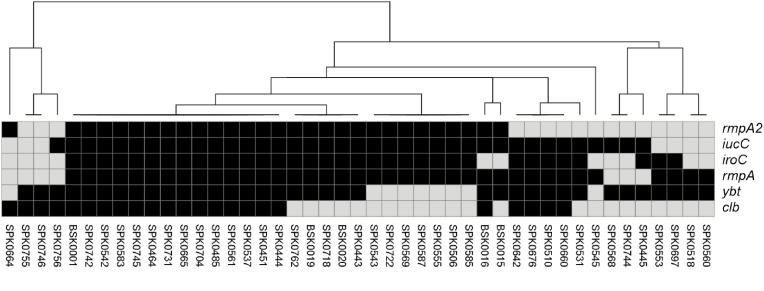 Figure 1
Peer Reviews
No public reviews on file for this paper yet. If you reviewed it on a platform where reviews are public (OpenReview, ICLR, NeurIPS, ICML), you can paste yours below so the community can read it here.
Videos
No videos yet. Explain this paper in a talk, walkthrough, or lecture? Add one.
Taxonomy
TopicsAntibiotic Resistance in Bacteria · Mycobacterium research and diagnosis · Pneumocystis jirovecii pneumonia detection and treatment
Study and Observations
Hypervirulent K. pneumoniae (hvKp) can cause severe infections, such as liver abscesses, even in young and healthy patients. Identification of hvKp in microbiological diagnostics is difficult, especially due to varying definitions of hypervirulence in literature. Recently, Han et al. presented global data on hvKp prevalence and suggestions for definition for hvKp [1]. They highlight the obstacles of defining hvKp and thereby the difficulties for diagnostics and epidemiological investigations. Most hvKp isolates are susceptible to a broad range of antibiotics, so hypervirulence traits remain undetected unless a patient presents with a liver abscess. Due to this challenge, and the lack of general surveillance systems, the availability of data for Europe is sparse or solely based on single case reports.
To overcome the lack of structured epidemiological data in Central Europe, our study aimed to investigate the amount of putative hvKp in two tertiary hospitals. Thus, enabling the establishment of a surveillance network in two neighbouring countries and a cross-border region. For this purpose, a testing procedure in diagnostics was established over 12 months to pre-select hvKp. Both sites followed the general testing strategy as described previously [2]: in 2023, all clinical isolates of K. pneumoniae sent routinely to microbiology diagnostics department, regardless of patients’ case presentation or the kind specimen, were string-tested. String-test positive isolates were subjected for molecular investigation of hvKp-related virulence genes using the eazyplex® hv- K. pneumoniae assay (Amplex Diagnostics GmbH, Gars-Bahnhof, Germany). This loop-mediated isothermal amplification (LAMP) assay enabled screening for presence of the marker genes aerobactin, salmochelin, colibactin, yersiniabactin, rmpA and rmpA2. This strategy was chosen based on the convincing results we obtained in a pilot study to establish a practicable surveillance approach for hypervirulence traits in microbiological routine diagnostics.
As suggested by Han et al., solely isolates with n ≥ 2 virulence genes were recognized as putative hvKp (=genetically hvKp) in the following. From 4398 string-tested isolates on both study sites, 45 isolates were identified as genetically hvKp. The virulence gene content varied for the isolates (Fig. 1).Fig. 1. Visual presentation of hypervirulence-associated marker genes detected in the K. pneumoniae isolates of the pilot cross-border surveillance study. Absent genes were depicted as grey. Visualization was realized with the Morpheus online tool (https://software.broadinstitute.org/morpheus), using hierarchical clustering approach with Jaccard distance and UPGMA approach.Fig. 1
As shown in Fig. 1, most common genes were aerobactin (iucC; n = 38) and rmpA (n = 38) genes, followed by yersiniabactin (ybt; n = 36) and salmochelin (iroC; n = 34). Colibactin (clb; n = 23) and rmpA (n = 29) genes were less frequently detected. Clustering revealed different combinations of marker genes and showed that most isolates carried n ≥ 4 genes. The isolates from centre 2 (BSK) carried all n ≥ 4 genes. Two Austrian and one German isolate were ESBL-producers, the other 42 putative hvKp were susceptible to antibiotics.
The testing revealed the different prevalence of putative hvKp isolates in the two study centres, as shown in Table 1.Table 1. Results of the cross-border hvKp-testing in two tertiary hospitals in Germany and Austria in 2023.Table 1. Study centreCountryHospitalized patientsString-tested isolatesString-test positive isolatesaPercentage putative hvKp [number]Estimated prevalencebNosocomial acquisition of putative hvKpHospitalization of patients with putative hvKpProportion female patients with putative hvKpAge of patients with putative hvKp [range]Center 1Germany81,665311526914.9 % [40/269]1.28 %42.5 % [17/40]Mean: 8.6 d30.0 % [12/40]Median: 64.5 y [35–95]Median: 2 dCenter 2Austria69,97912832222.7 % [5/22]0.39 %20 % [1/5]Mean: 33.3 d60.0 % [3/5]Median: 72 y [0–74]Median: 11 daExcluding multiple K. pneumoniae isolated the same patient at the same time.bRegarding all string-tested clinical isolates of K. pneumoniae per study centre.
In the German centre, 8-times more isolates with n ≥ 2 virulence genes were identified, while only 2.4-times more isolates were initially tested. This results also in a 3.3-times higher prevalence estimation in the German hospital, compared to the Austrian. Interestingly, 33 of 45 putative hvKp (73.3 %) isolates originated from male patients, whereas the proportion of female patients differed for the two centres. The median patient age were comparable. Interestingly, the hospitalization of patients with putative hvKp differed between the centres, with longer hospitalization days in centre 2. In contrast, the rate of nosocomial acquisition of putative hvKp was twice as high in centre 1 as in centre 2. Further, isolates from centre 1 included four cases of liver abscesses, resulting in a prevalence of 0.13 % regarding all K. pneumoniae, or 1.49 % of string-test positive isolates in 2023. Overall, 10 % of putative hvKp identified by string-test and LAMP, could be defined as clinical hvKp cases.
Here, we showed that by using a testing approach for identification of putative hvKp is possible in clinical routine diagnostics. In addition, the testing strategy enabled the epidemiological assessment of hvKp liver abscess cases in the context of all isolates and the knowledge about hypervirulence gene carriage in the K. pneumoniae population. The approach using an initial string-test is a limitation, but it selected for capsule-regulator marker genes that were identified as important marker of hvKp isolates in Germany [3]. Most positively tested by LAMP, also carried the rmpA and/or rmpA2 gene. Unfortunately, no sequencing-data could be included at this time, so no information about sequence type and serotype are available.
Even regarding identical study design and inclusion criteria in both study centres, the epidemiological situation of hvKp might vary a lot comparing different countries as it is known for multi-drug resistant pathogens [4]. Our approach for microbiological routine testing poses a diagnostics-focused surveillance approach and useful addition to investigations based on patient case presentation. Further, multicentre studies are warranted to give more insights in the epidemiology of hvKp.
CRediT authorship contribution statement
Bernd Neumann: Writing – review & editing, Writing – original draft, Visualization, Validation, Methodology, Investigation, Funding acquisition, Formal analysis, Data curation, Conceptualization. Sophie Wilhelm: Writing – review & editing, Formal analysis. Jan Marco Kern: Writing – review & editing, Validation, Funding acquisition, Data curation. Joerg Steinmann: Writing – review & editing, Validation, Project administration, Funding acquisition.
Ethics approval
Not required.
Sequence information
Not applicable.
Funding
This project was financially supported by an intramural cross-location research funding “Bridging Nuremberg-Salzburg” of the Paracelsus Medical University; as part of the project “Surveillance and molecular investigations of hypervirulent clinical isolates of Klebsiella pneumoniae” (PMU-RIF no. FMS_W_088.22-H).
Declaration of competing interest
The authors declare that they have no known competing financial interests or personal relationships that could have appeared to influence the work reported in this paper.
The reference list from the paper itself. Each links out to its DOI / PubMed record.
- 1Han X.Yao J.He J.Liu H.Jiang Y.Zhao D.Shi Q.Zhou J.Hu H.Lan P.Zhou H.Li X.Clinical and laboratory insights into the threat of hypervirulent Klebsiella pneumoniae Int J Antimicrob Agents 64202410727510.1016/j.ijantimicag.2024.10727539002700 · doi ↗ · pubmed ↗
- 2Neumann B.Stürhof C.Rath A.Kieninger B.Eger E.Müller J.U.von Poblocki A.Gerlitz N.Wollschläger P.Schneider-Brachert W.Schaufler K.Klaper K.Steinmann J.Detection and characterization of putative hypervirulent Klebsiella pneumoniae isolates in microbiological diagnostics Sci Rep 1320231902510.1038/s 41598-023-46221-w PMC 1062484537923898 · doi ↗ · pubmed ↗
- 3Wahl A.Fischer M.A.Klaper K.Müller A.Borgmann S.Friesen J.Hunfeld K.P.Ilmberger A.Kolbe-Busch S.Kresken M.Lippmann N.Lübbert C.Marschner M.Neumann B.Pfennigwerth N.Probst-Kepper M.Rödel J.Schulze M.H.Zautner A.E.Werner G.Pfeifer Y.Presence of hypervirulence-associated determinants in Klebsiella pneumoniae from hospitalised patients in Germany Int J Med Microbiol 314202415160110.1016/j.ijmm.2024.15160138359735 · doi ↗ · pubmed ↗
- 4Glasner C.Berends M.S.Becker K.Esser J.Gieffers J.Jurke A.Kampinga G.Kampmeier S.Klont R.Köck R.von Müller L.Al Naemi N.Ott A.Ruijs G.Saris K.Tami A.Voss A.Waar K.van Zeijl J.Friedrich A.W.A prospective multicentre screening study on multidrug-resistant organisms in intensive care units in the Dutch-German cross-border region, 2017 to 2018: the importance of healthcare structures Euro Surveill 27202210.2807/1560-7917.ES.2022.27.5.2001660 PMC 881510035115078 · doi ↗ · pubmed ↗