One-Pot Dual-Wavelength 3D Printing Breaks Free from Support Constraints
Jared Cason Head, Syed Muhammad Usama

TL;DR
This paper introduces a new 3D printing method that uses two light sources to create structures without needing support material.
Contribution
A novel dual-wavelength 3D printing technique that eliminates traditional support material through orthogonal light sources.
Findings
Freestanding 3D structures can be fabricated using dual-wavelength printing.
The method avoids the need for traditional support structures in 3D printing.
Orthogonal light sources enable precise and complex shape fabrication.
Abstract
The Page and Huang groups employ orthogonal light sources to fabricate freestanding 3D structures that eliminate the need for traditional support material.
Genes, proteins, chemicals, diseases, species, mutations and cell lines named across the full text — each resolved to its canonical identifier and authoritative record.
Click any figure to enlarge with its caption.
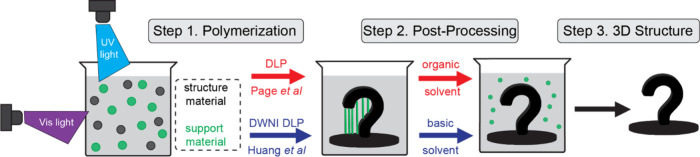 Figure 1
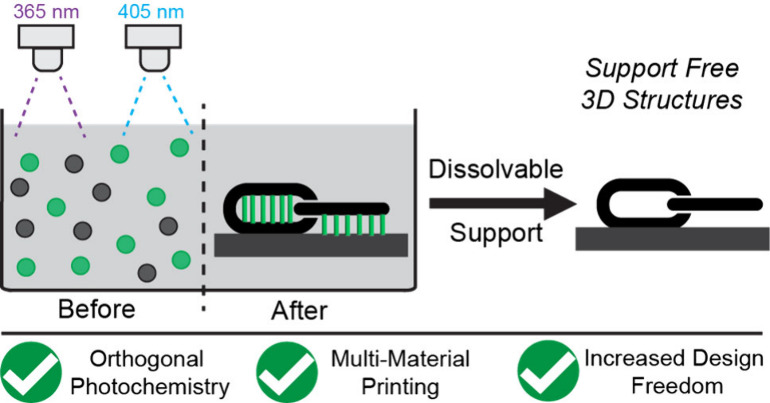 Figure 2
Peer Reviews
No public reviews on file for this paper yet. If you reviewed it on a platform where reviews are public (OpenReview, ICLR, NeurIPS, ICML), you can paste yours below so the community can read it here.
Videos
No videos yet. Explain this paper in a talk, walkthrough, or lecture? Add one.
Taxonomy
TopicsAdditive Manufacturing and 3D Printing Technologies · Manufacturing Process and Optimization · Interactive and Immersive Displays
Additive manufacturing (AM) via vat photopolymerization (VPP)particularly techniques like digital light processing (DLP)enables the rapid fabrication of polymer structures with high spatial resolution. VPP has advanced into an indispensable 3D printing tool for producing multimaterial components for diverse applications. However, limitations arising from the fabrication of intricate structures have posed a large obstacle for its mass adoption.
Vat photopolymerization has garnered increased attention in 3D printing owing to its high resolution, scalable production, design freedom, and reduced material waste. ?−? ? VPP relies on light exposure to selectively cure liquid resins, or inks, to create complex geometries that can be utilized in metamaterials,? microfluidics,? and biomedical engineering.? However, fabricating fine suspended features such as arches, hooks, bridges, or overhangs remains a key challenge in 3D printing. Without adequate support components, structures demanding freestanding or mobile features are prone to deform during printing, which limits design freedom. Moreover, supports are often removed through manual postprocessing steps that can obscure or damage delicate details, introducing a major bottleneck in the printing process?, prompting the need for innovative curing processes. In their current contribution, the Page and Huang groups report distinct yet convergent solutions using dual-wavelength DLP printing (Figure) to simultaneously fabricate robust parts and easily removable supportsall from a single resin formulation and without the need for printer modifications or multiple resin vats.
The Page group’s strategy? leverages orthogonal photopolymerization mechanisms within a carefully formulated wavelength-selective resin. Under blue or violet light (∼405 nm), acrylate monomers undergo radical chain-transfer polymerization, forming soluble thermoplastics. Simultaneously, UV light (∼365 nm) triggers cationic polymerization of epoxies into cross-linked thermosets, yielding insoluble components that constitute the built structure. Spatially modulated with a DLP projector, this dual-cure chemistry allows for rapid printing (up to 0.75 mm/min) of interlocked joints, unsupported arches, and freestanding chainsall in one build. Postprocessing is refreshingly simple: a 10 min rinse in ethyl acetate at room temperature dissolves the support regions, revealing smooth, structurally resilient features with <5 μm surface roughness and mechanical properties approaching those of commercial plastics (E ≈ 1 GPa, σ_m_ ≈ 30 MPa). Layer exposures of just 4–6 s per 50 μm slice enable fine feature resolution (<100 μm), matching or exceeding industry standards.
In a parallel effort, the Huang group? introduced a custom-built dual-wavelength negative imaging (DWNI) DLP printer to achieve similar results but with a different architectural and chemical approach. Their single-resin formulation contains both a carbonate-linked anhydride thermoset network and a UV-curable epoxy system. Visible light selectively cures the degradable anhydride acrylate matrix, while UV light simultaneously cross-links the permanent epoxy regionsall patterned using a single digital micromirror device (DMD). The approach eliminates the complexity of employing dual-vat or dual-projector setups. After printing, a mild thermal postcure enhances the structural network’s fidelity. The sacrificial support material can then be selectively removed in a gentle aqueous base (pH ≈ 11), avoiding harsh solvents and preserving fine interfacial details.
From a chemical standpoint, the two approaches diverge in mechanism yet converge in sophistication. The Page group employs light-orthogonal radical and cationic polymerizations to embed a degradable thermoplastic scaffold within a durable thermoset matrix. In contrast, the Huang group utilizes a dual-cure formulation with anhydride-based support networks that selectively degrade under basic conditions. Both strategies eliminate the need for resin switching by embedding wavelength-selective reactivity directly into a single formulation.
Whether through multicolor resin chemistry or dual-wavelength projection, the future of 3D printing lies in coupling photonics with smart molecular design. By shifting the paradigm from manual postprocessing to automated, chemically programmed support removal, both works move closer toward a vision where complexity comes free of costnot only in dollars, but also in time, labor, and waste.
These innovations seek to build on a rich history of support strategies. Early techniques involved mechanical breakaway scaffolds? or dissolvable filaments, mostly limited to rigid thermoplastics. Multimaterial resin systemswhile promisinghave long struggled with cross-contamination, alignment, and inconsistent cure kinetics.? More recently, grayscale photopolymerization and projection-based voxel tuning? hinted at the possibility of printing gradients or hybrid materials, but with limited compositional control. The dual-wavelength methods reported here offer a leap forward in integration and resolution. Sacrificial supports are intentionally programmed to disappear under gentle, selective conditions, opening the door to new applications in microfluidics, soft robotics, and bioprinting, where complex internal channels or delicate overhangs must remain pristine after fabrication.
Looking ahead, dual-wavelength DLP printing opens new frontiers in additive manufacturing. More tunable light sources could enable spatial control over mechanical or optical gradients within a single print. Expanding the resin palette to include conductive, stretchable, or bioresorbable materials would further extend the technology’s reach. From a sustainability perspective, the development of recyclable supports or greener solvents could enhance the environmental case for this approach.
These studies demonstrate that when materials chemistry and optical engineering are skillfully integrated, long-standing limitations in 3D printing can be reimaginednot merely overcome.
By choreographing photons of different energies, both works dismantle a core constraint of DLP printing: the need for mechanical postprocessing to remove supports. Their distinct strategiesorthogonal multicolor photopolymerization and dual-wavelength base-degradable networkspave the way toward autonomous, multimaterial manufacturing. In an era demanding faster prototyping, reduced waste, and greater geometric freedom, dual-wavelength DLP methods presented in this context are poised to become a cornerstone of next-generation additive manufacturing.
The reference list from the paper itself. Each links out to its DOI / PubMed record.
- 1Mason K. S.Kim J.-W.Recker E. A.Nymick J. M.Shi M.Stolpen F. A.Ju J.Page Z. A.Multicolor Digital Light Processing 3D Printing Enables Dissolvable Supports for Freestanding and Non-Assembly Structures ACS Central Science 202510.1021/acscentsci.5c 00289 PMC 1220326040585804 · doi ↗ · pubmed ↗
- 2Ponce I. A.Moran B.Hawker C. J.Shusteff M.Huang S.Dual-wavelength simultaneous patterning of degradable thermoset supports for one-pot embedded 3D printing ACS Central Science 202510.1021/acscentsci.5c 00337 PMC 1220342740585793 · doi ↗ · pubmed ↗
- 3Zhang F.Zhu L.Li Z.Wang S.Shi J.Tang W.Li N.Yang J.The recent development of vat photopolymerization: A review Additive Manufacturing 20214810242310.1016/j.addma.2021.102423 · doi ↗
- 4Liu C.Guo X.Tong Y.Liu C.Mao K.Sun H.Hu Q.Gong H.Li X.Feng Y.Vat photopolymerization 3D printing Si BCN ceramic metamaterials with strong electromagnetic wave absorption Additive Manufacturing 20248710423910.1016/j.addma.2024.104239 · doi ↗
- 5Xu Y.Qi F.Mao H.Li S.Zhu Y.Gong J.Wang L.Malmstadt N.Chen Y.In-situ transfer vat photopolymerization for transparent microfluidic device fabrication Nat. Commun.202213191810.1038/s 41467-022-28579-z 35177598 PMC 8854570 · doi ↗ · pubmed ↗
- 6Wu, J. ; Bai, C. ; Hu, D. ; Liu, D. ; Jiang, P. ; Wang, X. 10 - Vat photopolymerization 3D printing application in bioengineering. In Vat Photopolymerization Additive Manufacturing; Wang, X. , Ed.; Elsevier, 2024; pp 329–363.
- 7Jiang J.Xu X.Stringer J.Support Structures for Additive Manufacturing: A Review Journal of Manufacturing and Materials Processing 2018246410.3390/jmmp 2040064 · doi ↗
- 8Liang H.Hu B.Li R.Sun J.Wang Y.Zhou P.Cai P.Bai J.Enhancing mechanical integrity of vat photopolymerization 3D printed hydroxyapatite scaffolds through overcoming peeling defects Journal of the European Ceramic Society 2024441411664210.1016/j.jeurceramsoc.2024.05.064 · doi ↗