StripePy: fast and robust characterization of architectural stripes
Andrea Raffo, Roberto Rossini, Jonas Paulsen

TL;DR
StripePy is a new tool for identifying architectural stripes in genomic data, offering faster and more reliable analysis than existing methods.
Contribution
StripePy introduces a computational geometry-based method for stripe detection and includes a new simulated benchmark called StripeBench.
Findings
StripePy outperforms existing tools in detecting architectural stripes in Hi-C and Micro-C data.
StripePy includes a simulated benchmark called StripeBench for testing and validation.
Abstract
Architectural stripes in Hi-C and related data are crucial for gene regulation, development, and DNA repair. Despite their importance, few tools exist for automatic stripe detection. We introduce StripePy, which leverages computational geometry methods to identify and analyze architectural stripes in contact maps from Chromosome Conformation Capture experiments like Hi-C and Micro-C. StripePy outperforms existing tools, as shown through tests on various datasets and a newly developed simulated benchmark, StripeBench, providing a valuable resource for the community. StripePy is released to the public as an open-source, MIT-licensed Python application. StripePy source code is hosted on GitHub at https://github.com/paulsengroup/StripePy and is archived on Zenodo. StripePy can be easily installed from source or PyPI using pip and from Bioconda using conda. Containerized versions of…
Genes, proteins, chemicals, diseases, species, mutations and cell lines named across the full text — each resolved to its canonical identifier and authoritative record.
Click any figure to enlarge with its caption.
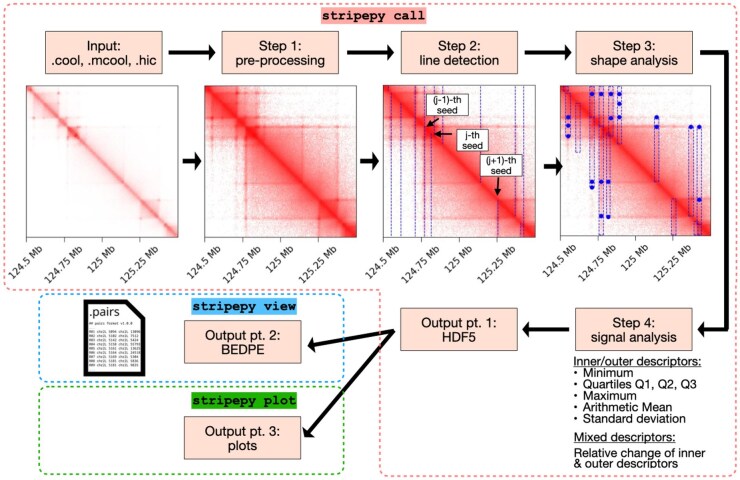 Figure 1
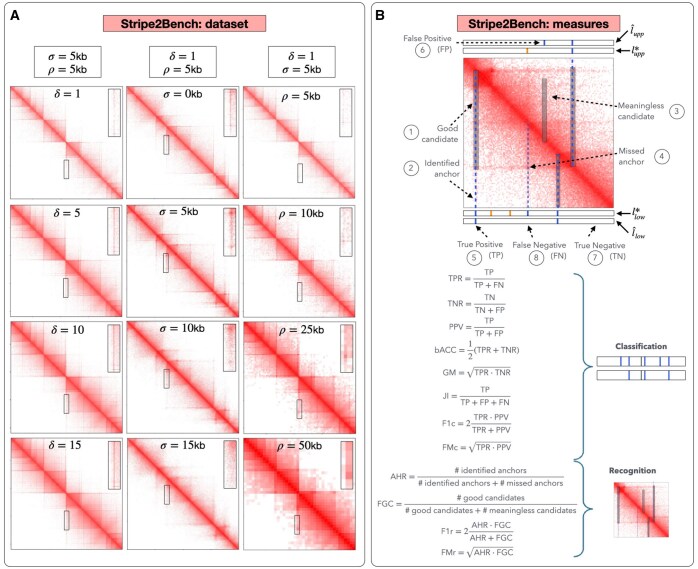 Figure 2
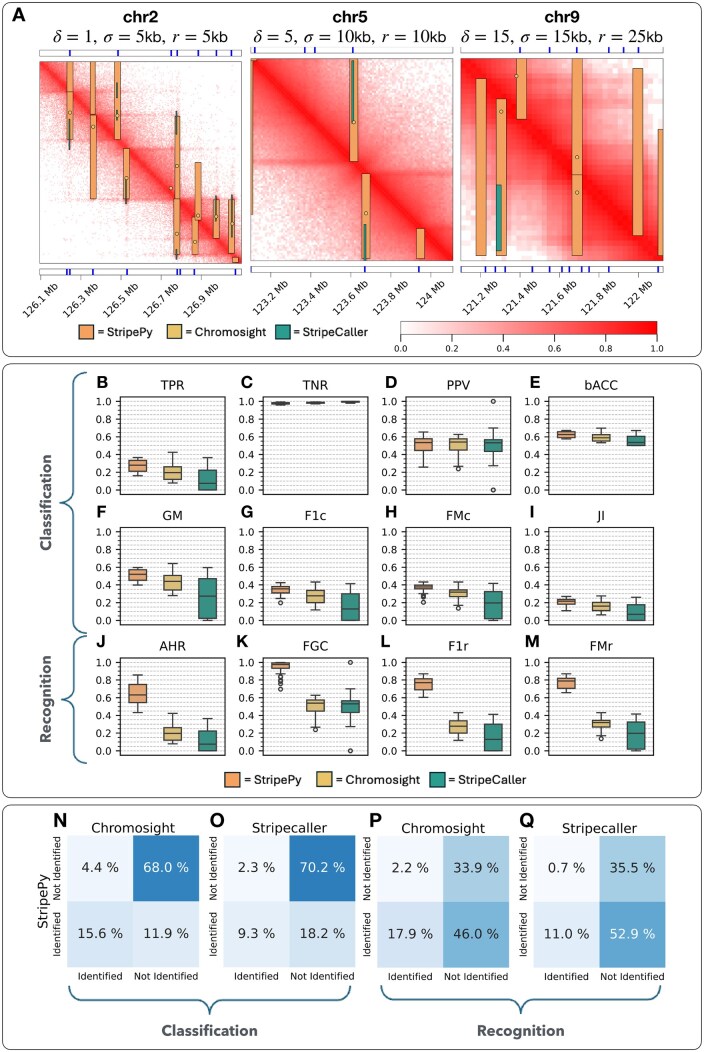 Figure 3
Peer Reviews
No public reviews on file for this paper yet. If you reviewed it on a platform where reviews are public (OpenReview, ICLR, NeurIPS, ICML), you can paste yours below so the community can read it here.
Videos
No videos yet. Explain this paper in a talk, walkthrough, or lecture? Add one.
Taxonomy
Topics3D Surveying and Cultural Heritage · Computer Graphics and Visualization Techniques · Remote Sensing and LiDAR Applications