Comparison of Near Infrared Spectra of Three Lichen Substances and Several Common Synthetic Organic Sunscreens
David Gilberto Torres Vargas

TL;DR
This study compares the near-infrared absorption of lichen substances and synthetic sunscreens, finding that less-substituted compounds offer better protection.
Contribution
The paper provides the first NIR spectra of common organic sunscreens and lichen compounds, offering insights into their photoprotective potential.
Findings
Less-substituted aromatic compounds like methyl orsellinate show better NIR absorption above 2100 nm.
Compounds with hydroxyl and carbonyl groups may offer effective NIR photoprotection.
NIR spectroscopy can be used for sunscreen quality control due to high concentrations in products.
Abstract
Near‐infrared (NIR) and UV radiation have been reported to alter skin physiology, causing oxidative stress, mitochondrial genetic damage, and potentially leading to cancer and photoageing. NIR screening is recommended, but only inorganic sunscreens such as zinc and titanium oxide are known to absorb, reflect, and scatter NIR. Additionally, NIR spectra of common organic sunscreens are neither available in the literature nor in technical datasheets. This study characterizes NIR absorption of several commercial sunscreens and alternative lichen compounds. To measure NIR absorbance and reflectance spectra, solid organic sunscreens were impregnated with minimal chloroform onto pure dry potassium bromide (KBr) crystals and analyzed using a Varian Cary 5000 spectrophotometer. Liquid compounds were tested directly in standard 1 cm quartz cells. Reflectance spectra were processed using the…
Genes, proteins, chemicals, diseases, species, mutations and cell lines named across the full text — each resolved to its canonical identifier and authoritative record.
Click any figure to enlarge with its caption.
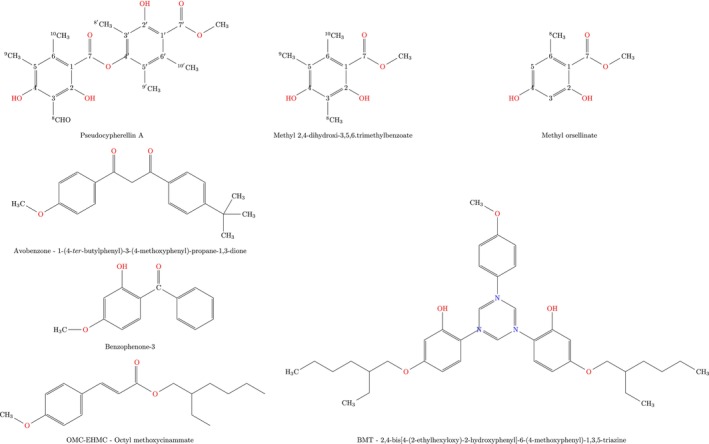 Figure 1
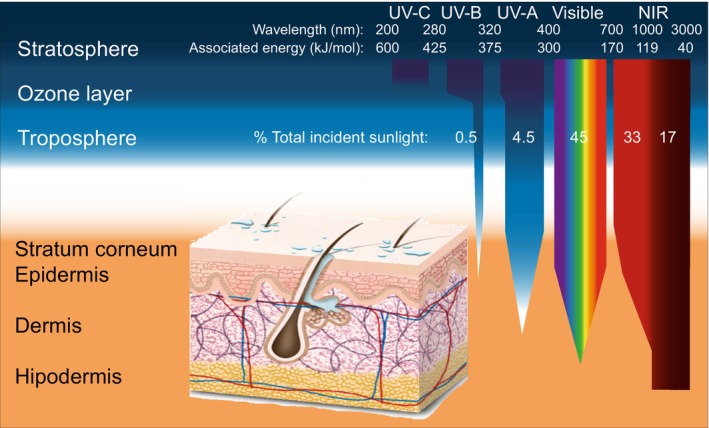 Figure 2
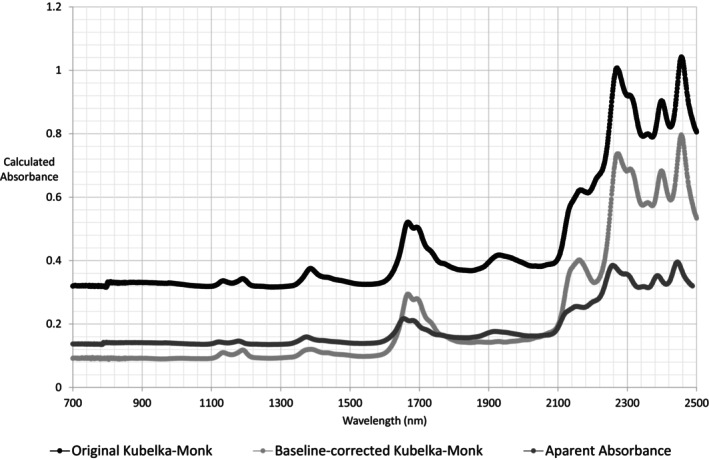 Figure 3
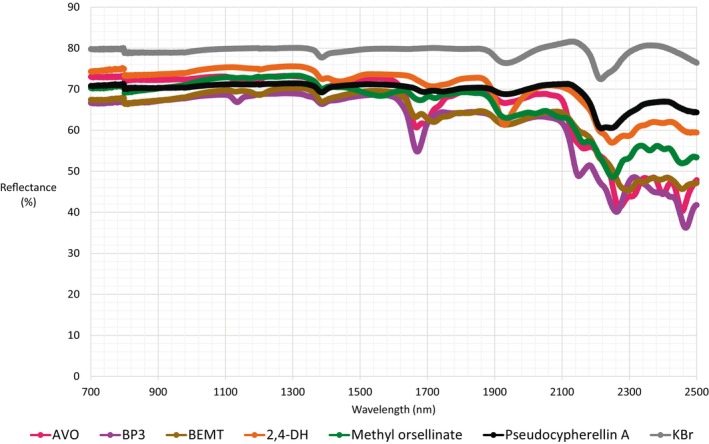 Figure 4
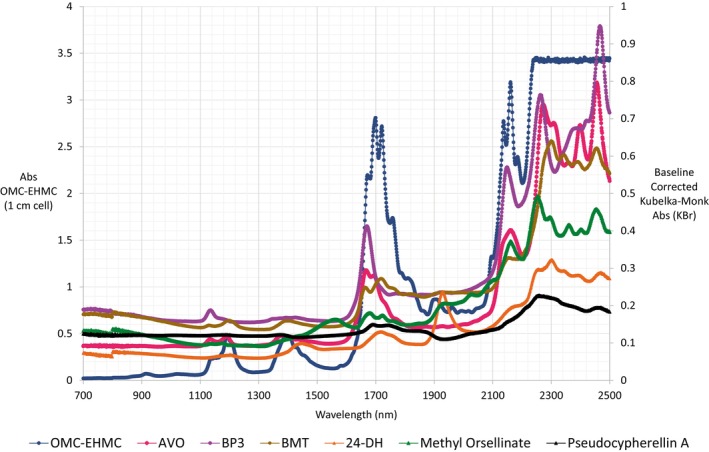 Figure 5
Peer Reviews
No public reviews on file for this paper yet. If you reviewed it on a platform where reviews are public (OpenReview, ICLR, NeurIPS, ICML), you can paste yours below so the community can read it here.
Videos
No videos yet. Explain this paper in a talk, walkthrough, or lecture? Add one.
Taxonomy
TopicsLichen and fungal ecology · Bee Products Chemical Analysis · Skin Protection and Aging