Implied object direction from eye location enhances animacy ratings but not detection of chasing behavior
Takahiro Kawabe

TL;DR
This study shows that eye-like features on moving objects influence how animate they seem, but not how well people detect chasing behavior.
Contribution
The study reveals how eye-like cues interact with object geometry to influence animacy perception.
Findings
Animacy impressions increase when motion aligns with gaze-implied direction, regardless of shape.
Eye-like feature location weakly affects performance in chasing behavior detection tasks.
Eye-related cues influence animacy perception at multiple cognitive stages.
Abstract
Understanding how humans perceive animacy in dynamic visual stimuli is fundamental to elucidating the mechanisms underlying visual social cognition. While both object geometry and eye-like features are known to independently influence animacy impressions, their interactive effects remain insufficiently explored. This study investigates how the combination of object geometry and the location of eye-like patterns modulates the perception of animacy in non-living moving objects. In Experiment 1, we manipulated the pointing direction of triangular objects and the location of eye-like features (near the vertex, near the edge, or absent), and found that animacy impressions were enhanced when the direction of motion aligned with the gaze-implied object direction, irrespective of the object’s geometrical shape. Experiment 2 examined whether this effect generalizes to an objective task, in which…
Genes, proteins, chemicals, diseases, species, mutations and cell lines named across the full text — each resolved to its canonical identifier and authoritative record.
Click any figure to enlarge with its caption.
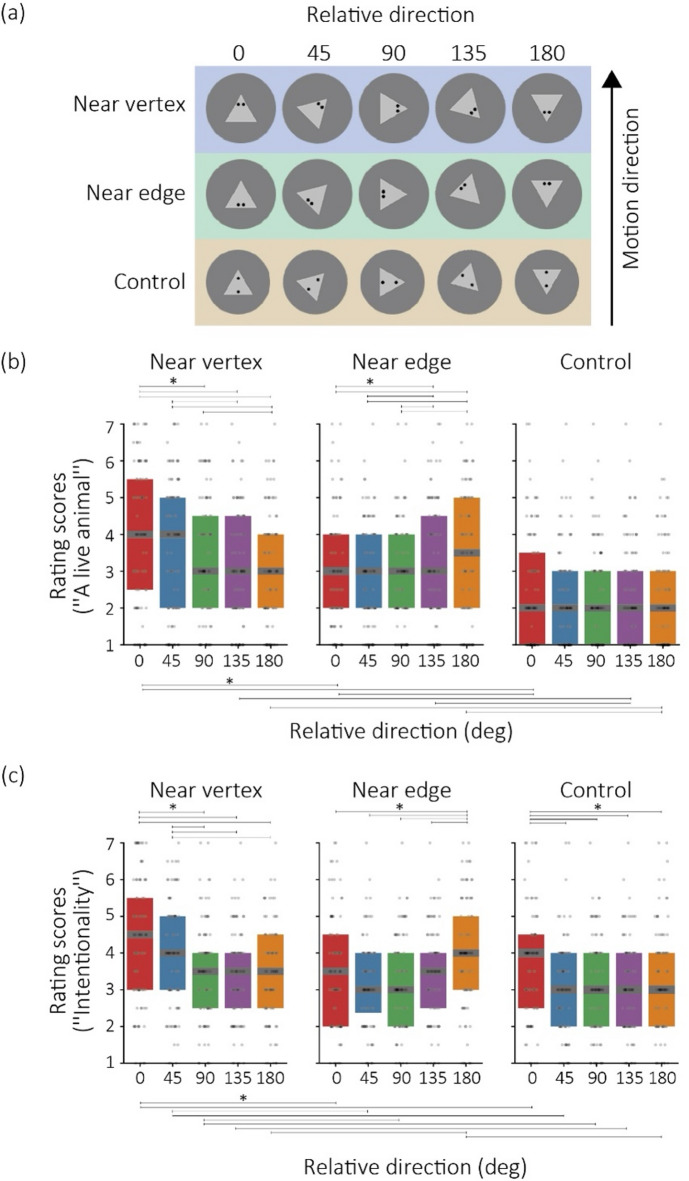 Figure 1
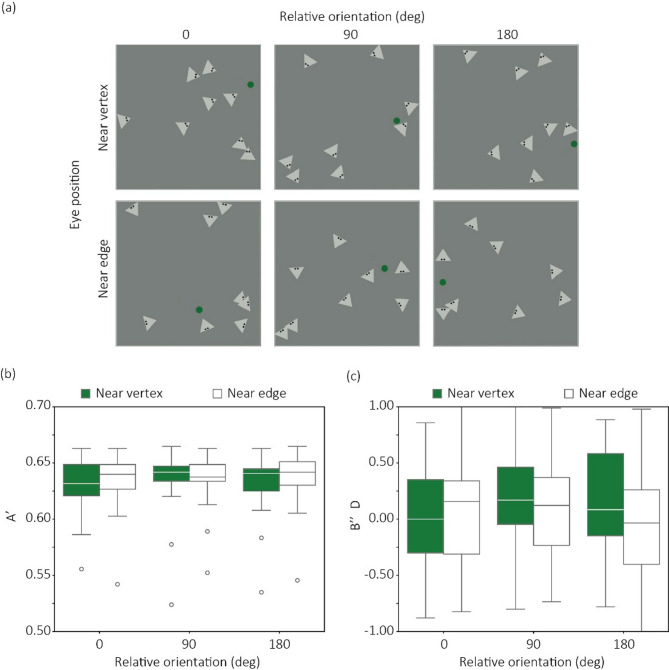 Figure 2
Peer Reviews
No public reviews on file for this paper yet. If you reviewed it on a platform where reviews are public (OpenReview, ICLR, NeurIPS, ICML), you can paste yours below so the community can read it here.
Videos
No videos yet. Explain this paper in a talk, walkthrough, or lecture? Add one.
Taxonomy
TopicsChild and Animal Learning Development · Action Observation and Synchronization · Face Recognition and Perception