Development and validation of a machine learning-based risk prediction model for stroke-associated pneumonia in older adult hemorrhagic stroke
Yi Cao, Haipeng Deng, Shaoyun Liu, Xi Zeng, Yangyang Gou, Weiting Zhang, Yixinyuan Li, Hua Yang, Min Peng

TL;DR
This study developed a machine learning model to predict pneumonia risk in older adults with brain bleeds, using factors like age and health scores to help doctors act early.
Contribution
The study introduces a validated logistic regression model as the most reliable predictor of stroke-associated pneumonia in older patients.
Findings
Logistic regression outperformed XGBoost, SVM, and Naive Bayes in predicting SAP with AUCs of 0.883, 0.855, and 0.882.
Age, smoking, low GCS, low Braden score, and nasogastric tube use were identified as key risk factors for SAP.
The model showed strong generalization across training, internal, and external validation datasets.
Abstract
To develop and validate a machine learning (ML)-based model for predicting stroke-associated pneumonia (SAP) risk in older adult hemorrhagic stroke patients. A retrospective collection of older adult hemorrhagic stroke patients from three tertiary hospitals in Guiyang, Guizhou Province (January 2019–December 2022) formed the modeling cohort, randomly split into training and internal validation sets (7:3 ratio). External validation utilized retrospective data from January–December 2023. After univariate and multivariate regression analyses, four ML models (Logistic Regression, XGBoost, Naive Bayes, and SVM) were constructed. Receiver operating characteristic (ROC) curves and area under the curve (AUC) were calculated for training and internal validation sets. Model performance was compared using Delong's test or Bootstrap test, while sensitivity, specificity, accuracy, precision,…
Genes, proteins, chemicals, diseases, species, mutations and cell lines named across the full text — each resolved to its canonical identifier and authoritative record.
Click any figure to enlarge with its caption.
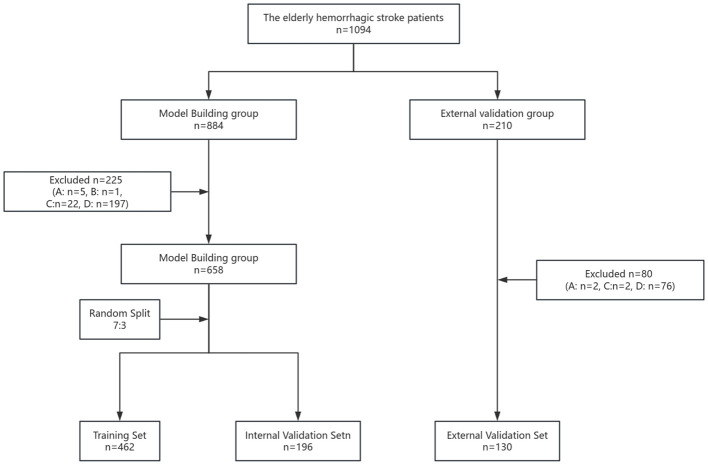 Figure 1
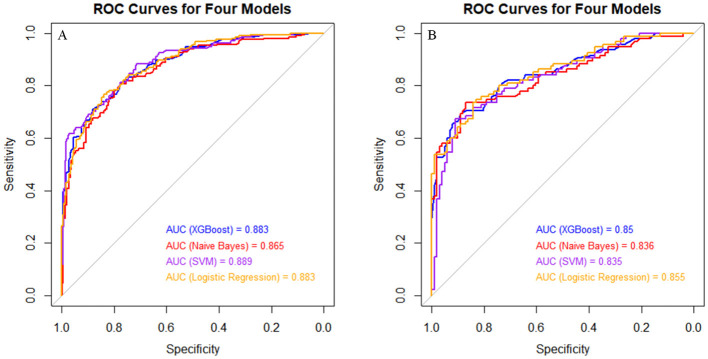 Figure 2
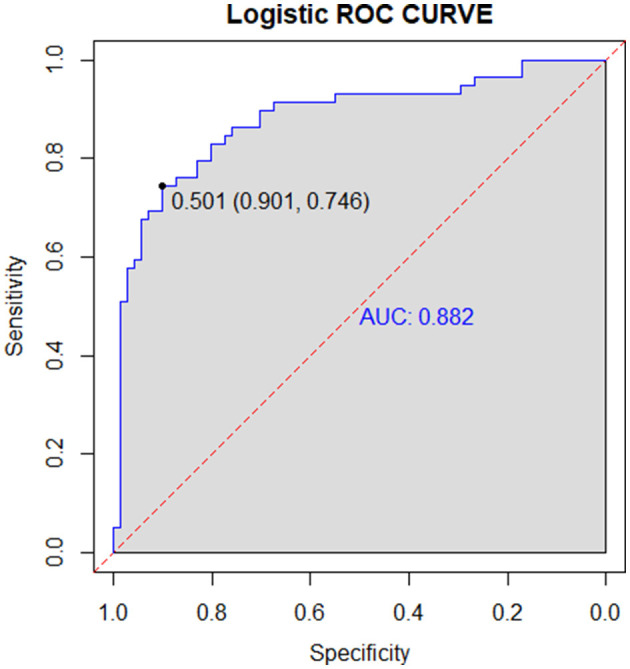 Figure 3
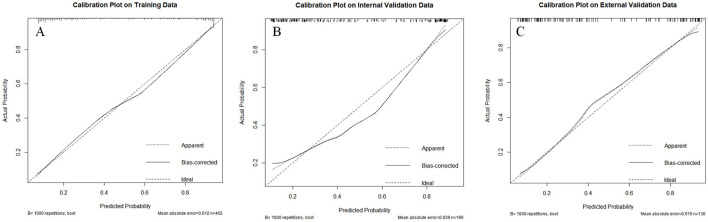 Figure 4
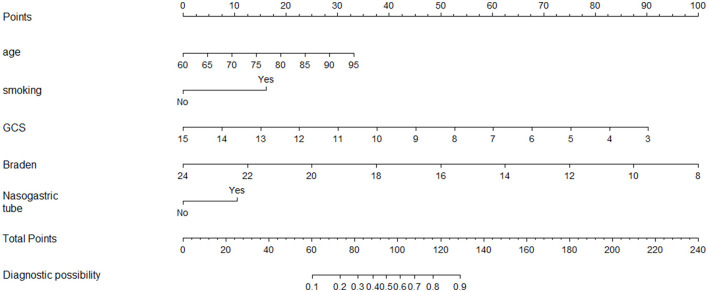 Figure 5
Peer Reviews
No public reviews on file for this paper yet. If you reviewed it on a platform where reviews are public (OpenReview, ICLR, NeurIPS, ICML), you can paste yours below so the community can read it here.
Videos
No videos yet. Explain this paper in a talk, walkthrough, or lecture? Add one.
Taxonomy
TopicsIntracerebral and Subarachnoid Hemorrhage Research · Acute Ischemic Stroke Management · Machine Learning in Healthcare