Sensitive and reliable detection of KIT p.D816V mutation in decalcified archival bone marrow trephines
Miriam Odensass, Stephan Bartels, Jerome Schlue, Guntram Büsche, Hans H. Kreipe, Ulrich Lehmann

TL;DR
This study shows that detecting a specific KIT gene mutation in bone marrow samples using mRNA is reliable and often better than traditional DNA methods.
Contribution
The study demonstrates the feasibility and advantage of using mRNA for detecting KIT p.D816V mutations in decalcified archival bone marrow samples.
Findings
Seven out of 80 bone marrow samples showed KIT p.D816V mutations only via mRNA/cDNA pyrosequencing.
Eleven samples showed the mutation only through digital PCR of genomic DNA.
mRNA-based detection is reliable and advantageous for clinical mutation analysis in archival bone marrow samples.
Abstract
The majority of mastocytosis cases are characterized by an activating mutation in the KIT gene in codon 816. The detection of this alteration is of importance for proper diagnostic workup. Therefore, reliable and sensitive methods for the detection of KIT Codon 816 hotspot mutations in various types of patient samples are required. Since mutated cancer genes are often overexpressed, we evaluated the feasibility and sensitivity of KIT p.D816V detection by analysing mRNA/cDNA instead of genomic DNA. From 80 bone marrow trephines harboring a KIT p.D816 mutation, seven were only mutated by mRNA/cDNA pyrosequencing and 11 only by digital PCR analysis of genomic DNA. These results clearly demonstrate that detection of clinically relevant mutations in mRNA extracted from routinely processed decalcified archival bone marrow trephines is not only possible in a reliable fashion but under many…
Genes, proteins, chemicals, diseases, species, mutations and cell lines named across the full text — each resolved to its canonical identifier and authoritative record.
Click any figure to enlarge with its caption.
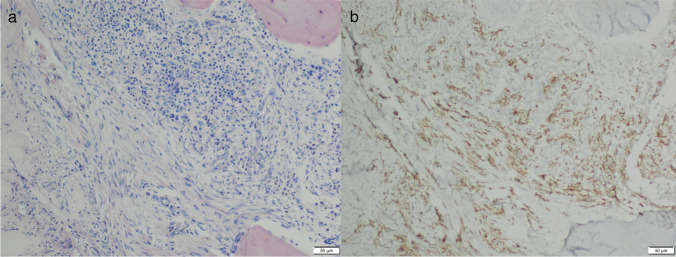 Figure 1
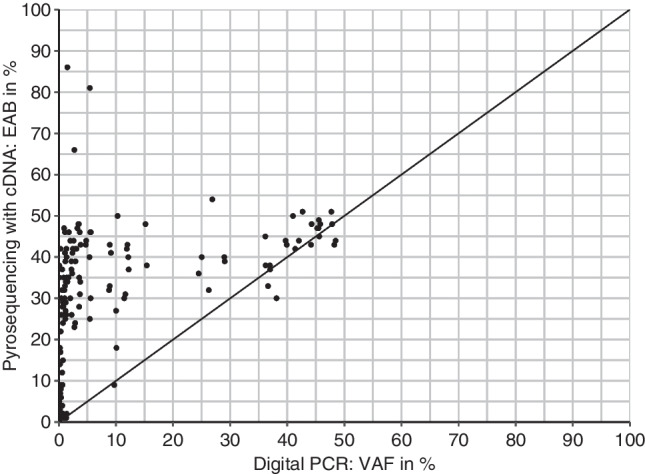 Figure 2
Peer Reviews
No public reviews on file for this paper yet. If you reviewed it on a platform where reviews are public (OpenReview, ICLR, NeurIPS, ICML), you can paste yours below so the community can read it here.
Videos
No videos yet. Explain this paper in a talk, walkthrough, or lecture? Add one.
Taxonomy
TopicsMast cells and histamine · Eosinophilic Disorders and Syndromes · Cell Adhesion Molecules Research