Different tightening schemes in thread-drawing therapy and their effects on anal function recovery in patients with high simple anal fistula
Pengfei Zhao, Lifang Wang, Qian Song, Shili Yuan, Dongmei Yang, Yao Liu, Tao Zhang

TL;DR
This study compares different tightening methods in thread-drawing therapy for anal fistulas and finds that 1/4 and 1/3 tightening schemes offer the best recovery with less pain and better anal function.
Contribution
The study introduces and evaluates specific fractional tightening schemes in thread-drawing therapy for high simple anal fistulas.
Findings
The 1/5 group had the longest wound healing time compared to other groups.
The 1/2 group had higher postoperative pain scores and Wexner scores, indicating worse anal function.
The 1/4 and 1/3 groups showed optimal anal function recovery with minimal impact.
Abstract
We aimed to compare the effects of different tightening schemes in thread-drawing therapy on the recovery of anal function in patients with high simple anal fistulas after treatment. One hundred patients with high simple anal fistulas who met the inclusion criteria were randomly divided into four groups of 25 patients each. All patients underwent low-level incision and high-level thread-drawing surgery. In the 1/5, 1/4, 1/3, and 1/2 groups, the rubber band cutting force was applied by tightening the surrounding muscle bundle to 1/5, 1/4, 1/3, and 1/2 of its circumference, respectively (using a graduated rubber band). Subsequent tightenings were also performed to the corresponding fractions of the circumference. The overall clinical efficacy, wound healing time, wound symptom score, anal function, and Wexner score were compared among the four groups. The 1/5 group had the longest wound…
Genes, proteins, chemicals, diseases, species, mutations and cell lines named across the full text — each resolved to its canonical identifier and authoritative record.
Click any figure to enlarge with its caption.
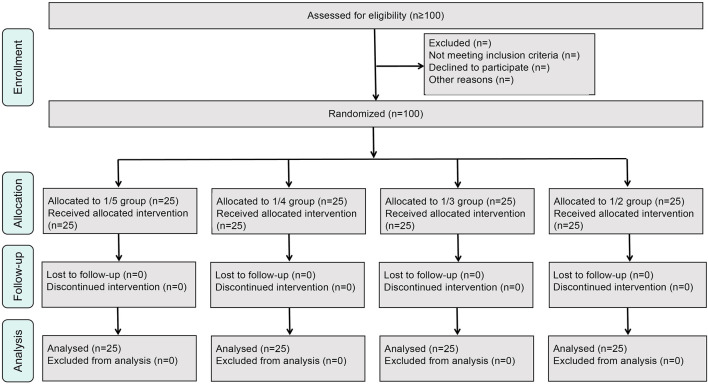 Figure 1
 Figure 2
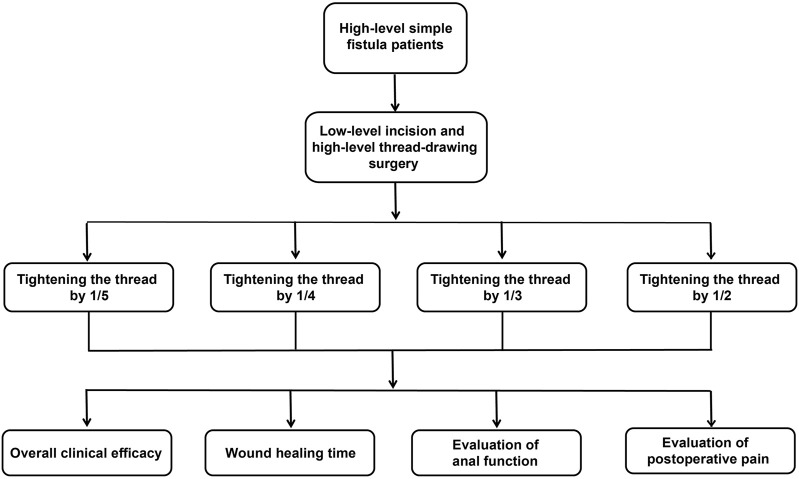 Figure 3
 Figure 4
Peer Reviews
No public reviews on file for this paper yet. If you reviewed it on a platform where reviews are public (OpenReview, ICLR, NeurIPS, ICML), you can paste yours below so the community can read it here.
Videos
No videos yet. Explain this paper in a talk, walkthrough, or lecture? Add one.
Taxonomy
TopicsAnorectal Disease Treatments and Outcomes · Pelvic floor disorders treatments · Colorectal Cancer Surgical Treatments