Emerging adults’ neuroticism links with depressive symptoms through personal belief in a just world and forgiveness
Sixiang Quan, Huibin Kang, Xiaohui Yang

TL;DR
This study shows that high neuroticism increases depressive symptoms in young adults by lowering their belief in a just world and forgiveness.
Contribution
The study identifies a sequential mediation pathway involving belief in a just world and forgiveness linking neuroticism to depressive symptoms.
Findings
Neuroticism has both direct and indirect effects on depressive symptoms.
Belief in a just world and forgiveness sequentially mediate the link between neuroticism and depressive symptoms.
Interventions targeting these mediators may help reduce depressive symptoms.
Abstract
High neuroticism is a stable risk predictor of depressive symptoms. Researchers struggled to understand how neuroticism linked with depressive symptoms. The aim of the current study was to explore whether personal belief in a just world and forgiveness acted as mediators in the relations between neuroticism and depressive symptoms among emerging adults. A total of 630 non-clinical undergraduates completed questionnaires about the studied variables. A sequential mediation model with personal belief in a just world and forgiveness as mediators of the association between neuroticism and depressive symptoms was explored. The results found both direct and indirect effects of neuroticism on depressive symptoms. The sequential mediation analyses revealed that the positive relationship between neuroticism and depressive symptoms was simply and sequentially mediated by personal belief in a just…
Genes, proteins, chemicals, diseases, species, mutations and cell lines named across the full text — each resolved to its canonical identifier and authoritative record.
Click any figure to enlarge with its caption.
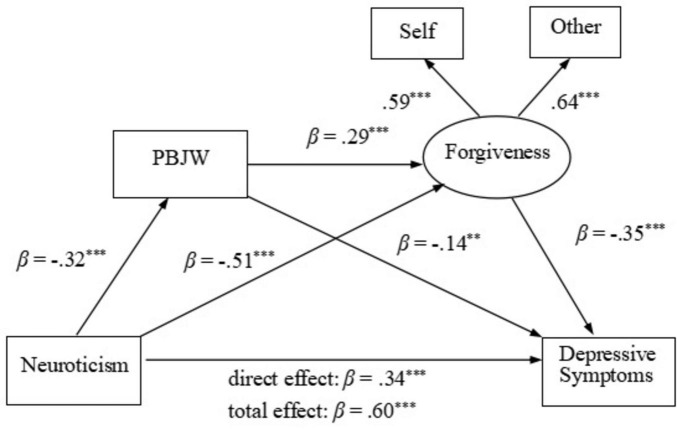 Figure 1
Peer Reviews
No public reviews on file for this paper yet. If you reviewed it on a platform where reviews are public (OpenReview, ICLR, NeurIPS, ICML), you can paste yours below so the community can read it here.
Videos
No videos yet. Explain this paper in a talk, walkthrough, or lecture? Add one.
Taxonomy
TopicsForgiveness and Related Behaviors · Religion, Spirituality, and Psychology · Attachment and Relationship Dynamics