Liver fibro-inflammation in psoriatic arthritis with MASLD improved by anti-IL-17 treatment: a clinical case
Lija James, Michele Pansini, Charlie Diamond, Hussein Al-Mossawi, Rajarshi Banerjee, Helena Thomaides-Brears, Laura C Coates

Abstract
Genes, proteins, chemicals, diseases, species, mutations and cell lines named across the full text — each resolved to its canonical identifier and authoritative record.
Click any figure to enlarge with its caption.
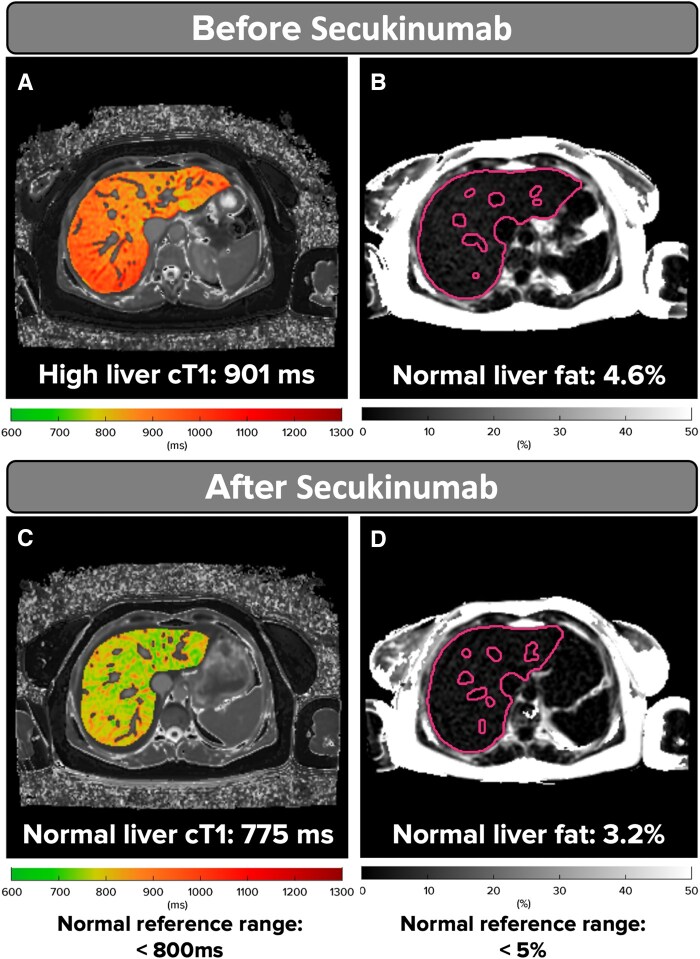 Figure 1
- —The National Psoriasis Foundation
- —UCB Biopharma SRL10.13039/100011110
- —National Institute for Health Research Clinician Scientist
- —AbbVie10.13039/100006483
- —Novo Nordisk10.13039/501100004191
- —AstraZeneca10.13039/100004325
- —NHS10.13039/100030827
- —NIHR10.13039/100006662
- —Department of Health10.13039/100004856
Peer Reviews
No public reviews on file for this paper yet. If you reviewed it on a platform where reviews are public (OpenReview, ICLR, NeurIPS, ICML), you can paste yours below so the community can read it here.
Videos
No videos yet. Explain this paper in a talk, walkthrough, or lecture? Add one.
Taxonomy
TopicsPsoriasis: Treatment and Pathogenesis · Spondyloarthritis Studies and Treatments · Cytokine Signaling Pathways and Interactions
Dear Editor, We report a case demonstrating the reversal of liver fibro-inflammation through the use of a biologic DMARD (bDMARD) in a patient with psoriatic disease and undiagnosed liver disease. A 37-year-old woman with a 20-year history of psoriasis and 17 years of PsA was enrolled in the COLIPSO (Co-prevalence of liver disease in psoriatic disease) study, a long-term observational project investigating liver disease prevalence in psoriatic disease before and after treatment. The patient underwent quantitative multiparametric MRI (mpMRI) of the liver immediately before and after 6 months of treatment with secukinumab, an IL-17A inhibitor.
The patient had no previous history of fatty liver disease, diabetes, hypertension, or hyperlipidaemia. Her BMI was 32.7 kg/m^2^, and her alcohol intake was minimal (<5 units/week). Previous treatments for PsA included MTX (15 mg weekly), discontinued after 4 weeks in 2011 due to transaminitis, as well as LEF, adalimumab, and SSZ, all of which failed to control the disease.
At baseline, the patient’s DASs included 3 tender and swollen joints, CRP 3.6 mg/l and psoriasis skin body surface area of 3%. The Disease Activity in Psoriatic Arthritis (DAPSA) Score was 15.46, indicating moderate disease activity (a score within the range of 15 to 28). The 12-item Psoriatic Arthritis Impact of Disease (PsAID-12) is a patient-reported outcome measure that assesses the symptoms and impact of PsA, with a higher score indicating a poorer patient-reported status. The score obtained at baseline was 2.75 out of 10, suggesting moderate symptom/impact (a score within the range of >1.95 to ≤3.60). On clinical examination, there was no evidence of enthesitis, dactylitis, or axial SpA. The patient’s routine liver function tests were within normal limits [albumin 38 g/l (<50 g/l), bilirubin 10 µmol/l (<21 µmol/l), alanine transaminase 36 U/l (<40 U/l), and ALP 68 U/l (<130 U/l)]. An unexpectedly elevated Enhanced Liver Fibrosis (ELF) score of 8.4 indicated mild underlying early fibrosis. The ELF test is a non-invasive blood test used to assess the risk of advanced liver fibrosis in individuals with metabolic dysfunction-associated steatotic liver disease (MASLD). Furthermore, the initial mpMRI detected previously unidentified liver disease activity with significantly elevated inflammation levels. The iron-corrected T1 (cT1) score was measured at 901 ms (normal range <800 ms), and the liver fat (MRI-proton density fat fraction) was found to be 4.6%, close to the diagnostic threshold of ≥5% for MASLD (see Fig. 1).
After 6 months of secukinumab treatment (300 mg once monthly following the loading dose), liver metrics improved remarkably: cT1 decreased to 775 ms, MRI-PDFF (proton density fat fraction) to 3.2% (see Fig. 1), and the ELF score to 7.9. This reduction in cT1 is associated with a >2-point change in non-alcoholic fatty liver disease activity score, which is recognized in hepatology as a clinically meaningful improvement in liver health [1]. Clinical disease activity improved significantly, with zero tender and swollen joints, CRP of 1.3 mg/l, and psoriasis body surface area 0%. Additionally, the DAPSA score was 4.13 (a score of between 0 and 4 suggests PsA is in remission), and the PsAID-12 score was 0.75, a 2-point decrease for the PsAID-12 total score from baseline (a score of ≤1.15 denotes remission/no symptoms/no impact).
MASLD is estimated to be the leading cause of liver disease worldwide [2]. It is increasingly recognized as a common condition coexisting in patients with psoriatic disease, along with other comorbidities such as obesity and diabetes. Quantitative mpMRI, combining cT1 and MRI-PDFF, can rapidly and non-invasively quantify liver tissue characteristics, particularly inflammation and steatosis [3, 4].
In the context of psoriatic disease treatment, various biologic DMARDs target pro-inflammatory cytokines such as TNF alpha and ILs (IL-17 and IL-12/23). Nonetheless, there are currently no established guidelines for treating PsA with co-existing MASLD, and the precise impact of bDMARD medications on this condition is still unknown. Hepatic immune cell function undergoes restructuring in MASLD, which in turn plays a role in the development and progression of the disease [5]. Recent studies have highlighted the role of the type 3 cytokines, including IL-17 and IL-22, in modulating MASLD pathogenesis [5, 6]. Increased lipid uptake by liver cells and obesity drive higher IL-17 production, both systemically and within liver cells. IL-17 activates inflammation and biological processes, contributing to MASLD progression [7]. Gene expression profiling has further revealed a strong association between the IL-17 pathway and both psoriatic disease and MASLD [8]. These findings suggest a potential mechanistic link between the two conditions and highlight the possibility of targeting shared pathways for therapeutic benefit.
To our knowledge, this is the first reported case demonstrating the reversal of liver fibro-inflammation through the use of a biologic DMARD. This case suggests the potential of IL-17A inhibitors to improve co-existing liver disease in patients with PsA, underscoring the importance of considering liver health in psoriatic disease management. It suggests a possible dual benefit of certain biologic treatments, targeting shared immunological pathways between psoriatic disease and MASLD. Further research is warranted to explore the efficacy of biologic DMARDs in managing MASLD in patients with psoriatic disease, potentially opening new avenues for treatment strategies that address both conditions simultaneously.
Ethics committee approval was granted by Bromley REC for the COLIPSO study (Ref: 20/LO/0616). The patient in this case report has approved the publication and reviewed the report.
The reference list from the paper itself. Each links out to its DOI / PubMed record.
- 1Banerjee R , Pavlides M, Tunnicliffe EM et al Multiparametric magnetic resonance for the non-invasive diagnosis of liver disease. J Hepatol 2014;60:69–77.24036007 10.1016/j.jhep.2013.09.002PMC 3865797 · doi ↗ · pubmed ↗
- 2Chan WK , Chuah KH, Rajaram RB et al Metabolic Dysfunction-Associated Steatotic Liver Disease (MASLD): A State-of-the-Art Review. J Obes Metab Syndr 2023;32:197–213.37700494 10.7570/jomes 23052 PMC 10583766 · doi ↗ · pubmed ↗
- 3Rinella ME , Neuschwander-Tetri BA, Siddiqui MS et al AASLD Practice Guidance on the clinical assessment and management of nonalcoholic fatty liver disease. Hepatology 2023;77:1797–835.36727674 10.1097/HEP.0000000000000323 PMC 10735173 · doi ↗ · pubmed ↗
- 4Andersson A , Kelly M, Imajo K et al Clinical Utility of Magnetic Resonance Imaging Biomarkers for Identifying Nonalcoholic Steatohepatitis Patients at High Risk of Progression: A Multicenter Pooled Data and Meta-Analysis. Clin Gastroenterol Hepatol 2022;20:2451–61 e 3.34626833 10.1016/j.cgh.2021.09.041 · doi ↗ · pubmed ↗
- 5Sawada K , Chung H, Softic S, Moreno-Fernandez ME, Divanovic S. The bidirectional immune crosstalk in metabolic dysfunction-associated steatotic liver disease. Cell Metab 2023;35:1852–71.37939656 10.1016/j.cmet.2023.10.009PMC 10680147 · doi ↗ · pubmed ↗
- 6Abdelnabi MN , Hassan GS, Shoukry NH. Role of the type 3 cytokines IL-17 and IL-22 in modulating metabolic dysfunction-associated steatotic liver disease. Front Immunol 2024;15:1437046.39156888 10.3389/fimmu.2024.1437046 PMC 11327067 · doi ↗ · pubmed ↗
- 7Giles DA , Moreno-Fernandez ME, Stankiewicz TE et al Regulation of Inflammation by IL-17A and IL-17F Modulates Non-Alcoholic Fatty Liver Disease Pathogenesis. P Lo S One 2016;11:e 0149783.26895034 10.1371/journal.pone.0149783 PMC 4760740 · doi ↗ · pubmed ↗
- 8Tan S , Liu M, Feng F et al Exploring the pathogenesis and immunological profiles of psoriasis complicated with MASLD. P Lo S One 2024;19:e 0305217.38917217 10.1371/journal.pone.0305217 PMC 11198785 · doi ↗ · pubmed ↗