Designing for trustworthiness and research reciprocity: An example from the Illinois research network hub in the NIH RECOVER adult cohort study
Elijah Kindred, Alejandra L. Ibañez, Marta Cerda, Emily Kowey, Hugh Musick, Robin Mermelstein, Lynn B. Gerald, Jerry A. Krishnan

Abstract
Genes, proteins, chemicals, diseases, species, mutations and cell lines named across the full text — each resolved to its canonical identifier and authoritative record.
Click any figure to enlarge with its caption.
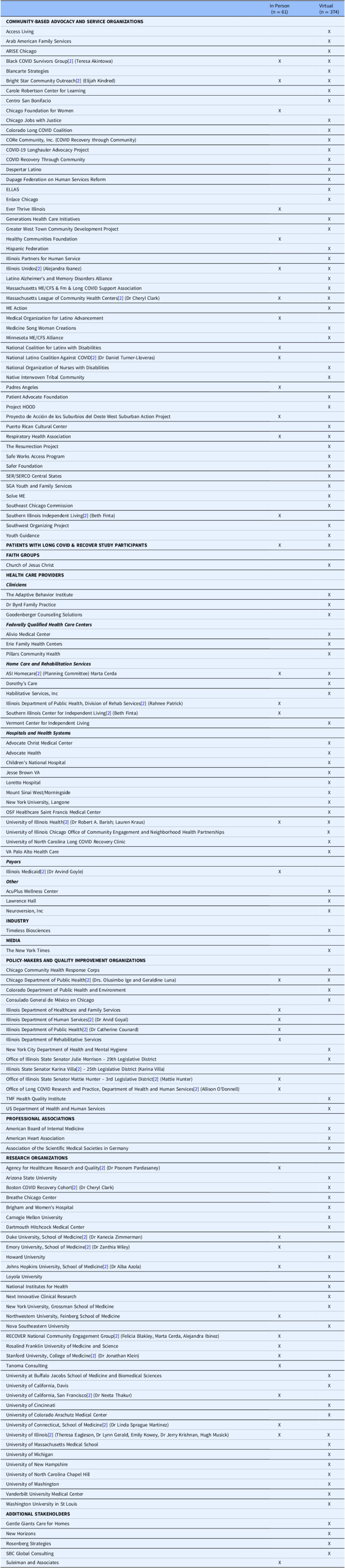 Figure 1
Peer Reviews
No public reviews on file for this paper yet. If you reviewed it on a platform where reviews are public (OpenReview, ICLR, NeurIPS, ICML), you can paste yours below so the community can read it here.
Videos
No videos yet. Explain this paper in a talk, walkthrough, or lecture? Add one.
Taxonomy
TopicsHealth, Environment, Cognitive Aging
Community-based participatory research (CBPR) is a collaborative model of translational research [1] that engages community members and researchers as equal partners, focused on addressing community-identified needs to drive policy change.[2–4] Increasingly, early-stage translational researchers partner with affected populations, including community-based organizations (CBOs), to identify and overcome barriers to recruitment and retention [5,6]. While such a role is critical, limiting CBOs involvement to recruitment and retention views these organizations’ primary function as serving as an intermediary between researchers and participants and fails to appreciate the full scope of what partner organizations can offer to research collaborations.
We advocate for expanded inclusion of CBOs in designing early-stage translational research as a part of a paradigm shift to designing for dissemination and sustainability (D4DS) [7]. D4DS refers to principles and methods for ensuring the fit between a health innovation and the context before adoption. A co-design process including researchers and CBOs can ensure that innovations are usable by the communities which are the target of the intervention [7–11]. This report describes a unique example of a community-led summit which brought together patients, community organizations, federal and state organizations, and state legislators to address community concerns regarding Long COVID. To our knowledge, this is the first example of community involvement on a national scale for a study that spans multiple methodologies including pathogenesis, epidemiology, and clinical trials. The NIH Researching COVID to Enhance Recover (RECOVER) Initiative aims to deepen our understanding of Long COVID’s epidemiology and develop effective treatments for affected individuals [12]. RECOVER is one of the largest studies ever funded by the federal government representing $1.7 billion in investment since its inception in 2021. Here, we highlight how CBOs leveraged their access to scientific experts and healthcare providers to elevate awareness of affected communities’ needs, organizing a national meeting with local, state, and federal policymakers.
The Illinois Research Network (ILLInet) Hub, a collaborator in the RECOVER Adult Cohort Study, operates across five Illinois sites, including two operated by CBOs (Illinois Unidos and Bright Star Community Outreach) [13]. ILLInet includes seven additional CBOs (ASI Home Care Services, Envision Community Service, Teamwork Englewood, Tri-County Urban League, Peoria Friendship House, Chicago Urban League, Central Illinois Friends) who contribute by co-designing and disseminating educational materials on COVID-19 and Long COVID, providing feedback on community-based research activities, and identifying effective communication channels for outreach. These partnerships were essential to ILLInet’s enrolling and conducting follow-up visits in 900 diverse participants (49% non-Hispanic white, 22% non-Hispanic Black, 14% Hispanic, 6% multiple, 5% Asian, 3% unknown).
In the study’s fourth year, three CBOs (ASI Home Care Service, Bright Star Community Outreach, and Illinois Unidos) organized a summit to learn about research findings and engage state policymakers. The summit featured 61 in-person and 367 virtual attendees (Table 1) and included live Spanish interpretation. People with Long COVID, representatives of community organizations, and federal and state government officials served as speakers and discussants on various topics, including the 2024 National Academies’ definition of Long COVID [14], the NIH RECOVER Initiative (observational studies and clinical trials) [12], strategies for stakeholder engagement and policy advocacy[15], barriers to Long COVID care[16], and the AHRQ Long COVID Care Network [17].
Table 1.Stakeholder groups participating in the long COVID summit.^ 1 ^ In Person(n = 61)Virtual(n = 374) COMMUNITY-BASED ADVOCACY AND SERVICE ORGANIZATIONS Access LivingXArab American Family ServicesXARISE ChicagoXBlack COVID Survivors Group[2] (Teresa Akintowa)XXBlancarte StrategiesXBright Star Community Outreach[2] (Elijah Kindred)XXCarole Robertson Center for LearningXCentro San BonifacioXChicago Foundation for WomenXChicago Jobs with JusticeXColorado Long COVID CoalitionXCORe Community, Inc. (COVID Recovery through Community)XCOVID-19 Longhauler Advocacy ProjectXCOVID Recovery Through CommunityXDespertar LatinoXDupage Federation on Human Services ReformXELLASXEnlace ChicagoXEver Thrive IllinoisXGenerations Health Care InitiativesXGreater West Town Community Development ProjectXHealthy Communities FoundationXHispanic FederationXIllinois Partners for Human ServiceXIllinois Unidos[2] (Alejandra Ibanez)XXLatino Alzheimer’s and Memory Disorders AllianceXMassachusetts ME/CFS & Fm & Long COVID Support AssociationXMassachusetts League of Community Health Centers[2] (Dr Cheryl Clark)XXME ActionXMedical Organization for Latino AdvancementXMedicine Song Woman CreationsXMinnesota ME/CFS AllianceXNational Coalition for Latinx with DisabilitiesXNational Latino Coalition Against COVID[2] (Dr Daniel Turner-Lloveras)XNational Organization of Nurses with DisabilitiesXNative Interwoven Tribal CommunityXPadres AngelesXPatient Advocate FoundationXProject HOODXProyecto de Acción de los Suburbios del Oeste West Suburban Action ProjectXPuerto Rican Cultural CenterXRespiratory Health AssociationXXThe Resurrection ProjectXSafe Works Access ProgramXSafer FoundationXSER/SERCO Central StatesXSGA Youth and Family ServicesXSolve MEXSoutheast Chicago CommissionXSouthern Illinois Independent Living[2] (Beth Finta)XSouthwest Organizing ProjectXYouth GuidanceX PATIENTS WITH LONG COVID & RECOVER STUDY PARTICIPANTS XX FAITH GROUPS Church of Jesus ChristX HEALTH CARE PROVIDERS
** Clinicians ** The Adaptive Behavior InstituteXDr Byrd Family PracticeXGoodenberger Counseling SolutionsX ** Federally Qualified Health Care Centers ** Alivio Medical CenterXErie Family Health CentersXPillars Community HealthX ** Home Care and Rehabilitation Services ** ASI Homecare[2] (Planning Committee) Marta CerdaXXDorothy’s CareXHabilitative Services, IncXIllinois Department of Public Health, Division of Rehab Services[2] (Rahnee Patrick)XSouthern Illinois Center for Independent Living[2] (Beth Finta)XVermont Center for Independent LivingX ** Hospitals and Health Systems ** Advocate Christ Medical CenterXAdvocate HealthXChildren’s National HospitalXJesse Brown VAXLoretto HospitalXMount Sinai West/MorningsideXNew York University, LangoneXOSF Healthcare Saint Francis Medical CenterXUniversity of Illinois Health[2] (Dr Robert A. Barish; Lauren Kraus)XXUniversity of Illinois Chicago Office of Community Engagement and Neighborhood Health PartnershipsXUniversity of North Carolina Long COVID Recovery ClinicXVA Palo Alto Health CareX ** Payors ** Illinois Medicaid[2] (Dr Arvind Goyle)X ** Other ** AcuPlus Wellness CenterXLawrence HallXNeuroversion, IncX INDUSTRY Timeless BiosciencesX MEDIA The New York TimesX POLICY-MAKERS AND QUALITY IMPROVEMENT ORGANIZATIONS Chicago Community Health Response CorpsXChicago Department of Public Health[2] (Drs. Olusimbo Ige and Geraldine Luna)XXColorado Department of Public Health and EnvironmentXConsulado General de México en ChicagoXIllinois Department of Healthcare and Family ServicesXIllinois Department of Human Services[2] (Dr Arvid Goyal)XIllinois Department of Public Health[2] (Dr Catherine Counard)XIllinois Department of Rehabilitative ServicesXNew York City Department of Health and Mental HygieneXOffice of Illinois State Senator Julie Morrison – 29th Legislative DistrictXIllinois State Senator Karina Villa[2] – 25th Legislative District (Karina Villa)Office of Illinois State Senator Mattie Hunter – 3rd Legislative District[2] (Mattie Hunter)XOffice of Long COVID Research and Practice, Department of Health and Human Services[2] (Allison O’Donnell)XTMF Health Quality InstituteXUS Department of Health and Human ServicesX PROFESSIONAL ASSOCIATIONS American Board of Internal MedicineXAmerican Heart AssociationXAssociation of the Scientific Medical Societies in GermanyX RESEARCH ORGANIZATIONS Agency for Healthcare Research and Quality[2] (Dr Poonam Pardasaney)XArizona State UniversityXBoston COVID Recovery Cohort[2] (Dr Cheryl Clark)XBreathe Chicago CenterXBrigham and Women’s HospitalXCarnegie Mellon UniversityXDartmouth Hitchcock Medical CenterXDuke University, School of Medicine[2] (Dr Kanecia Zimmerman)XEmory University, School of Medicine[2] (Dr Zanthia Wiley)XHoward UniversityXJohns Hopkins University, School of Medicine[2] (Dr Alba Azola)XLoyola UniversityXNational Institutes for HealthXNext Innovative Clinical ResearchXNew York University, Grossman School of MedicineXNorthwestern University, Feinberg School of MedicineXNova Southeastern UniversityXRECOVER National Community Engagement Group[2] (Felicia Blakley, Marta Cerda, Alejandra Ibinez)XRosalind Franklin University of Medicine and ScienceXStanford University, College of Medicine[2] (Dr Jonathan Klein)XTanoma ConsultingXUniversity at Buffalo Jacobs School of Medicine and Biomedical SciencesXUniversity of California, DavisXUniversity of California, San Francisco[2] (Dr Neeta Thakur)XUniversity of CincinnatiXUniversity of Colorado Anschutz Medical CenterXUniversity of Connecticut, School of Medicine[2] (Dr Linda Sprague Martinez)XUniversity of Illinois[2] (Theresa Eagleson, Dr Lynn Gerald, Emily Kowey, Dr Jerry Krishnan, Hugh Musick)XXUniversity of Massachusetts Medical SchoolXUniversity of MichiganXUniversity of New HampshireXUniversity of North Carolina Chapel HillXUniversity of WashingtonXVanderbilt University Medical CenterXWashington University in St LouisX ADDITIONAL STAKEHOLDERS Gentle Giants Care for HomesXNew HorizonsXRosenberg StrategiesXSBC Global ConsultingXSuleiman and AssociatesX 1 Organizations that registered for the Summit are grouped into categories to show the breadth and diversity of participants, but organizations may fit into more than one category. [2] Indicates speaker, panelist, or moderator at the Summit.
After the didactic portions of the meeting, in-person summit participants were divided into work groups for in-depth discussion to determine recommendations for actions to improve Long COVID care. The following actions were recommended:
- Engage CBOs or other trusted representatives of affected populations as research partners from the start of studies involving human volunteers to ensure study activities are culturally sensitive, linguistically accessible, and address systemic barriers (e.g., mistrust in medical institutions among people of color).
- Fund CBOs or other trusted representatives to co-design outreach and support (e.g., education, mask distribution), provide navigation services (e.g., disability applications, provider referrals), and share information about research opportunities, including clinical trials.
- Expand the AHRQ Long COVID Care Network and increase funding for training healthcare professionals to effectively diagnose, treat, and advocate for Long COVID patients.
- Support researcher-CBO collaborations to drive policy change and combat misinformation, enhancing trust and promoting health equity.
CBO partners are presenting these recommendations to the Illinois State Legislature which are more likely to be adopted because CBOs and researchers worked together. The recommendations are based on science but also consider the needs and desires of the communities most affected by Long COVID. CBOs have substantial influence in lobbying legislators and public health officials to adopt and sustain programs and policies.
We conclude that the current model of CBPR should be expanded to support greater reciprocity between early-stage translational research and affected populations. By collaborating closely with CBOs and other representatives, researchers can go beyond traditional recruitment and retention goals to conduct studies that address knowledge gaps and are designed to promote trustworthiness in both the research process and study results. CBOs can be valuable collaborators in co-designing research questions and implementing studies. These partnerships enable researchers to gain valuable insight into community needs, ensure culturally and contextually appropriate study designs, provide mechanisms for communities to engage meaningfully in research, and enhance adoption potential. Moving toward a D4DS approach enhances the public health impact of research by ensuring effective dissemination such as policy changes that benefit all populations.
The reference list from the paper itself. Each links out to its DOI / PubMed record.
- 1Fort DG , Herr TM , Shaw PL , Gutzman KE , Starren JB. Mapping the evolving definitions of translational research. J Clin Transl Sci. 2017;1(1):60–66. doi: 10.1017/cts.2016.10.28480056 PMC 5408839 · doi ↗ · pubmed ↗
- 2Lacombe D , Bogaerts J , Tombal B , et al. Late translational research: putting forward a new model for developing new anti-cancer treatments that addresses the needs of patients and society. Mol Oncol. 2019;13(3):558–566. doi: 10.1002/1878-0261.12431.30561901 PMC 6396352 · doi ↗ · pubmed ↗
- 3Nichols M , Magwood G , Woodbury M , Brown K , Jenkins C , Owolabi M. Crafting community-based participatory research stroke interventions. Stroke. 2022;53(3):680–688. doi: 10.1161/STROKEAHA.121.035306.35105185 PMC 8885875 · doi ↗ · pubmed ↗
- 4Tariq S , Grewal EK , Booth R , et al. Lessons learned from a virtual community-based participatory research project: prioritizing needs of people who have diabetes and experiences of homelessness to co-design a participatory action project. Res Involv Engagem. 2023;9(1):46. doi: 10.1186/s 40900-023-00456-z.37403184 PMC 10320889 · doi ↗ · pubmed ↗
- 5Georas SN , Wright RJ , Ivanova A , et al. The precision interventions for severe and/or exacerbation-prone (Prec ISE) asthma network: an overview of network organization, procedures, and interventions. J Allergy Clin Immunol. 2022;149(2):488–516.e 9. doi: 10.1016/j.jaci.2021.10.035.34848210 PMC 8821377 · doi ↗ · pubmed ↗
- 6Reyfman PA , Sugar E , Hazucha H , et al. Study protocol for a national cohort of adults focused on respiratory health: the American Lung Association Lung Health Cohort (ALA-LHC) study. BMJ Open. 2021;11(7):e 053342. doi: 10.1136/bmjopen-2021-053342.PMC 825866434226239 · doi ↗ · pubmed ↗
- 7Kwan BM , Brownson RC , Glasgow RE , Morrato EH , Luke DA. Designing for dissemination and sustainability to promote equitable impacts on health. Annu Rev Public Health. 2022;43:331–353. doi: 10.1146/annurev-publhealth-052220-112457.34982585 PMC 9260852 · doi ↗ · pubmed ↗
- 8Bonham-Werling J , Passmore S , Hendricks K , et al. Co-designing to advance community health and health equity in Wisconsin: building the neighborhood health partnerships program. J Clin Transl Sci. 2021;5(1):e 87. doi: 10.1017/cts.2021.11. · doi ↗