Genomic characteristics of the multiresistant Acinetobacter baumannii global clone 1 reference strain A297/RUH875
Jonathan Koong, Ruth M Hall, Mehrad Hamidian

TL;DR
This paper analyzes the genome of a drug-resistant Acinetobacter baumannii strain to understand its resistance and evolutionary history.
Contribution
The study provides a complete genome sequence of A297/RUH875, revealing resistance genes and phylogenetic placement within GC1.
Findings
The genome includes a 3.965 Mb chromosome and three plasmids, including a 200 kb conjugative plasmid.
The AbaR21 resistance island contains seven antibiotic resistance genes and six prophage regions.
Phylogenetic analysis shows A297/RUH875 as a distinct lineage within GC1 with 122 SNPs compared to A1.
Abstract
Acinetobacter baumannii ST1, also known as global clone 1 (GC1), is a globally distributed lineage associated with antimicrobial resistance (AMR). The multiresistant isolate A297/RUH8751, recovered from a urinary tract infection in the Netherlands in 1984, has served as a reference strain for ST1. We aimed to generate and analyse the complete genome sequence of A297/RUH8751 to provide insights into its genomic features, antibiotic resistance determinants and phylogenetic placement. WGS was performed using Oxford Nanopore GridION and Illumina HiSeq platforms. Assembly was conducted with Autocycler v0.2.1. Genomic features, including antibiotic resistance genes, insertion sequences and restriction-modification systems, were characterized using ResFinder, ISFinder and REBASE. Comparative analyses were conducted with the draft genome of NIPH 527, which also represents RUH875, to assess…
Genes, proteins, chemicals, diseases, species, mutations and cell lines named across the full text — each resolved to its canonical identifier and authoritative record.
Click any figure to enlarge with its caption.
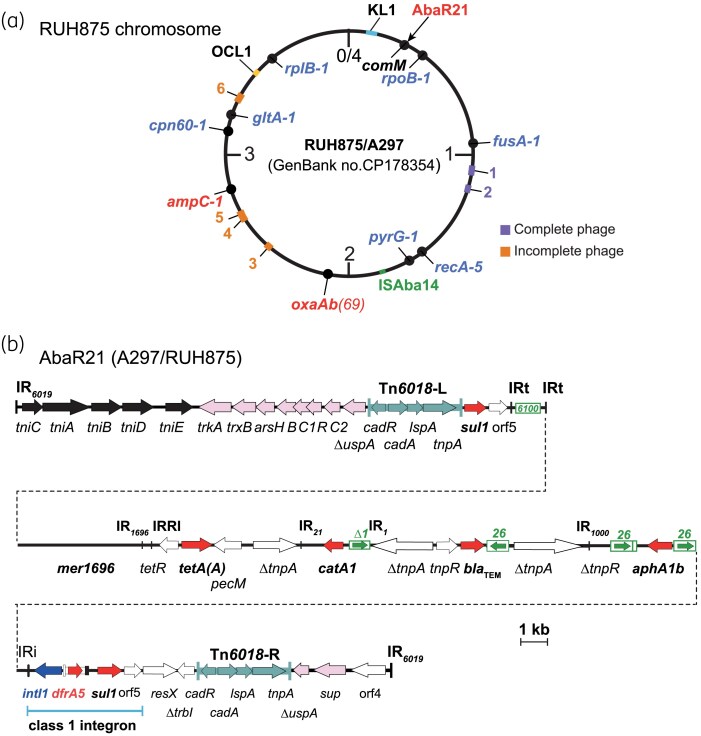 Figure 1
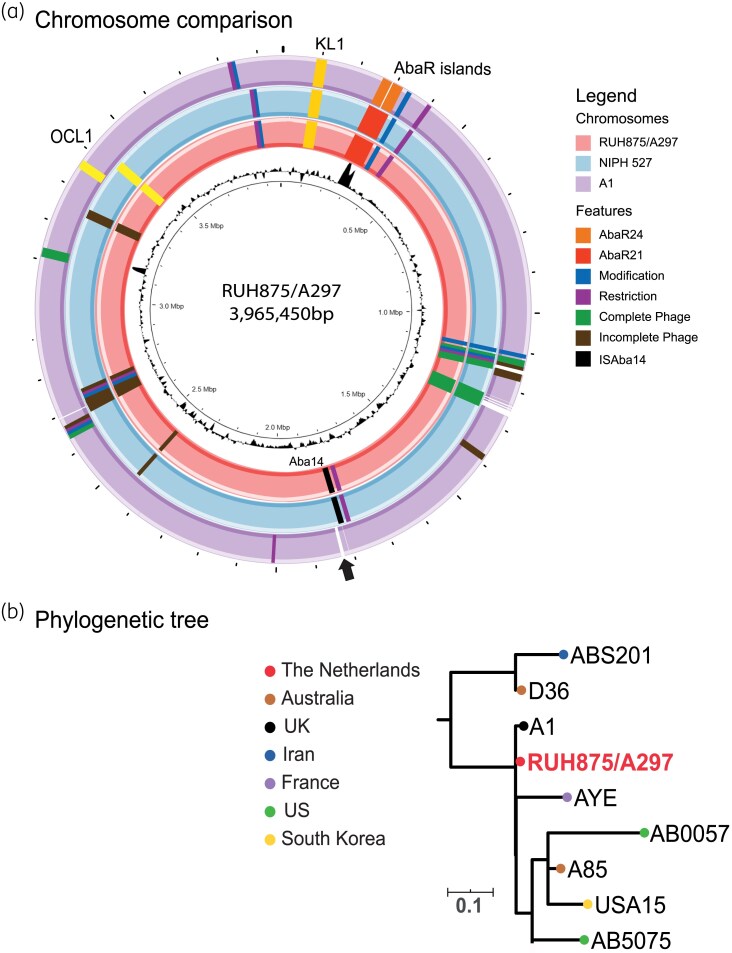 Figure 2
- —Australian Institute for Microbiology and Infection
- —University of Technology Sydney, Australia10.13039/501100001775
- —Australian Government Research Training Program
- —National Health and Medical Research Council Australia Investigator Fellowship
Peer Reviews
No public reviews on file for this paper yet. If you reviewed it on a platform where reviews are public (OpenReview, ICLR, NeurIPS, ICML), you can paste yours below so the community can read it here.
Videos
No videos yet. Explain this paper in a talk, walkthrough, or lecture? Add one.
Taxonomy
TopicsAntibiotic Resistance in Bacteria · Genomics and Phylogenetic Studies · Salmonella and Campylobacter epidemiology
Introduction
MDR, XDR and pan-resistant isolates of Acinetobacter baumannii are predominantly members of two globally distributed STs: ST1 (Institut Pasteur); and ST2 (also known as global clones 1 and 2 or simply GC1 and GC2, respectively).^1,2^ Accessing genome sequence data of historical and reference strains is essential for tracking the genetic evolution of antibiotic resistance and understanding the mechanisms behind the spread of these resistant isolates. The multiresistant isolate RUH875^3^ was recovered in Dordrecht, The Netherlands from a urinary tract infection in 1984. It has been used in many studies as a reference strain for ST1 (GC1) and ST1 isolates are now known to be distributed globally as they have been found in Asia, Australia,^4^ the Middle East region,^5^ Europe, the USA, Africa^6,7^ and in South America.^8^
RUH875 was stored as A297^9^ in the laboratory of Dr Kevin Towner at the Nottingham University Hospitals NHS Trust, UK and sent to the Hall laboratory where it was stored at −80˚C. We previously reported the draft genome of A297^4^ (GenBank no. FBWR00000000) and also showed it contains three plasmids, namely pA297-1 (6078 bp; GenBank no. KU869529.1), which is also known as pRAY*,^10^ pA297-2 (8731 bp; GenBank no. KU869528.1) encoding an R3-T1 replication protein, and pA297-3 (200 633 bp conjugative plasmid with an MPF_I_ transfer system; GenBank no. KU744946.1).^11^ In addition, pA297-3 has been shown to mobilize pRAY* at high frequency.^12^ Here, we report the complete genome sequence of the multiresistant A. baumannii isolate A297 representing RUH875 and compare it with the draft genome of NIPH 527,^13^ which also represents RUH857 that was stored in the laboratory of Dr Alexandre Nemec in the Czech Republic.
Materials and methods
WGS and assembly
Whole-cell DNA was extracted from A297 cells grown at 37°C in LB inoculated from a single colony as described previously.^4^ The DNA was prepared, barcoded and long-read sequenced at the Ramaciotti Centre for Genomics (UNSW Sydney, Australia) using a GridION GXB03456 (Oxford Nanopore Technology), flow cell FLO-MIN114 and kit SQKRBK114-96. Sequencing was run using the high-accuracy model basecalling (v4.3.0, 400 bp) and a minimum Q score of 9. The GridION reads were quality checked using Filtlong v0.2.1 (https://github.com/rrwick/Filtlong) with their adaptors removed using Porechop v0.2.4 (https://github.com/rrwick/Porechop) using default parameters. Short-read Illumina HiSeq data, determined previously^4^ with 100 × coverage and N50: 110 bp (SRA accession number ERS192746), were quality checked using the FastQC program (https://www.bioinformatics.babraham.ac.uk/projects/fastqc/) followed by trimming adaptors using the Trimmomatic program.^14^ The GridION reads were combined with Illumina HiSeq using Autocycler v0.2.1 (https://github.com/rrwick/Autocycler) to generate a complete assembly.
Sequence and phylogenetic analysis
Antibiotic resistance genes, insertion sequences and surface polysaccharides that were previously reported by Holt et al. in 2016,^4^ were confirmed using the ResFinder,^15^ ISFinder^16^ and Kaptive^17^ programs. REBASE was used to identify restriction/modification genes (https://rebase.neb.com/rebase/rebase.html). CRISPR-Cas types were found using the CRISPR-CasFinder database (https://crisprcas.i2bc.paris-saclay.fr/CrisprCasFinder/Index). Proksee software was used to align the genomes of A297, NIPH527 and A1, and to generate the circular alignment map.^18^ PHASTEST was used to identify prophage regions in A297, NIPH527 and A1.^19^
Phylogenetic analysis
For comparative analyses, eight additional GC1 genomes representing the main clades and lineages within GC1 (as previously determined by Koong et al.^20^) were included in this study. Whole-genome alignments were produced using Panaroo v1.3.2 (https://github.com/gtonkinhill/panaroo). SNPs acquired by recombination were filtered using Gubbins v.2.4.1^21^ and fed into IQ-Tree2 v2.2.0.3 (http://www.iqtree.org/) to produce a maximum-likelihood phylogenetic tree. The final maximum-likelihood phylogenetic tree was inferred from the resulting alignment using RAxML v8 (https://cme.h-its.org/exelixis/web/software/raxml/index.html) with the generalized time-reversible (GTR) gamma model of nucleotide substitution, as previously described. The phylogenetic tree was visualized using the ggtree package^22^ in R.
The reference list from the paper itself. Each links out to its DOI / PubMed record.
- 1Cain AK, Hamidian M. Portrait of a killer: uncovering resistance mechanisms and global spread of Acinetobacter baumannii. P Lo S Pathog 2023; 19: e 1011520. 10.1371/journal.ppat.101152037561719 PMC 10414682 · doi ↗ · pubmed ↗
- 2Hamidian M, Nigro SJ. Emergence, molecular mechanisms and global spread of carbapenem-resistant Acinetobacter baumannii. Microb Genom 2019; 5: e 000306. 10.1099/mgen.0.00030631599224 PMC 6861865 · doi ↗ · pubmed ↗
- 3Dijkshoorn L, Aucken H, Gerner-Smidt P et al Comparison of outbreak and nonoutbreak Acinetobacter baumannii strains by genotypic and phenotypic methods. J Clin Microbiol 1996; 34: 1519–25. 10.1128/jcm.34.6.1519-1525.19968735109 PMC 229053 · doi ↗ · pubmed ↗
- 4Holt K, Kenyon JJ, Hamidian M et al Five decades of genome evolution in the globally distributed, extensively antibiotic-resistant Acinetobacter baumannii global clone 1. Microb Genom 2016; 2: e 000052. 10.1099/mgen.0.00005228348844 PMC 5320584 · doi ↗ · pubmed ↗
- 5Douraghi M, Kenyon JJ, Aris P et al Accumulation of antibiotic resistance genes in carbapenem-resistant Acinetobacter baumannii isolates belonging to lineage 2, global clone 1, from outbreaks in 2012–2013 at a Tehran Burns Hospital. m Sphere 2020; 5: e 00164-20. 10.1128/m Sphere.00164-2032269158 PMC 7142300 · doi ↗ · pubmed ↗
- 6Ambrose SJ, Ibri P, Harmer CJ et al Characterisation of an early South African multiply antibiotic-resistant global clone 1 Acinetobacter baumannii isolate. J Glob Antimicrob Resist 2023; 33: 337–44. 10.1016/j.jgar.2023.05.00337225002 · doi ↗ · pubmed ↗
- 7Lowe M, Singh-Moodley A, Ismail H et al Molecular characterisation of Acinetobacter baumannii isolates from bloodstream infections in a tertiary-level hospital in South Africa. Front Microbiol 2022; 13: 863129. 10.3389/fmicb.2022.86312935992699 PMC 9391000 · doi ↗ · pubmed ↗
- 8Brito BP, Koong J, Wozniak A et al Genomic analysis of carbapenem-resistant Acinetobacter baumannii strains recovered from Chilean hospitals reveals lineages specific to South America and multiple routes for acquisition of antibiotic resistance genes. Microbiol Spectr 2022; 10: e 02463-22. 10.1128/spectrum.02463-2236154439 PMC 9602995 · doi ↗ · pubmed ↗