Washing obsessive-compulsive symptoms as adaptation—insights from a 3-year longitudinal cohort during the COVID-19 pandemic
Ana Daniela Costa, Catarina Raposo-Lima, Beatriz Couto, Afonso Fernandes, Mafalda Machado-Sousa, Pedro Silva Moreira, Sónia Ferreira, Maria Picó-Pérez, Pedro Morgado

TL;DR
This study shows how washing behaviors increased during the early pandemic but decreased over time, suggesting they were adaptive responses to stress.
Contribution
The study provides longitudinal evidence on how pandemic-related stress influenced obsessive-compulsive and anxiety symptoms in the general population.
Findings
Washing symptoms increased in 2020 but decreased significantly by 2021 and 2022.
Anxiety scores were highest in 2020 and 2022, with a dip in 2021.
The study highlights the adaptive role of psychological distress during global crises.
Abstract
Stressful events are one cause for the emergence and/or worsening of obsessive-compulsive symptoms. The public health measures employed to prevent the contraction of the COVID-19 virus overlap with common behaviors adopted by people diagnosed with obsessive-compulsive disorder. Thus, we decided to study the longitudinal impact of the pandemic in the general Portuguese population assessed with the Obsessive-Compulsive Inventory (OCI-R), and the Depressive, Anxiety, and Stress Scale (DASS-21). One hundred and eighty-nine participants reported their scores at three different time-points of the pandemic in Portugal: March of 2020, March of 2021, and March of 2022. Non-parametric repeated measures analyses were performed on the OCI-R and DASS-21 scores to analyze differences in the levels of symptomatology throughout time. We found statistically significant differences with time in the…
Genes, proteins, chemicals, diseases, species, mutations and cell lines named across the full text — each resolved to its canonical identifier and authoritative record.
Click any figure to enlarge with its caption.
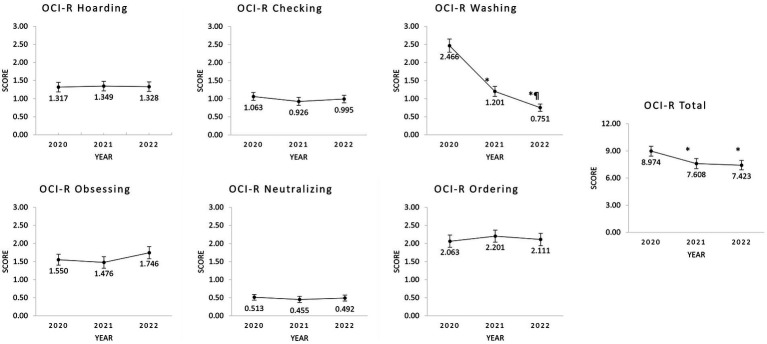 Figure 1
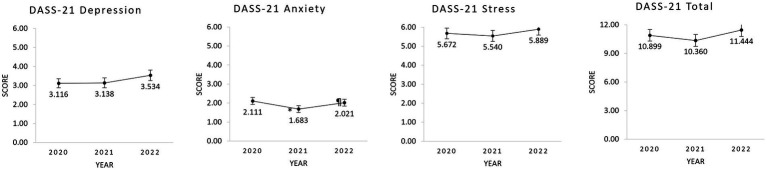 Figure 2
Peer Reviews
No public reviews on file for this paper yet. If you reviewed it on a platform where reviews are public (OpenReview, ICLR, NeurIPS, ICML), you can paste yours below so the community can read it here.
Videos
No videos yet. Explain this paper in a talk, walkthrough, or lecture? Add one.
Taxonomy
TopicsObsessive-Compulsive Spectrum Disorders · Body Image and Dysmorphia Studies · Anxiety, Depression, Psychometrics, Treatment, Cognitive Processes