Humans exhibit associative symmetry in the absence of backward training and stimulus overlap
Victor M. Navarro, Edward A. Wasserman

TL;DR
This study shows that humans can exhibit associative symmetry without backward training or overlapping stimuli, addressing common issues in previous research.
Contribution
The study introduces an improved method for testing associative symmetry in humans, eliminating common confounding factors.
Findings
Participants showed robust symmetry in associative networks without backward training.
Removing temporal overlap between stimuli did not eliminate symmetry effects.
Symmetry was observed in both bidirectional and unidirectional networks.
Abstract
A recent survey of the evidence on associative symmetry in humans revealed that nearly all the demonstrations either unintentionally trained backward stimulus pairings and/or had a temporal overlap between the stimuli being trained. We consider these criticisms and improve on our own method of “associative networks.” In this method, participants learn multiple stimulus pairings via arbitrary matching‐to‐sample tasks in which the stimuli are concurrently presented as sample and comparison stimuli. In Experiment 1, human participants learned a bidirectional network (in which symmetry was synergistic) and a unidirectional network (in which symmetry was antagonistic) or two unidirectional networks (removing explicit reinforcement of backward stimulus pairings). In Experiment 2, participants learned two unidirectional networks; however, we removed the temporal overlap between sample and…
Genes, proteins, chemicals, diseases, species, mutations and cell lines named across the full text — each resolved to its canonical identifier and authoritative record.
Click any figure to enlarge with its caption.
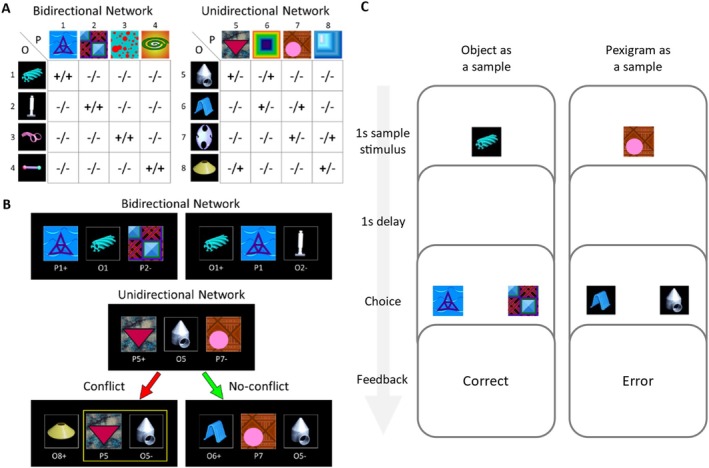 Figure 1
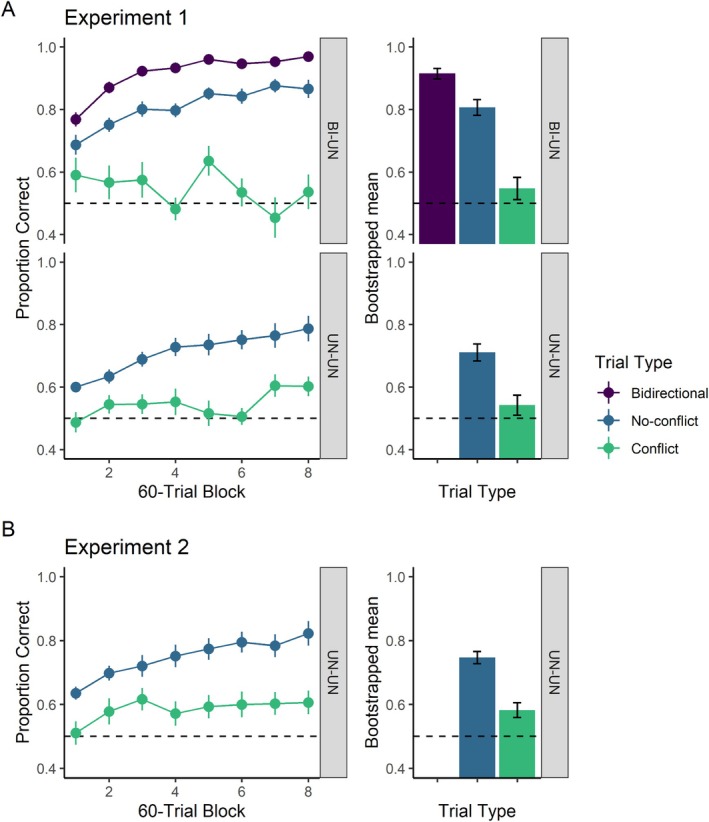 Figure 2
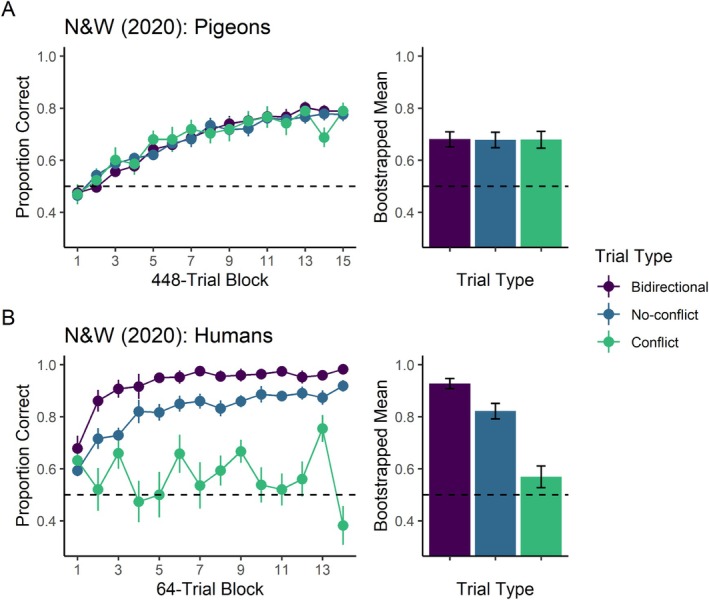 Figure 3
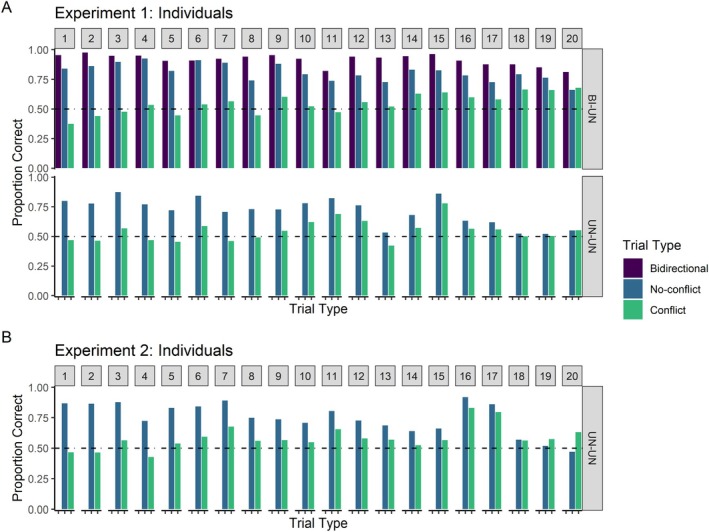 Figure 4
Peer Reviews
No public reviews on file for this paper yet. If you reviewed it on a platform where reviews are public (OpenReview, ICLR, NeurIPS, ICML), you can paste yours below so the community can read it here.
Videos
No videos yet. Explain this paper in a talk, walkthrough, or lecture? Add one.
Taxonomy
TopicsBehavioral and Psychological Studies · Child and Animal Learning Development · Cognitive and developmental aspects of mathematical skills