GPR139, an Ancient Receptor and an Emerging Target for Neuropsychiatric and Behavioral Disorders
Minyu Chan, Satoshi Ogawa

TL;DR
GPR139 is a conserved receptor linked to neuropsychiatric disorders and may serve as a therapeutic target for conditions like substance abuse and cognitive deficits.
Contribution
This review highlights GPR139's role in neuropsychiatric and behavioral disorders and identifies knowledge gaps for future research.
Findings
GPR139 is conserved across vertebrates and expressed in midbrain regions linked to behavior and cognition.
Dysregulation of GPR139 is associated with substance abuse, withdrawal, and cognitive deficits in animal and human studies.
Modulation of GPR139 with agonists like TAK-041 shows promise but has produced inconsistent clinical results.
Abstract
GPR139 is an orphan G-protein-coupled receptor that is predominantly expressed in several midbrain regions, e.g., the habenula, striatum, and hypothalamus. GPR139 gene is highly conserved across vertebrate phylogenetic taxa, suggesting its fundamental importance in neurophysiology. Evidence from both animal studies and human genetic association studies has demonstrated that dysregulation of GPR139 expression and function is linked to aberrant behaviors, cognitive deficits, alterations in sleep and alertness, and substance abuse and withdrawal. Animal knockout models suggest that GPR139 plays an anti-opioid role by modulating the signaling activity of the μ-opioid receptor (MOR), as well as the intensity of withdrawal symptoms and nociception in behavioral paradigms. Modulation of GPR139 activity by surrogate agonists such as TAK-041 and JNJ-63533054 has shown promising results in…
Genes, proteins, chemicals, diseases, species, mutations and cell lines named across the full text — each resolved to its canonical identifier and authoritative record.
Click any figure to enlarge with its caption.
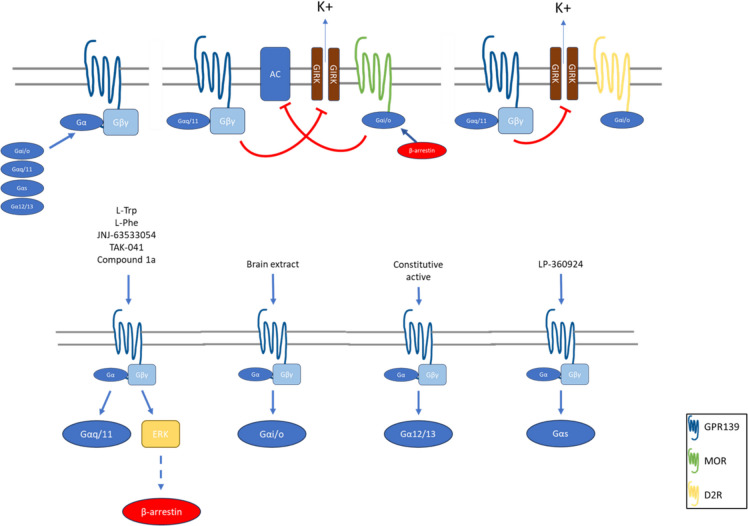 Figure 1
Peer Reviews
No public reviews on file for this paper yet. If you reviewed it on a platform where reviews are public (OpenReview, ICLR, NeurIPS, ICML), you can paste yours below so the community can read it here.
Videos
No videos yet. Explain this paper in a talk, walkthrough, or lecture? Add one.
Taxonomy
TopicsReceptor Mechanisms and Signaling · Neuropeptides and Animal Physiology · Neurotransmitter Receptor Influence on Behavior