Molecular Prevalence and Identification of Zoonotic Plasmodium spp., Including Plasmodium knowlesi, Plasmodium cynomolgi, and Plasmodium inui, in Long-Tailed Macaques (Macaca fascicularis) of Southern Thailand
Thanawat Hmaidee, Rucksak Rucksaken, Supakarn Kaewchot, Piya Sereerak, Salintorn Thongsahuan, Thitichai Jarudecha, Sakulchit Wichainchot, Phakorn Wilaisri, Chanapath Thabthimsri, Perm Premphoolsawat, Wanat Sricharern

TL;DR
This study found that long-tailed macaques in southern Thailand carry zoonotic malaria parasites, highlighting the risk of transmission to humans.
Contribution
The study reports the molecular prevalence and identification of Plasmodium inui, Plasmodium knowlesi, and Plasmodium cynomolgi in long-tailed macaques in southern Thailand.
Findings
Plasmodium inui was the most prevalent species at 9.4% in macaques.
Surat Thani had the highest prevalence of infected macaques at 18%.
Zoonotic Plasmodium spp. in macaques pose a public health risk due to increasing human-macaque interactions.
Abstract
Zoonotic malaria, caused by simian Plasmodium spp., poses a major public health challenge in Southeast Asia, including Thailand, where long-tailed macaques (Macaca fascicularis) serve as natural reservoirs. This study investigated the molecular prevalence and species identification of zoonotic simian Plasmodium spp. in macaques from four provinces in Southern Thailand: Phetchaburi, Satun, Phang Nga, and Surat Thani. A total of 310 blood samples were collected between May 2023 and June 2024 and analyzed using nested and seminested polymerase chain reaction (PCR) techniques targeting the 18S rRNA gene. Sequencing analyses confirmed the presence of zoonotic Plasmodium species. Overall, 11.3% (35/310; 95% CI: 7.9–15.3) of the macaques tested positive, with Plasmodium inui being the most prevalent species at 9.4% (29/310), followed by Plasmodium knowlesi and Plasmodium cynomolgi, each at…
Genes, proteins, chemicals, diseases, species, mutations and cell lines named across the full text — each resolved to its canonical identifier and authoritative record.
Click any figure to enlarge with its caption.
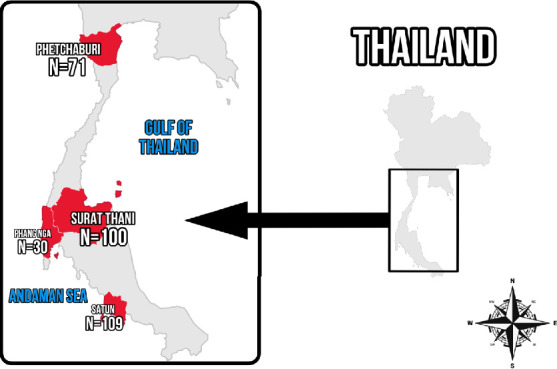 Figure 1
Peer Reviews
No public reviews on file for this paper yet. If you reviewed it on a platform where reviews are public (OpenReview, ICLR, NeurIPS, ICML), you can paste yours below so the community can read it here.
Videos
No videos yet. Explain this paper in a talk, walkthrough, or lecture? Add one.
Taxonomy
TopicsMalaria Research and Control · Primate Behavior and Ecology · Bird parasitology and diseases