Trichophyton rubrum inhibits Candida albicans filamentation and its gene expression when grown in biofilms in vitro
Níura Madalena Bila, Carolina Orlando Vaso, Jenyffie Araújo Belizário, Mariana M Santoni Biasioli, Ana Marisa Fusco-Almeida, Luis R Martinez, Caroline Barcelos Costa-Orlandi, Maria José Soares Mendes-Giannini

TL;DR
Trichophyton rubrum inhibits the filamentation of Candida albicans in biofilms, possibly by altering key gene expressions.
Contribution
The study reveals a novel antagonistic interaction between Trichophyton rubrum and Candida albicans at the gene expression level in biofilms.
Findings
Trichophyton rubrum supernatants reduced the thickness of Candida albicans biofilms.
Candida albicans filamentation genes (CPH1, HWP1, EFG1) were downregulated in co-culture with Trichophyton rubrum.
Direct cultivation of the two fungi inhibited Candida albicans filamentation.
Abstract
Dermatomycoses are caused by various fungi, including dermatophytes and Candida species, which are the most prevalent in isolated or associated forms. A great number of virulence factors expressed by these fungi are important for infection, and biofilm formation leads to the persistence of these infections. This work aimed to evaluate the dynamics of Candida albicans filamentation genes in biofilms formed by Candida albicans and Trichophyton rubrum. The effect of the supernatants on the biofilms was assessed by XTT reduction assay, confocal microscopy, and gene expression profile analysis by real-time polymerase chain reaction (RT-PCR). The supernatants did not reduce the metabolic activities or damage the topography of the monospecies biofilms but caused a reduction in their thickness. The filamentation of C. albicans was inhibited when both fungi were cultivated directly. The…
Genes, proteins, chemicals, diseases, species, mutations and cell lines named across the full text — each resolved to its canonical identifier and authoritative record.
Click any figure to enlarge with its caption.
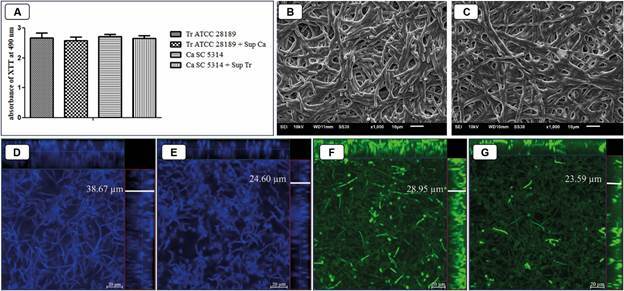 Figure 1
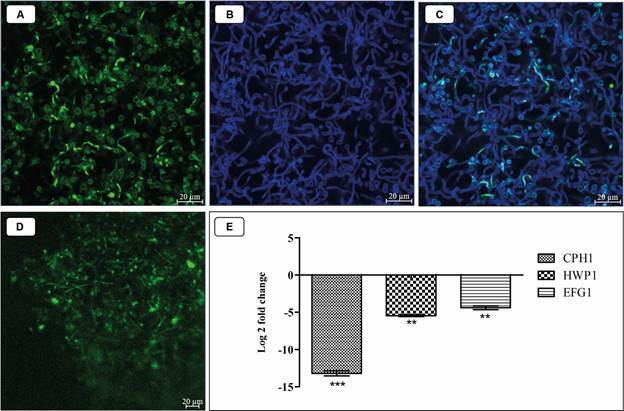 Figure 2
Peer Reviews
No public reviews on file for this paper yet. If you reviewed it on a platform where reviews are public (OpenReview, ICLR, NeurIPS, ICML), you can paste yours below so the community can read it here.
Videos
No videos yet. Explain this paper in a talk, walkthrough, or lecture? Add one.
Taxonomy
TopicsAntifungal resistance and susceptibility · Nail Diseases and Treatments · Fungal Infections and Studies