Exploring the torque- velocity relationship in postmenopausal women: Analyzing the influence of data processing
Jessica Rial-Vázquez, Alejandra Camacho-Villa, Sonia Liliana Rivera-Mejía, Iván Nine, María Rúa-Alonso, Juan Fariñas, Borja Revuelta-Lera, Eliseo Iglesias-Soler, Hasan Sozen, Hasan Sozen, Hasan Sozen

TL;DR
This study compares different models for fitting torque-velocity data in postmenopausal women and finds that data processing methods significantly affect the results.
Contribution
The study introduces a comparison of linear and nonlinear models for torque-velocity relationships and highlights the impact of data processing in postmenopausal women.
Findings
The goodness of fit and estimated parameters differ significantly between actual and target data for both knee extensors and elbow flexors.
Quadratic polynomial models provided the best fit for elbow flexors, while Hill’s model was best for knee extensors but produced unrealistic velocity estimates.
The study recommends using quadratic polynomial models for torque-velocity data in postmenopausal women.
Abstract
The main aims of this study were to compare the goodness of fit and derived parameters of linear and non-linear models for fitting the torque-velocity (TV) relationship in postmenopausal women, and to examine the influence of data processing on the results obtained. Sixteen physically active postmenopausal women completed the experiment. Knee extensor (KE) and elbow flexor (EF) muscle strength was evaluated in the dominant limb using an isokinetic dynamometer. Isometric and isokinetic tests were conducted at 30, 60, 120, 180, 240, and 300°/s. Peak torque and the corresponding joint angles were recorded for each test. TV data were fitted using linear, quadratic polynomial (PM), and Hill’s (HM) regression models. TV relationships were analyzed using both actual data (i.e., the velocity achieved and its associated torque; TVA) and target data (i.e., the velocity preset on the dynamometer…
Genes, proteins, chemicals, diseases, species, mutations and cell lines named across the full text — each resolved to its canonical identifier and authoritative record.
Click any figure to enlarge with its caption.
 Figure 1
 Figure 2
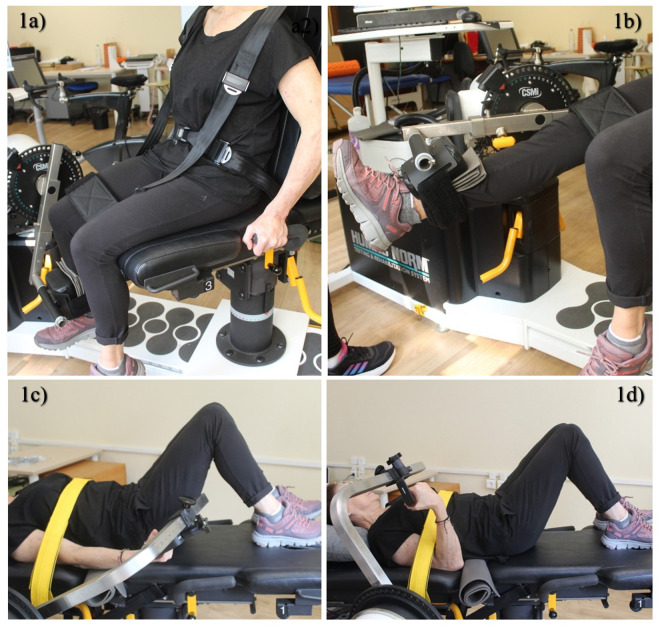 Figure 3
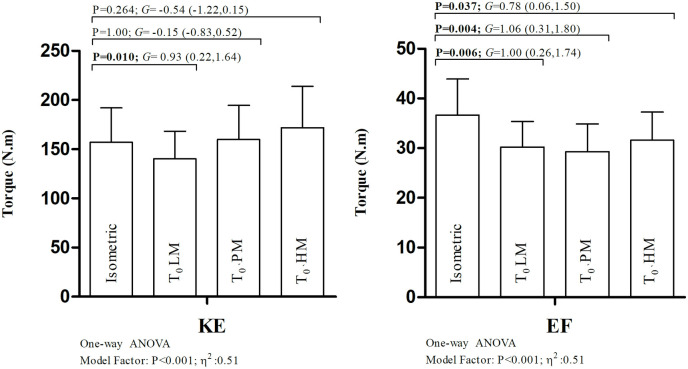 Figure 4
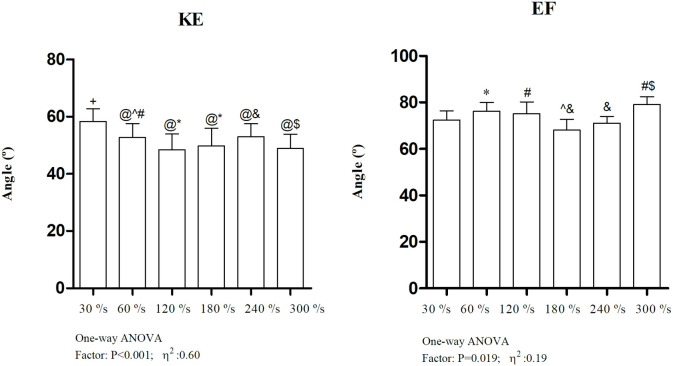 Figure 5
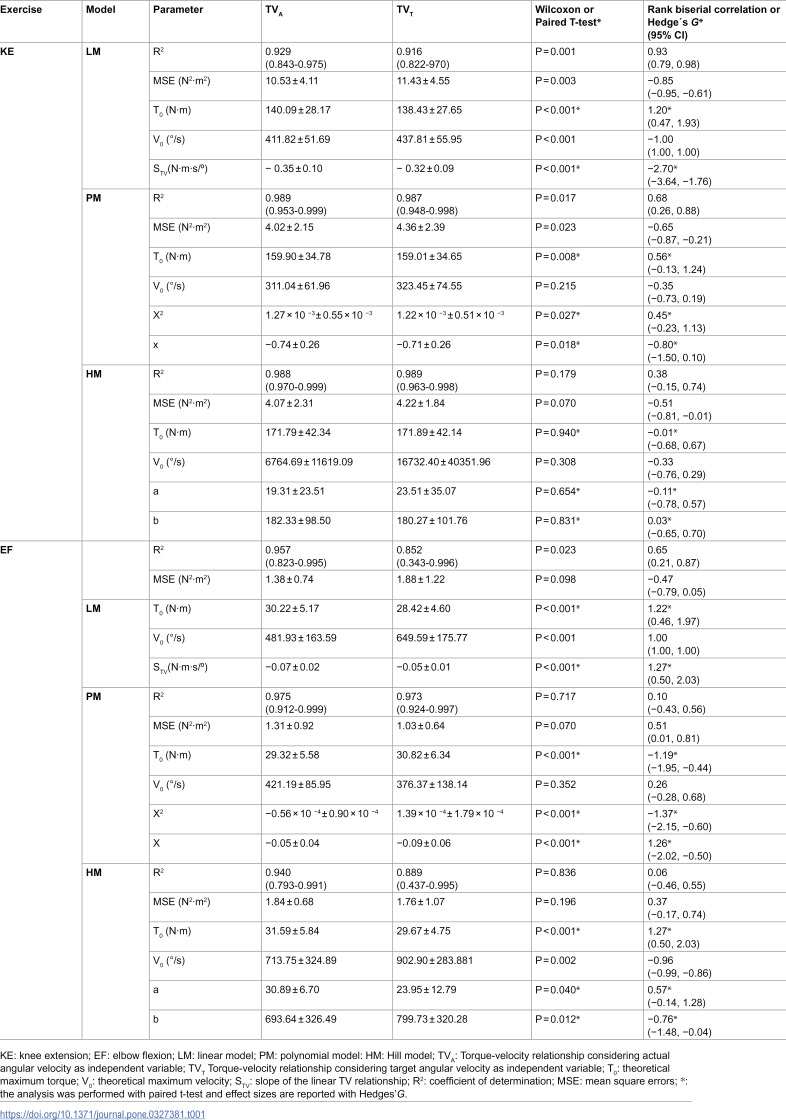 Figure 6
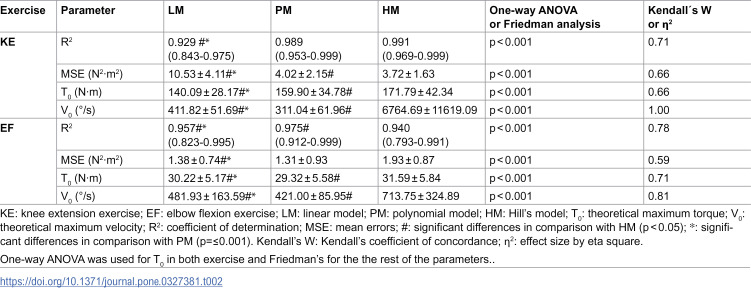 Figure 7
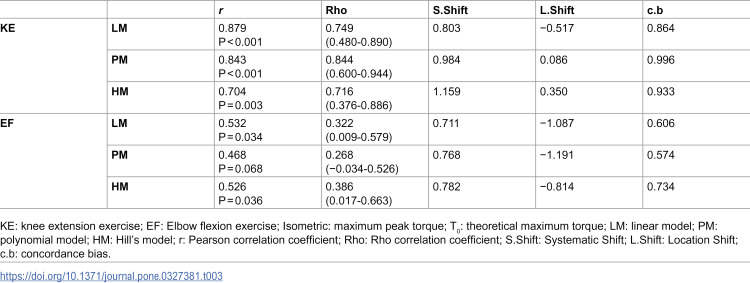 Figure 8
Peer Reviews
No public reviews on file for this paper yet. If you reviewed it on a platform where reviews are public (OpenReview, ICLR, NeurIPS, ICML), you can paste yours below so the community can read it here.
Videos
No videos yet. Explain this paper in a talk, walkthrough, or lecture? Add one.
Taxonomy
TopicsSports Performance and Training · Muscle activation and electromyography studies · Sports injuries and prevention