Investigating Awareness and Acceptance of Digital Phenotyping in Dhaka’s Korail Slum: Qualitative Study
Nadia Alam, Domenico Giacco, Bulbul Siddiqi, Swaran P Singh, Sagar Jilka

TL;DR
This study explores how residents of a slum in Dhaka, Bangladesh, perceive digital phenotyping for mental health care, finding a need for education, privacy safeguards, and cultural adaptation.
Contribution
The study provides novel insights into awareness, acceptance, and privacy concerns of digital phenotyping in a low-income, urban slum population in a LMIC context.
Findings
Most participants lacked prior knowledge of digital phenotyping but acknowledged its potential after explanation.
Privacy concerns were significant, with fears of data misuse and a need for trust-building measures.
Participants emphasized the importance of adapting DP tools to local cultural and technological contexts.
Abstract
Digital phenotyping (DP), the process of using data from digital devices, such as smartphones and wearable technology to understand and monitor people’s behavior, health, and daily activities, has shown significant promise in mental health care within high-income countries. However, its application in low- and middle-income countries (LMICs) is limited, particularly among impoverished populations such as slum residents. This study investigates the awareness, knowledge, acceptance, and implementation of DP, including willingness to share data, and concerns regarding privacy and data security, among residents of Dhaka’s Korail slum, one of Bangladesh’s largest and most densely populated informal settlements. Understanding awareness, acceptance, and privacy concerns surrounding DP in these settings is critical for its effective implementation. We conducted 8 focus group discussions with…
Genes, proteins, chemicals, diseases, species, mutations and cell lines named across the full text — each resolved to its canonical identifier and authoritative record.
Click any figure to enlarge with its caption.
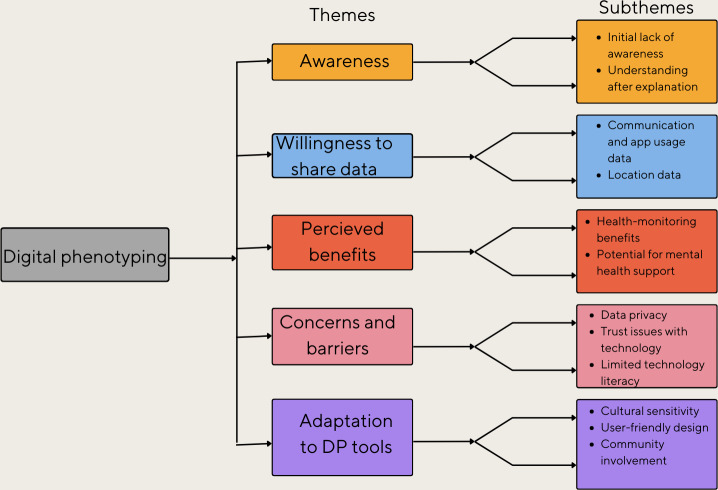 Figure 1
Peer Reviews
No public reviews on file for this paper yet. If you reviewed it on a platform where reviews are public (OpenReview, ICLR, NeurIPS, ICML), you can paste yours below so the community can read it here.
Videos
No videos yet. Explain this paper in a talk, walkthrough, or lecture? Add one.
Taxonomy
TopicsMobile Health and mHealth Applications · Participatory Visual Research Methods · Persona Design and Applications