Phosphonium fullerides: isolable zwitterionic adducts of a phosphine with C60
Maike B. Röthel, Jonas H. Franzen, Daniel Leitner, Thomas S. Hofer, Michael Seidl, Fabian Dielmann

TL;DR
Scientists created new zwitterionic compounds by combining a phosphine with C60, which can be modified further for potential applications.
Contribution
The first isolable zwitterionic phosphonium fullerides formed from a phosphine and C60 are reported.
Findings
The reaction of (tmg)3P with C60 forms zwitterionic adducts (tmg)3PC60 and (tmg)3PC60P(tmg)3 in high yield.
Up to two (tmg)3P molecules can reversibly bind to C60, forming bisphosphine adducts with reduced P–C bond stability.
Phosphonium fullerides can be functionalized with electrophiles, showing their reactivity and potential for modification.
Abstract
Although fullerene derivatization has been extensively studied for decades, zwitterionic adducts with neutral Lewis bases are rare, and those with tertiary phosphines remain elusive. This work presents a combined experimental and computational study on the first isolable zwitterionic phosphonium fullerides. The reaction of tris(tetramethylguanidinyl)phosphine ((tmg)3P) with C60 results in the formation of the zwitterionic adducts (tmg)3PC60 and (tmg)3PC60P(tmg)3 in quantitative yield. Stoichiometric studies demonstrate that up to two (tmg)3P molecules can reversibly bind to C60, forming bisphosphine adducts as regioisomeric mixtures with reduced P–C bond stability. Spectroscopic, crystallographic, and computational analyses reveal the presence of σ-type dative P–C bonds and significant charge redistribution within the fullerene cage. Furthermore, functionalizations of the phosphonium…
Genes, proteins, chemicals, diseases, species, mutations and cell lines named across the full text — each resolved to its canonical identifier and authoritative record.
Click any figure to enlarge with its caption.
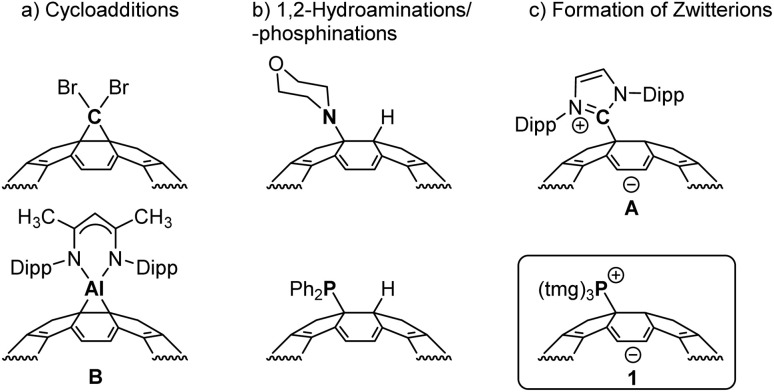 Figure 1
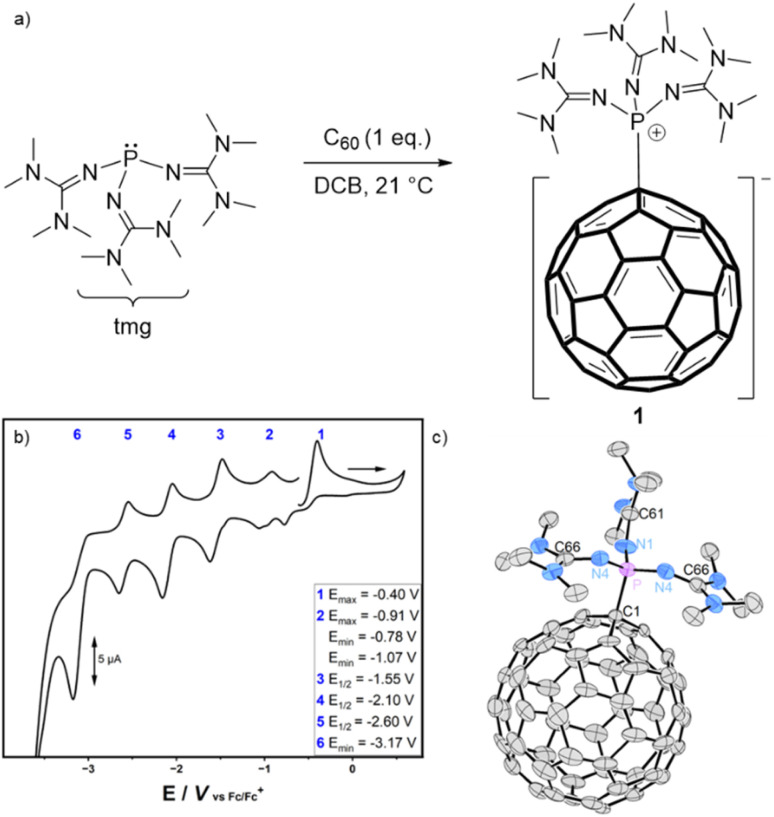 Figure 2
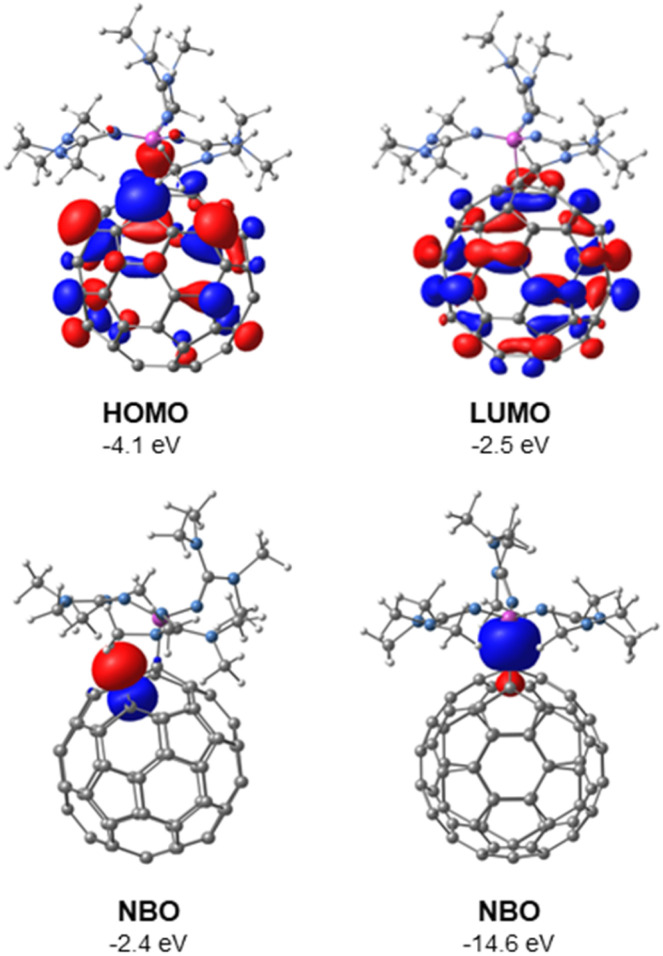 Figure 3
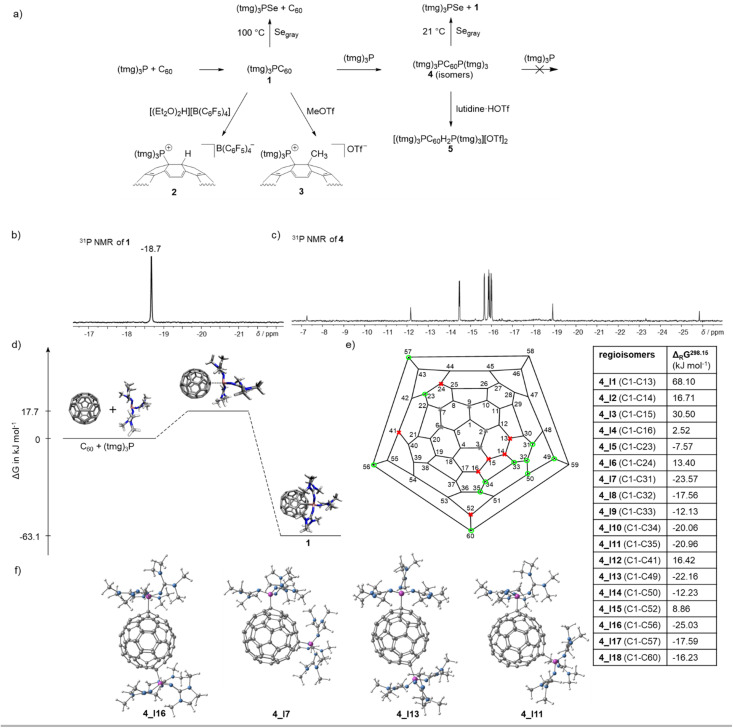 Figure 4
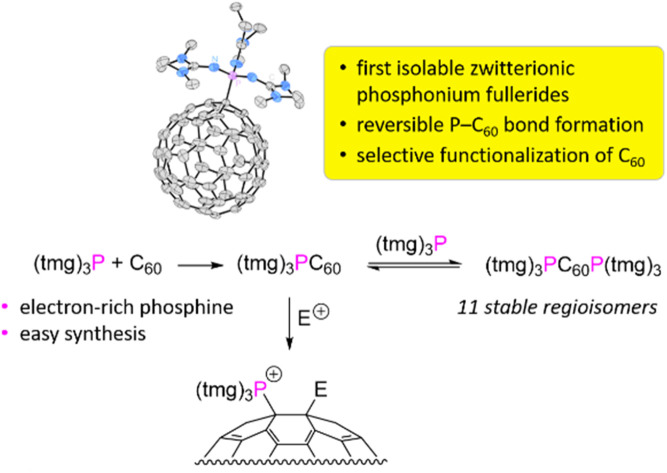 Figure 5
Peer Reviews
No public reviews on file for this paper yet. If you reviewed it on a platform where reviews are public (OpenReview, ICLR, NeurIPS, ICML), you can paste yours below so the community can read it here.
Videos
No videos yet. Explain this paper in a talk, walkthrough, or lecture? Add one.
Taxonomy
TopicsFullerene Chemistry and Applications · Synthesis and characterization of novel inorganic/organometallic compounds · Molecular Junctions and Nanostructures