Tendency in tip polarity changes in non-contact atomic force microscopy imaging on a fluorite surface
Bob Kyeyune, Philipp Rahe, Michael Reichling

TL;DR
This study explores how changes in the microscope tip affect imaging of a fluorite surface at the atomic level.
Contribution
The paper identifies a tendency for tip changes to result in negative tip termination during NC-AFM imaging.
Findings
Tip changes can be classified as polarity-preserving or polarity-changing.
Most tip changes lead to negative tip termination.
The findings suggest stable tip configurations for imaging CaF2(111) surfaces.
Abstract
We investigate the impact of tip changes on atomic-scale non-contact atomic force microscopy (NC-AFM) contrast formation when imaging a CaF2(111) surface. A change of the atomic contrast is explained by a polarity change of the tip-terminating cluster or by a polarity-preserving tip change via the re-arrangement of the foremost atoms. Based on the established understanding of the unique contrast patterns on CaF2(111), polarity-preserving and polarity-changing tip changes can be identified unambiguously. From analyzing a large set of images, we find that the vast majority of tip changes tend to result in negative tip termination. This analysis delivers hints for tip configurations suitable for stable imaging of CaF2(111) surfaces.
Genes, proteins, chemicals, diseases, species, mutations and cell lines named across the full text — each resolved to its canonical identifier and authoritative record.
Click any figure to enlarge with its caption.
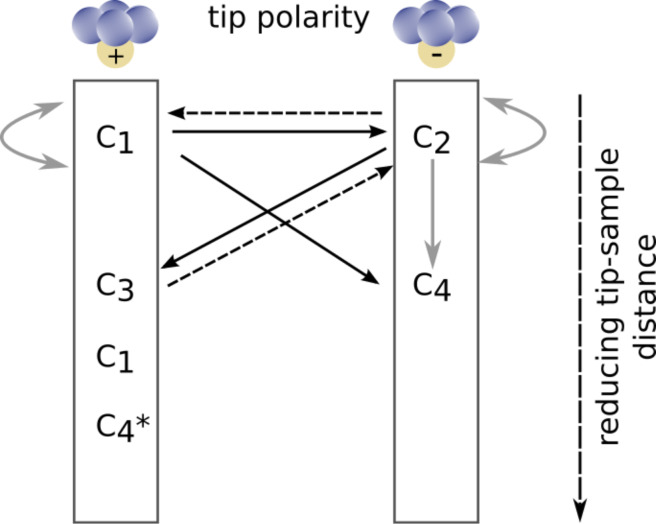 Figure 1
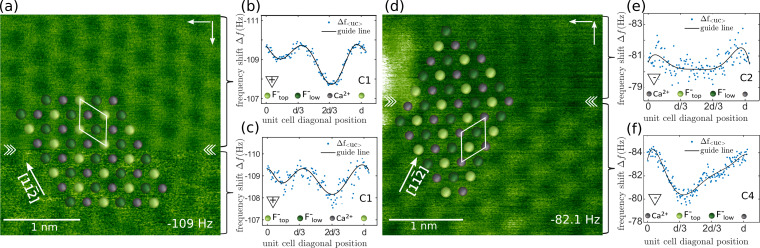 Figure 2
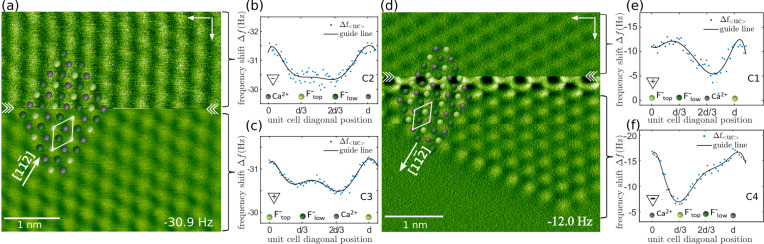 Figure 3
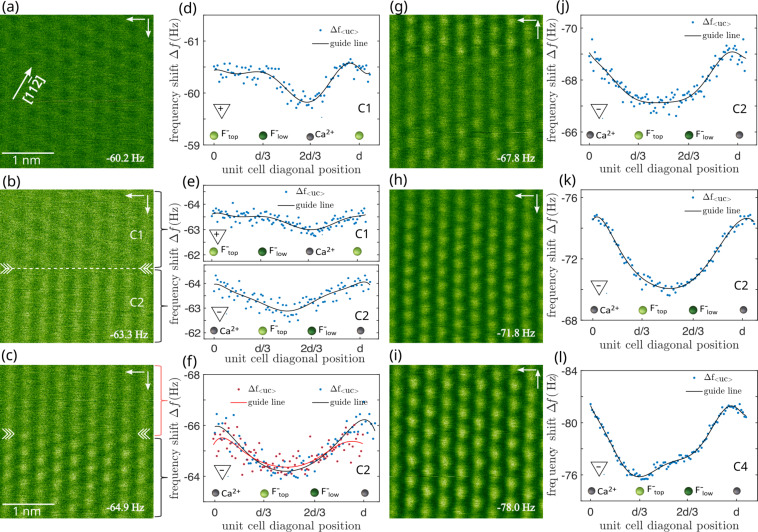 Figure 4
 Figure 5
 Figure 6
 Figure 7
 Figure 8
 Figure 9
 Figure 10
 Figure 11
 Figure 12
 Figure 13
 Figure 14
Peer Reviews
No public reviews on file for this paper yet. If you reviewed it on a platform where reviews are public (OpenReview, ICLR, NeurIPS, ICML), you can paste yours below so the community can read it here.
Videos
No videos yet. Explain this paper in a talk, walkthrough, or lecture? Add one.
Taxonomy
TopicsForce Microscopy Techniques and Applications · Surface and Thin Film Phenomena · Mechanical and Optical Resonators