Macrocyclic Peptide Probes for Immunomodulatory Protein CD59: Potent Modulators of Bacterial Toxin Activity and Antibody‐Dependent Cytotoxicity
Jasmine K. Bickel, Ammar. I. S. Ahmed, Aidan B. Pidd, Rhodri M. Morgan, Tom E. McAllister, Sam Horrell, Emma C. Couves, Hemavathi Nagaraj, Edward J. Bartlett, Kamel El Omari, Akane Kawamura, Doryen Bubeck, Edward W. Tate

TL;DR
Researchers developed new macrocyclic peptides that strongly bind to CD59, a protein involved in immune regulation and disease, offering potential for treating related conditions.
Contribution
The study introduces macrocyclic peptides as a novel strategy to target CD59 with low nanomolar affinity and functional activity.
Findings
Macrocyclic peptide CP-06 binds CD59 through an intermolecular beta-sheet, mimicking natural interactions.
Dimeric and lipidated versions of CP-06 effectively inhibit CD59 activity in cellular contexts.
These peptides modulate both complement-mediated cell killing and bacterial toxin activity.
Abstract
CD59 is an immunomodulatory cell surface receptor associated with human disease. Despite its importance in complement regulation and bacterial pathogenesis, CD59 remains a challenging therapeutic target. Research to date has focused on antibody or protein‐based strategies. Here we present a new approach to target CD59 using macrocyclic peptides with low nanomolar affinity for CD59. Through X‐ray crystallographic studies and structure‐activity relationship (SAR) studies, we identify key interactions that are essential for binding and activity. We find that the macrocyclic peptide CP‐06 adopts a beta‐hairpin structure and binds CD59 through an intermolecular beta‐sheet, mimicking protein–protein interactions of biologically relevant CD59 interaction partners. We create dimeric and lipidated macrocyclic peptide conjugates as enhanced cell‐active CD59 inhibitors and show that these probes…
Genes, proteins, chemicals, diseases, species, mutations and cell lines named across the full text — each resolved to its canonical identifier and authoritative record.
Click any figure to enlarge with its caption.
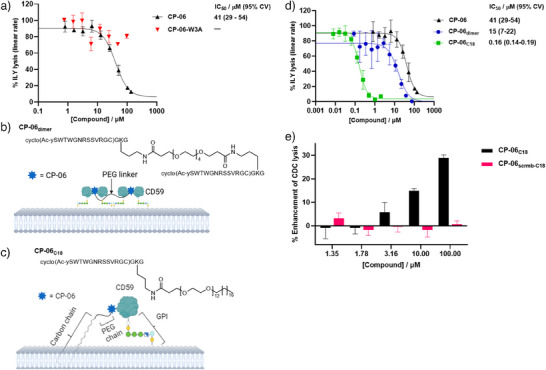 Figure 1
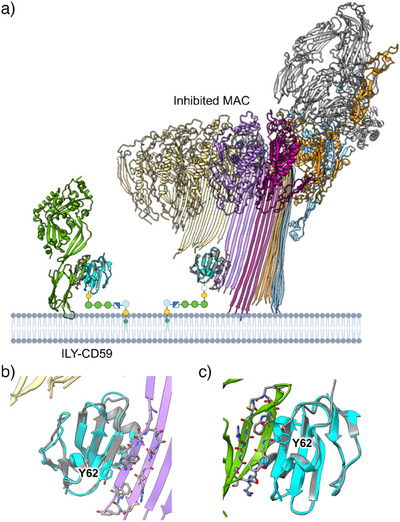 Figure 2
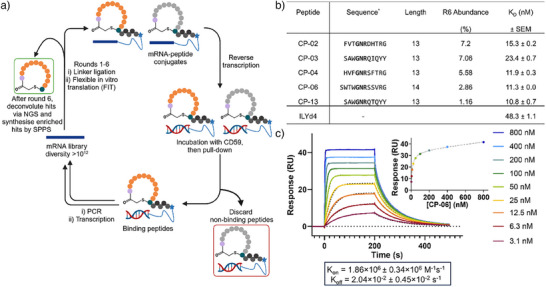 Figure 3
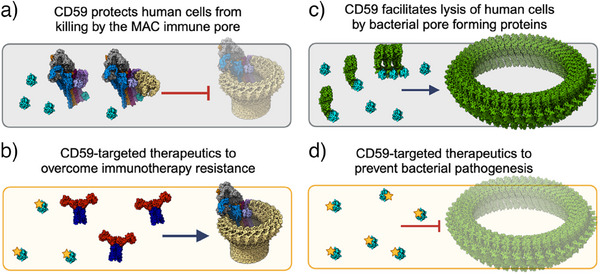 Figure 4
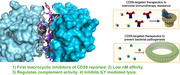 Figure 5
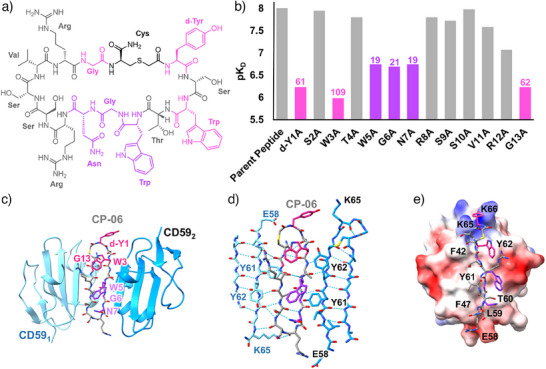 Figure 6
Peer Reviews
No public reviews on file for this paper yet. If you reviewed it on a platform where reviews are public (OpenReview, ICLR, NeurIPS, ICML), you can paste yours below so the community can read it here.
Videos
No videos yet. Explain this paper in a talk, walkthrough, or lecture? Add one.
Taxonomy
TopicsAntimicrobial Peptides and Activities · Complement system in diseases · Immunotherapy and Immune Responses