Bayesian Meta‐Learning for Few‐Shot Reaction Outcome Prediction of Asymmetric Hydrogenation of Olefins
Sukriti Singh, José Miguel Hernández‐Lobato

TL;DR
This paper introduces a Bayesian meta-learning framework that predicts chemical reaction outcomes using limited data, outperforming traditional methods in accuracy.
Contribution
The novel contribution is a Bayesian meta-learning workflow that improves prediction accuracy for asymmetric hydrogenation reactions with sparse data.
Findings
Bayesian meta-learning methods (DKT and ADKF) outperformed single-task models like random forest and graph neural networks.
The proposed ADKF-prior method further improved performance in low-data scenarios.
The meta-model generalized well on substrate- and time-based splits.
Abstract
Recent years have witnessed the increasing application of machine learning (ML) in chemical reaction development. These ML methods, in general, require huge training set examples. The published literature has large amounts of data, but there are modelling challenges due to the sparse nature of these datasets. Herein, we report a meta‐learning workflow that can utilize the literature‐mined data and return accurate predictions with limited data. A literature dataset comprising of over 12 000 transition metal catalyzed asymmetric hydrogenation of olefins (AHO) is chosen to demonstrate the utility of our protocol. A meta‐model is trained in a binary classification setting to identify highly enantioselective AHO reactions. Two Bayesian meta‐learning approaches are considered, namely, deep kernel transfer (DKT) and adaptive deep kernel fitting (ADKF). Both these methods returned better…
Click any figure to enlarge with its caption.
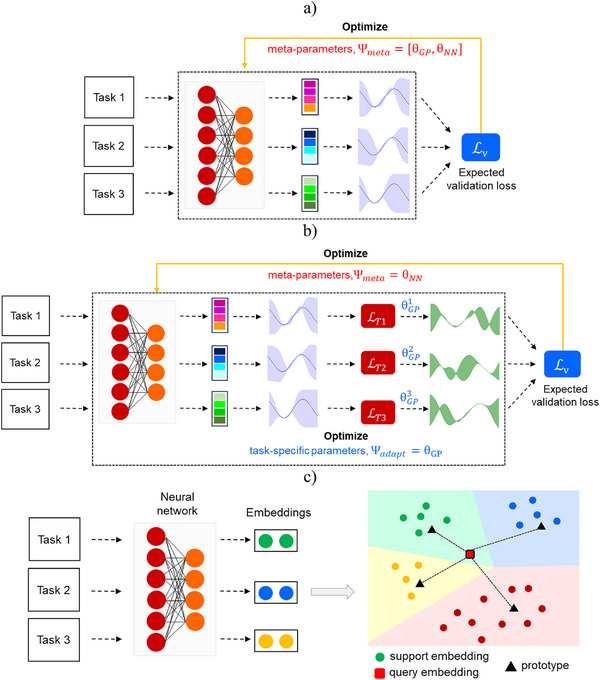 Figure 1
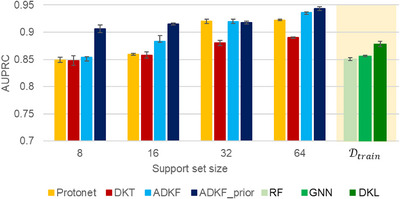 Figure 2
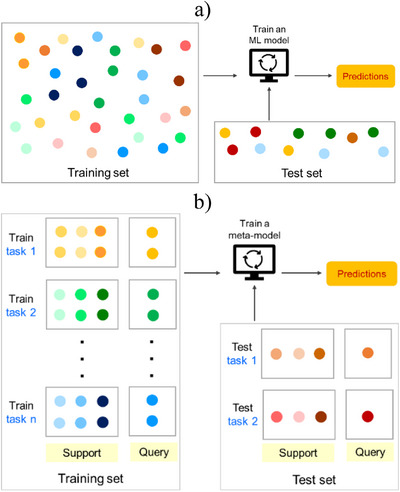 Figure 3
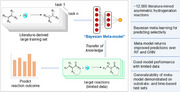 Figure 4
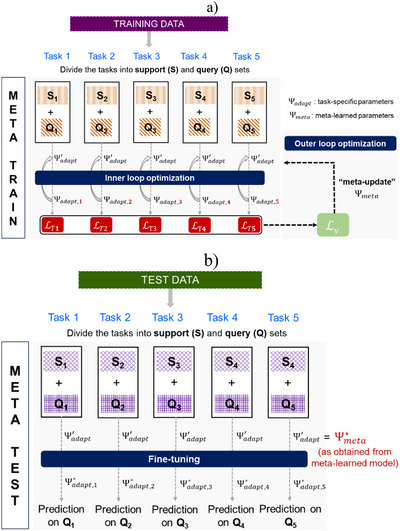 Figure 5
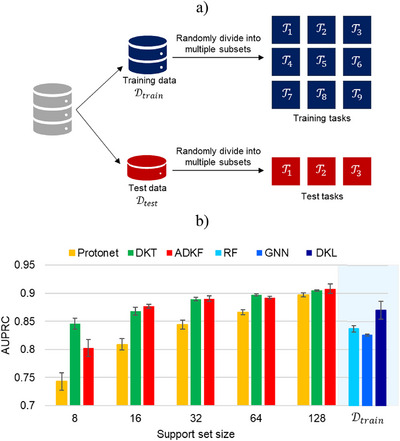 Figure 6
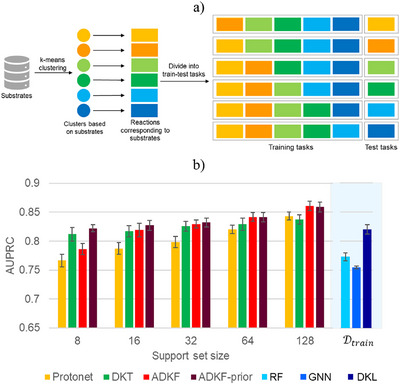 Figure 7
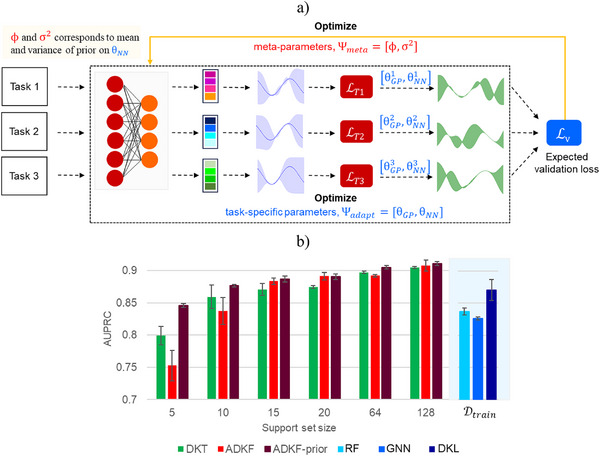 Figure 8
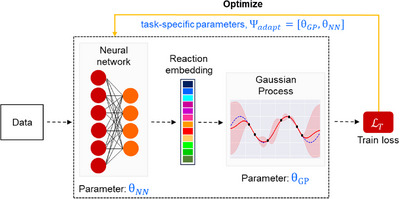 Figure 9
Peer Reviews
No public reviews on file for this paper yet. If you reviewed it on a platform where reviews are public (OpenReview, ICLR, NeurIPS, ICML), you can paste yours below so the community can read it here.
Videos
No videos yet. Explain this paper in a talk, walkthrough, or lecture? Add one.
Taxonomy
TopicsTopic Modeling · Machine Learning in Materials Science · Text and Document Classification Technologies