Successful left atrial access through GORE CARDIOFORM ASD occluder using an integrated transseptal wire system after failed RF needle approach
Yuko Suzuki, Keijiro Nakamura, Takayuki Shimizu, Masako Asami, Hidehiko Hara

TL;DR
A new method using an integrated transseptal wire system successfully accessed the left atrium after a failed RF needle attempt during a heart procedure.
Contribution
The use of an integrated transseptal wire system for accessing the left atrium through a large occluder is novel and effective.
Findings
The integrated transseptal wire system overcame the elastic resistance of the GORE CARDIOFORM ASD occluder.
A large-bore cryoballoon sheath was advanced successfully using the sequential sheath technique.
The procedure was completed without complications for atrial fibrillation ablation.
Abstract
An integrated transseptal wire system enabled successful left atrial access through the elastic resistance posed by a large GORE CARDIOFORM ASD occluder after failed RF needle attempt, allowing large‐bore cryoballoon sheath advancement via sequential sheath technique for atrial fibrillation ablation without procedural complications.
Genes, proteins, chemicals, diseases, species, mutations and cell lines named across the full text — each resolved to its canonical identifier and authoritative record.
Click any figure to enlarge with its caption.
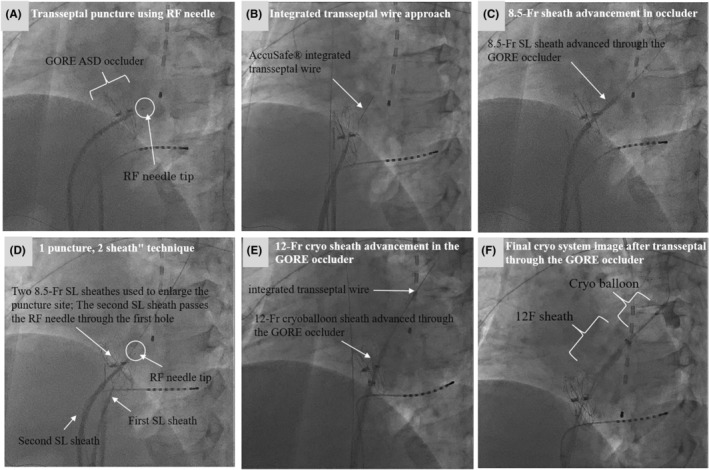 Figure 1
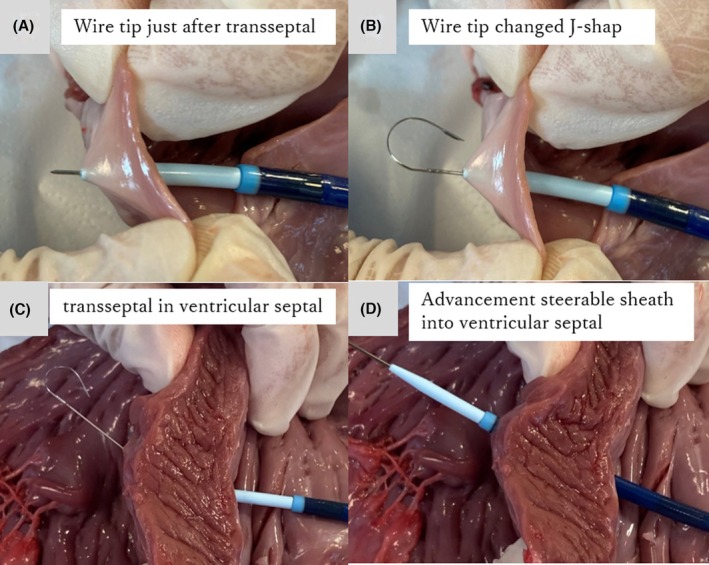 Figure 2
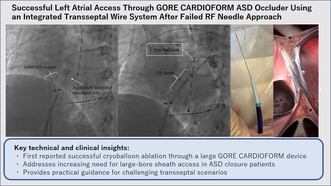 Figure 3
Peer Reviews
No public reviews on file for this paper yet. If you reviewed it on a platform where reviews are public (OpenReview, ICLR, NeurIPS, ICML), you can paste yours below so the community can read it here.
Videos
No videos yet. Explain this paper in a talk, walkthrough, or lecture? Add one.
Taxonomy
TopicsAtrial Fibrillation Management and Outcomes · Cardiac Arrhythmias and Treatments · Cardiac pacing and defibrillation studies