Impact assessment of Benazir Nashonuma Programme (BNP) on maternal, child health and nutritional status in Pakistan: a quasi-experimental study protocol
Shah Muhammad, Asma Abdul Malik, Sajid Soofi, Atif Habib, Muhammad Umer, Arjumand Rizvi, Imran Ahmed, Jef Leroy, Simon Cousens, Zulfiqar Ahmed Bhutta

TL;DR
This study evaluates the impact of Pakistan's Benazir Nashonuma Programme on maternal and child health and nutrition through a quasi-experimental design.
Contribution
The study introduces a quasi-experimental protocol to assess a national nutritional programme's effectiveness in reducing childhood stunting.
Findings
The study will measure changes in under-five stunting prevalence in intervention and control districts.
It will provide insights into the effectiveness of nutritional supplementation in resource-constrained settings.
A difference-in-differences approach will be used to estimate the programme's impact over time.
Abstract
Maternal and child malnutrition is a significant public health concern in Pakistan, with 40% of children under five being stunted. In response, the Government of Pakistan initiated the Benazir Nashonuma Programme (BNP), a nutritional supplementation programme for pregnant women, mothers of children aged 0 to 23 months and children aged 6 to 24 months. This study aims to evaluate the effectiveness of the BNP in reducing childhood stunting and improving maternal and child health outcomes. A quasi-experimental longitudinal study comprising baseline, midline and endline surveys will be conducted across 18 districts (9 intervention and 9 control) in Pakistan. The surveys will use a two-stage cluster sampling method to enrol 13 200 children aged 0–59 months and their mothers from the Benazir Income Support Programme households. The primary outcome of interest is the prevalence of under-five…
Genes, proteins, chemicals, diseases, species, mutations and cell lines named across the full text — each resolved to its canonical identifier and authoritative record.
Click any figure to enlarge with its caption.
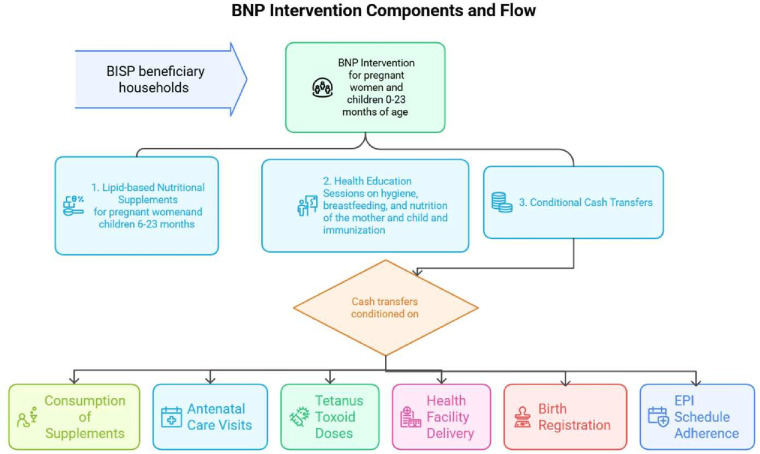 Figure 1
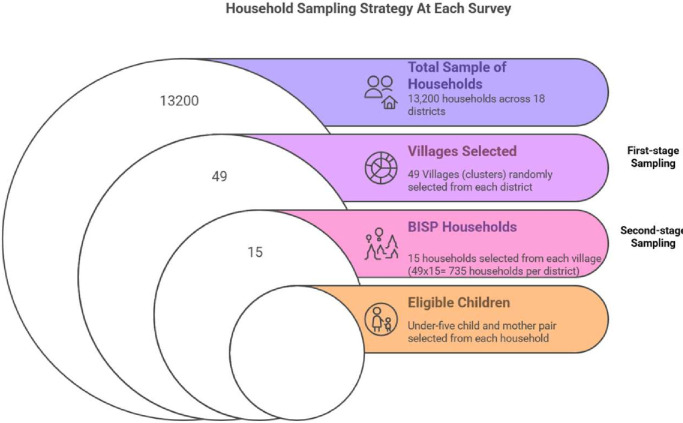 Figure 2
Peer Reviews
No public reviews on file for this paper yet. If you reviewed it on a platform where reviews are public (OpenReview, ICLR, NeurIPS, ICML), you can paste yours below so the community can read it here.
Videos
No videos yet. Explain this paper in a talk, walkthrough, or lecture? Add one.
Taxonomy
TopicsChild Nutrition and Water Access · Poverty, Education, and Child Welfare · Food Security and Health in Diverse Populations