Analysis of argument structure constructions in a deep recurrent language model
Pegah Ramezani, Achim Schilling, Patrick Krauss

TL;DR
This paper investigates how a recurrent neural network processes different types of sentence structures, showing that even simple models can form abstract language representations.
Contribution
The study demonstrates that a brain-constrained LSTM model can form construction-level representations of ASCs through prediction-based learning.
Findings
Distinct clusters for four ASCs were observed across all hidden layers of the LSTM.
The strongest separation of ASC clusters was found in the final hidden layer.
The results align with prior findings in large language models, showing similar abstract representations.
Abstract
Understanding how language and linguistic constructions are processed in the brain is a fundamental question in cognitive computational neuroscience. This study builds directly on our previous work analyzing Argument Structure Constructions (ASCs) in the BERT language model, extending the investigation to a simpler, brain-constrained architecture: a recurrent neural language model. Specifically, we explore the representation and processing of four ASCs–transitive, ditransitive, caused-motion, and resultative–in a Long Short-Term Memory (LSTM) network. We trained the LSTM on a custom GPT-4-generated dataset of 2,000 syntactically balanced sentences. We then analyzed the internal hidden layer activations using Multidimensional Scaling (MDS) and t-Distributed Stochastic Neighbor Embedding (t-SNE) to visualize sentence representations. The Generalized Discrimination Value (GDV) was…
Genes, proteins, chemicals, diseases, species, mutations and cell lines named across the full text — each resolved to its canonical identifier and authoritative record.
Click any figure to enlarge with its caption.
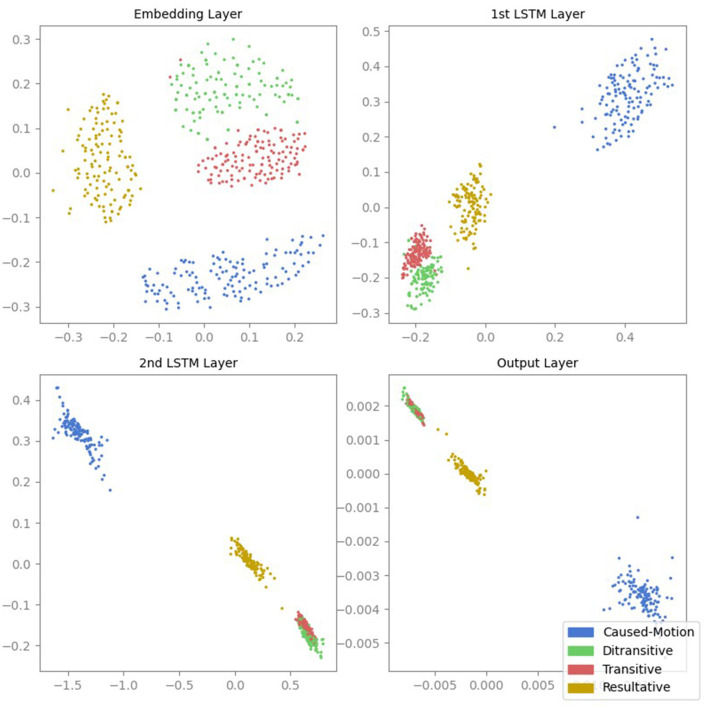 Figure 1
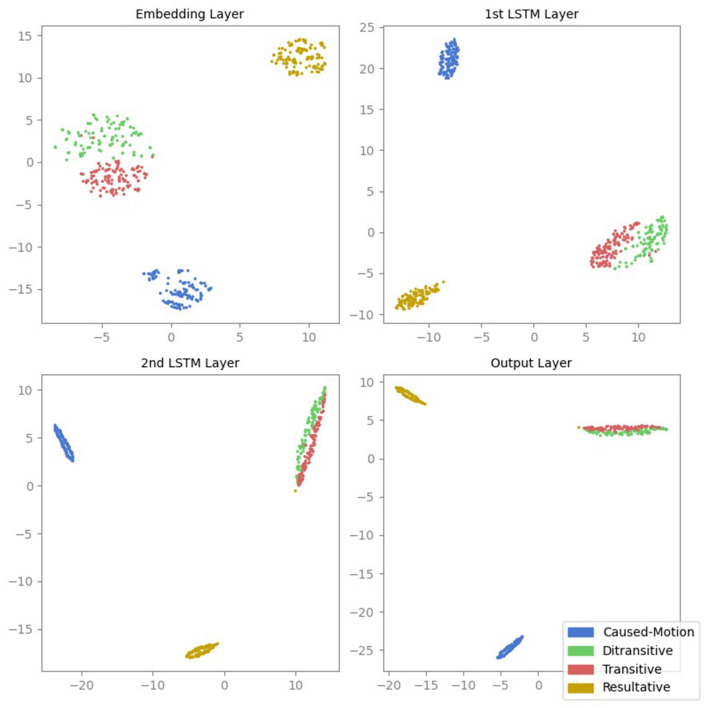 Figure 2
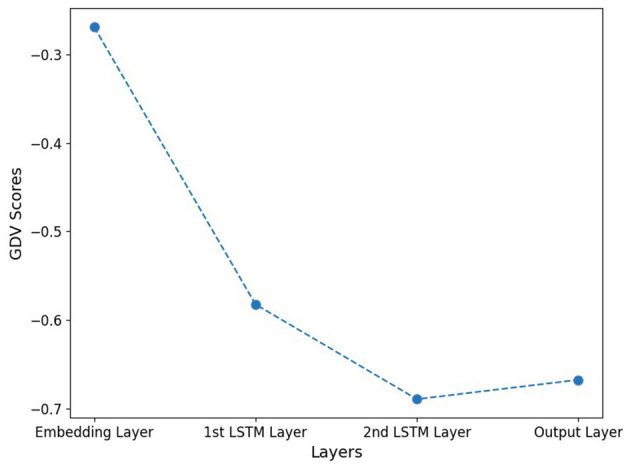 Figure 3
Peer Reviews
No public reviews on file for this paper yet. If you reviewed it on a platform where reviews are public (OpenReview, ICLR, NeurIPS, ICML), you can paste yours below so the community can read it here.
Videos
No videos yet. Explain this paper in a talk, walkthrough, or lecture? Add one.
Taxonomy
TopicsArtificial Intelligence in Law · Topic Modeling · Artificial Intelligence Applications